
Chat types are the building blocks of a LiveCase experience. They determine how learners receive information, interact with characters, and respond to decisions or questions. Choose each type according to the learning task: presenting evidence, eliciting reasoning, exploring alternatives, or supporting reflection.
This guide covers the 31 types available in the current authoring menu. Each participant preview shows how the interaction appears to learners, using fictional case content. Previews are visible below each description; expand View authoring settings when you want to see how a type is configured. Screenshots are static examples, so controls within them are not interactive. Author notes are internal, and the Genially section links to an external presentation example.
Choose a type
- Communicate information: Message, Image, Video, File, or Voice Memo.
- Create a particular moment: Emoji, GIF, Alert, or Meeting.
- Elicit a response: choose among ten question formats, from Multiple Choice to Matrix and Allocated Balance.
- Develop dialogue or a character briefing: Talk to character (AI) or Video Avatar.
- Present structured material: Slide, Gamma, Genially, or Programming language.
- Establish the setting or provide an exhibit: use a Context type.
- Leave internal guidance: use Author note.
Add or edit a chat
- Open Content in your case. For a season or series, open the relevant episode's content.
- Select Add message, New chat below, or the edit control beside an existing chat.
- Choose a format from Type. The headings in that menu group the available formats.
- Complete the fields shown for that type. Where available, choose the character in From and any prerequisite in Only visible if badge.
- Select Create or Save, then use Preview episode to check the experience.
Some existing media items cannot be converted to another type. If a type selector is unavailable, create a new chat of the required type and check the surrounding sequence before removing anything. Draft changes still follow the normal publishing process.
Messaging
Chat type: Message
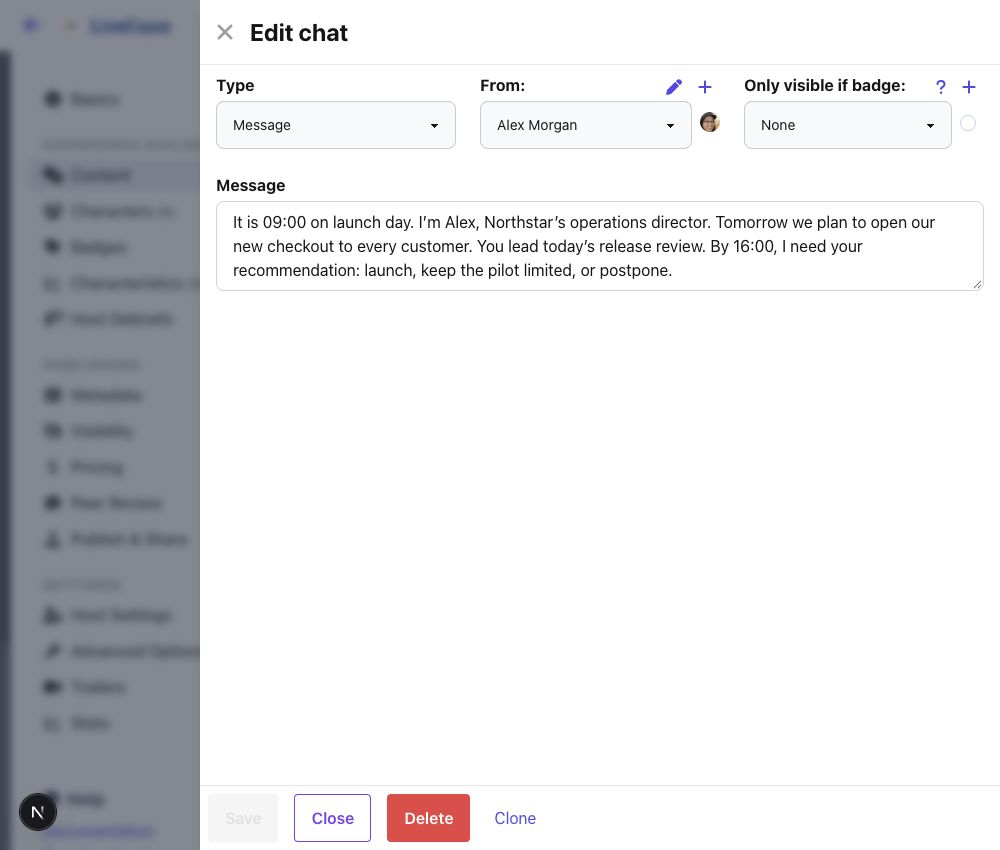
A message attributed to a character. Use it for dialogue, instructions, requests, or evidence conveyed by a person in the scenario.

Configure: Choose the speaker and write the message. Keep each message focused enough to read comfortably within a conversation.
Teaching example: An operations director asks the learner to recommend whether a launch should proceed.
View authoring settings: Message
Chat type: Image
An image within the conversation. Use it when a chart, photograph, diagram, or exhibit provides information relevant to the decision.
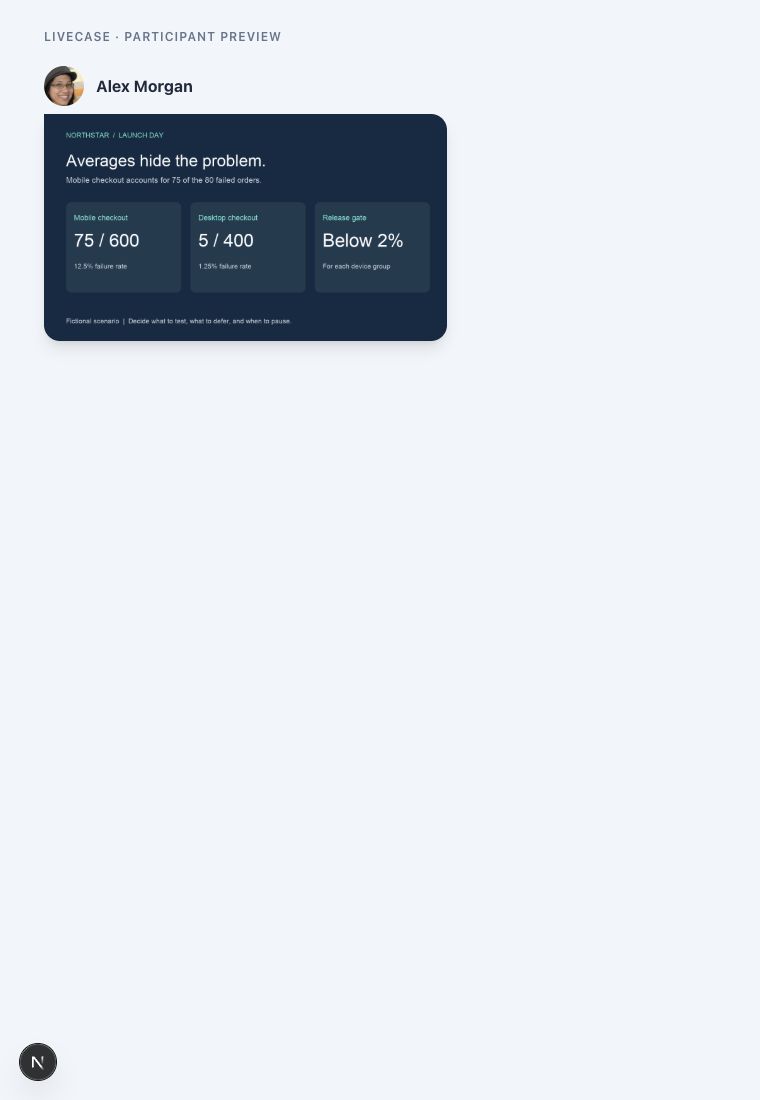
Configure: Add the image and meaningful alternative text. Review the size and any full-screen display option available in the editor.
Teaching example: A chart compares checkout failures on mobile and desktop devices.
View authoring settings: Image
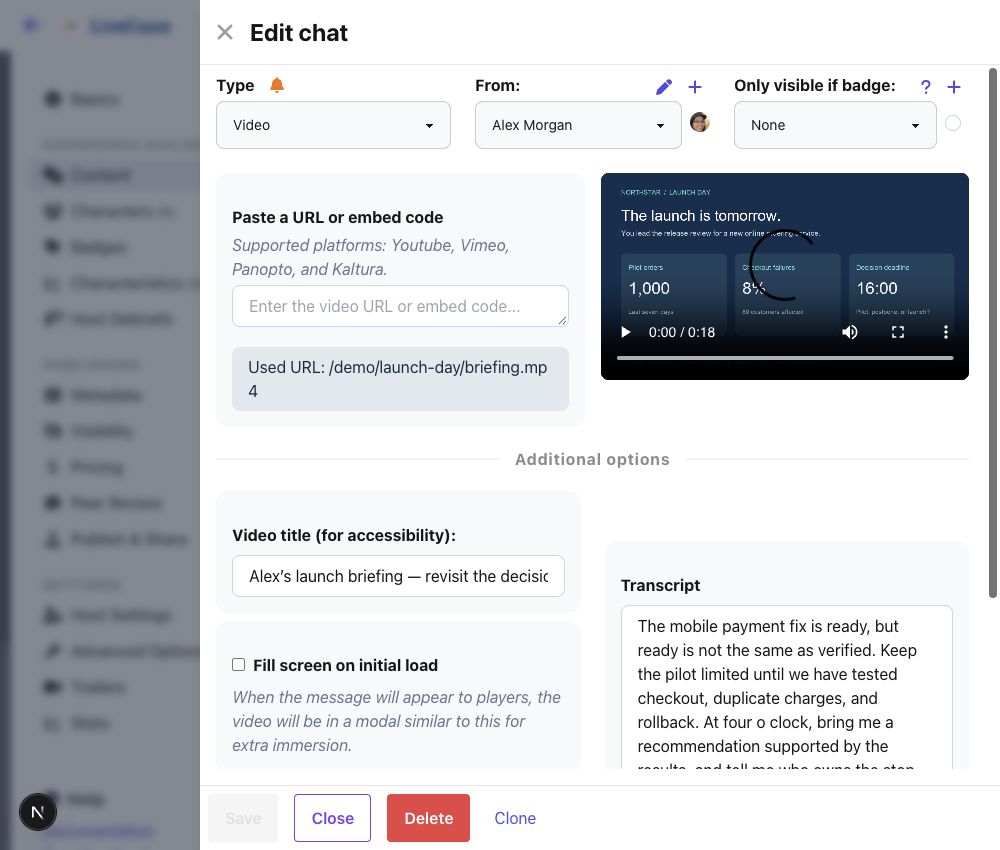
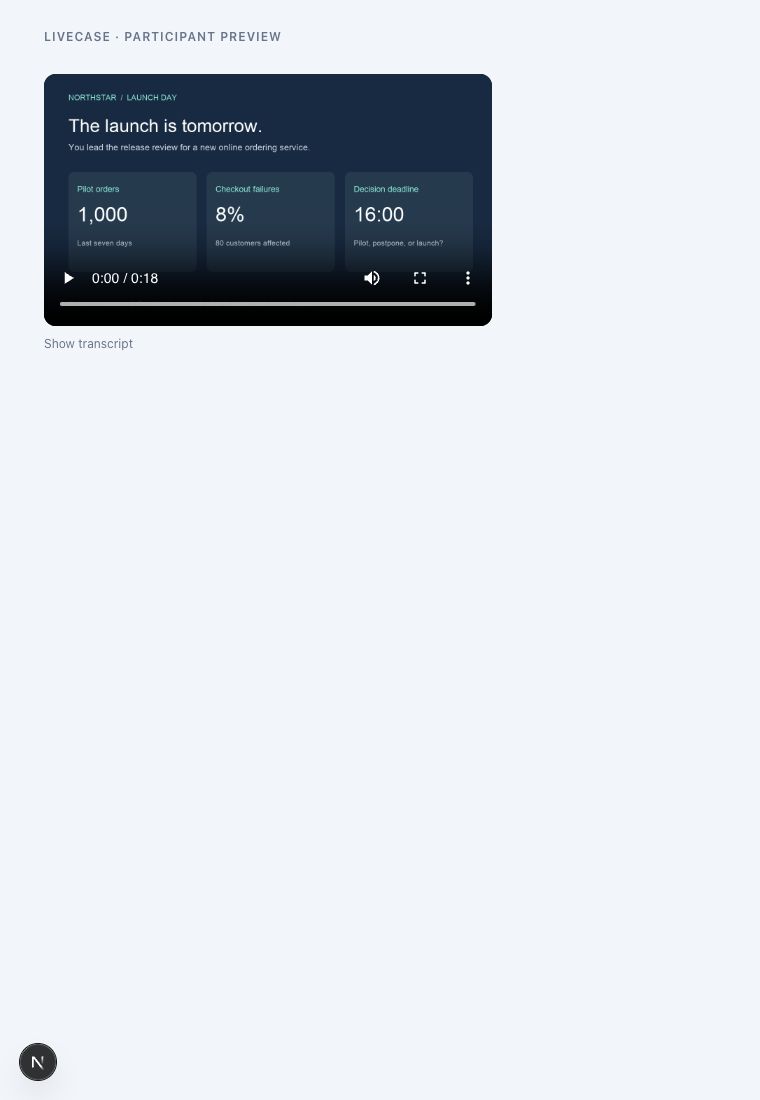
Chat type: Video
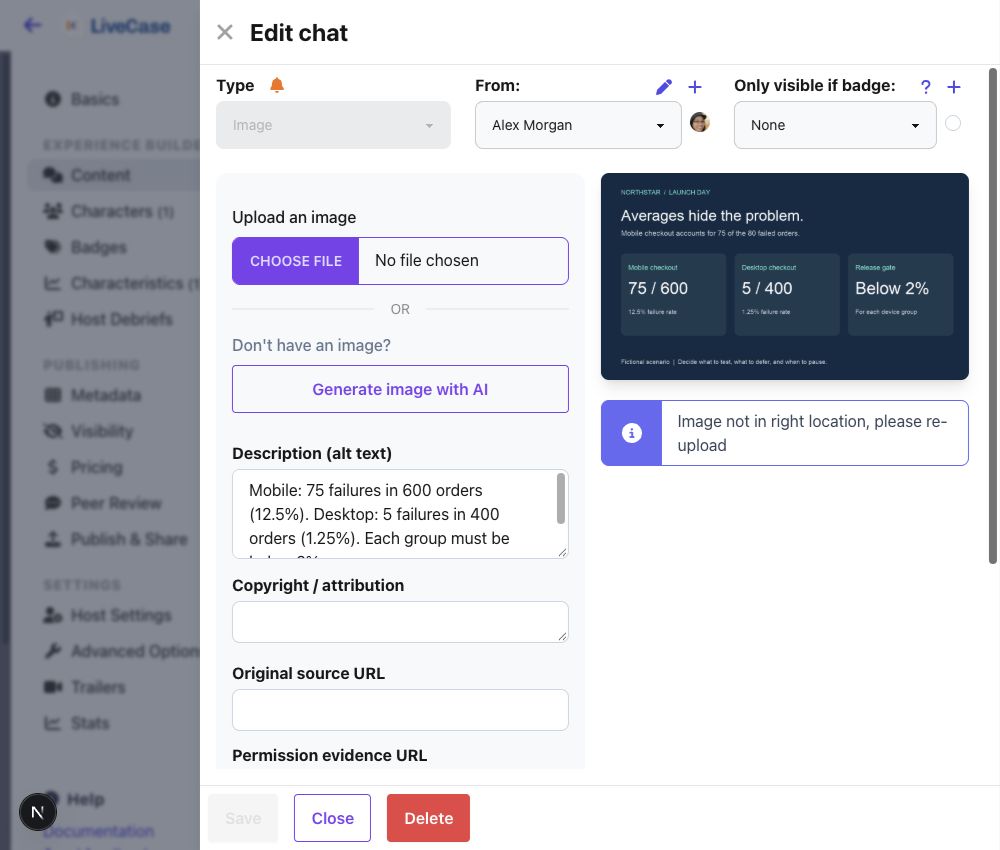
A video within the conversation. Use it for a briefing, demonstration, or piece of evidence that benefits from audiovisual presentation.
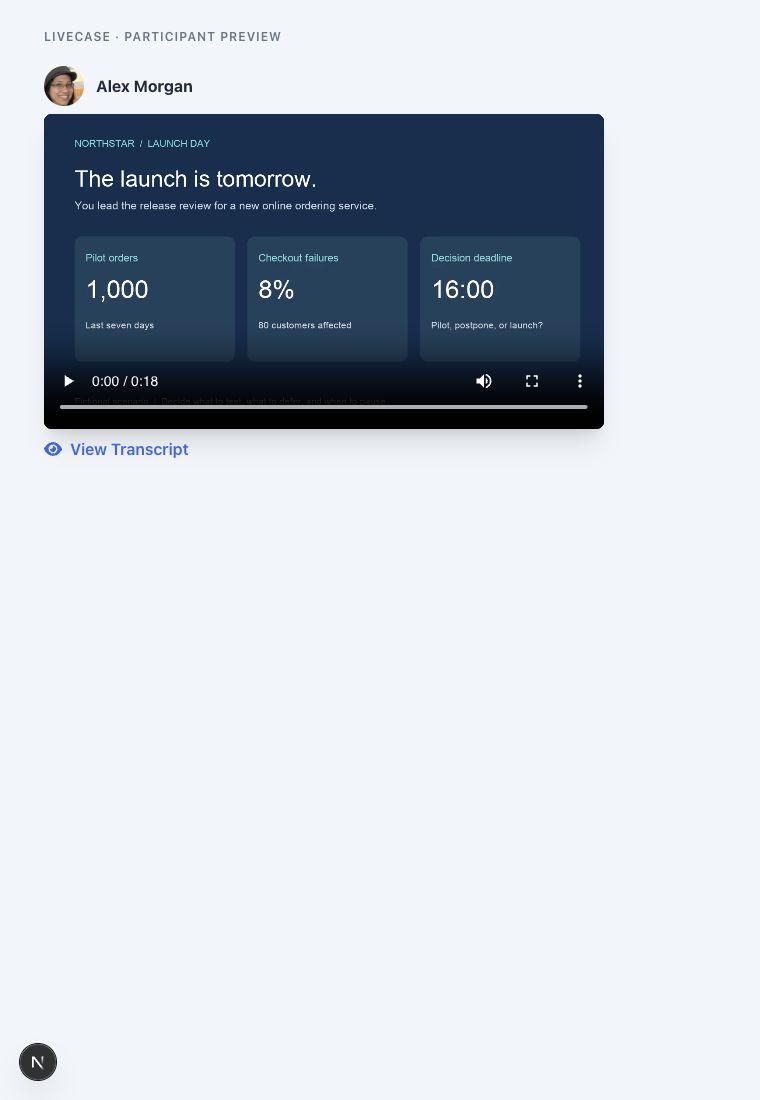
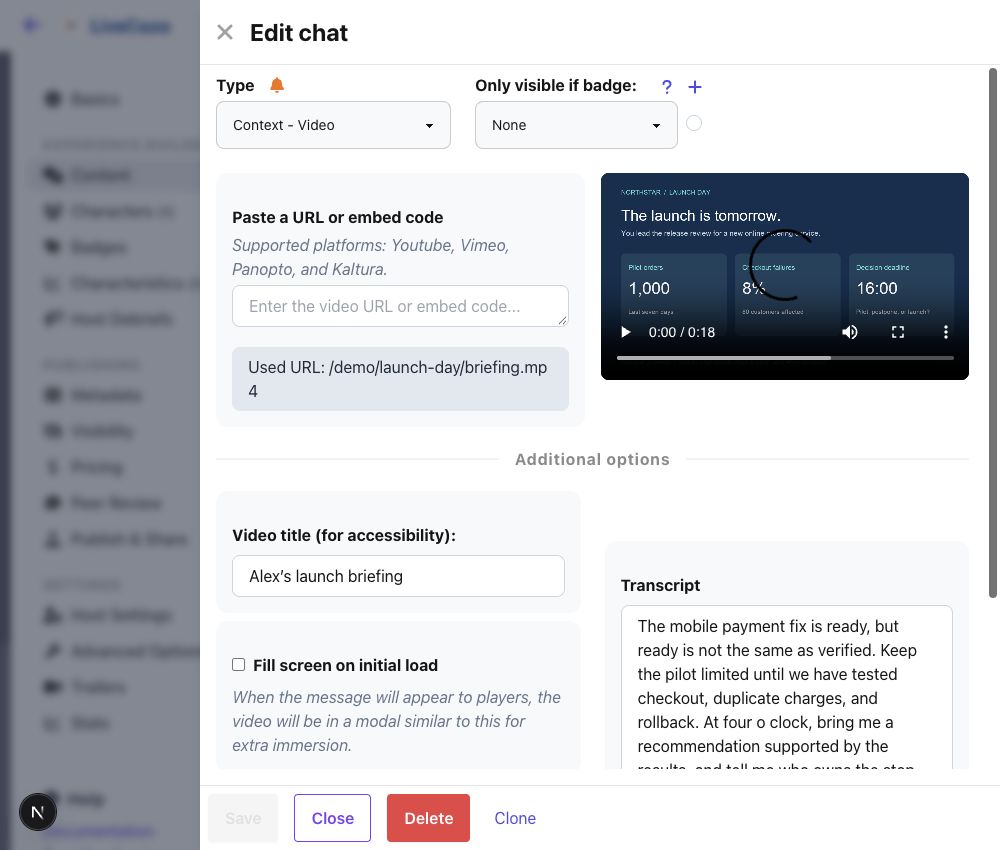
Configure: Provide the video URL and review the available title, transcript, playback, and display settings. Check that the video is accessible from the environment in which learners will participate.
Teaching example: A short briefing introduces the release criteria. Provide an equivalent transcript for learners who cannot use audio.
View authoring settings: Video
Chat type: File
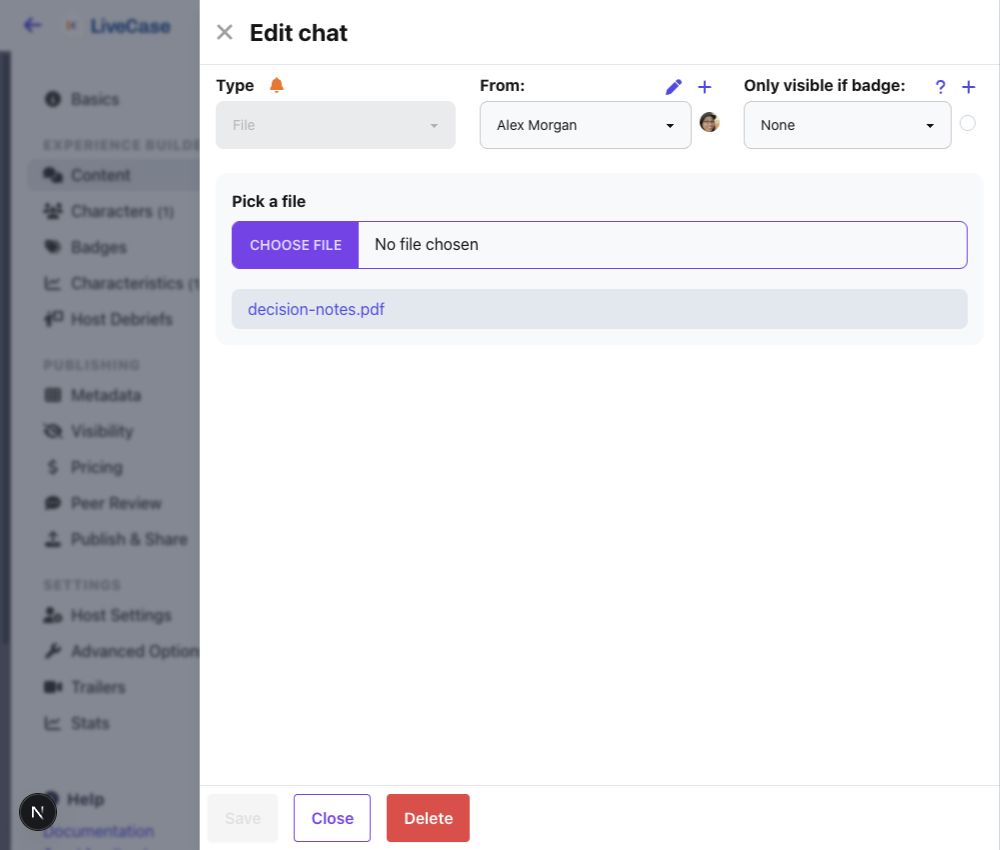
A downloadable document or other supporting file. Use it for a case exhibit that learners need to inspect or retain.

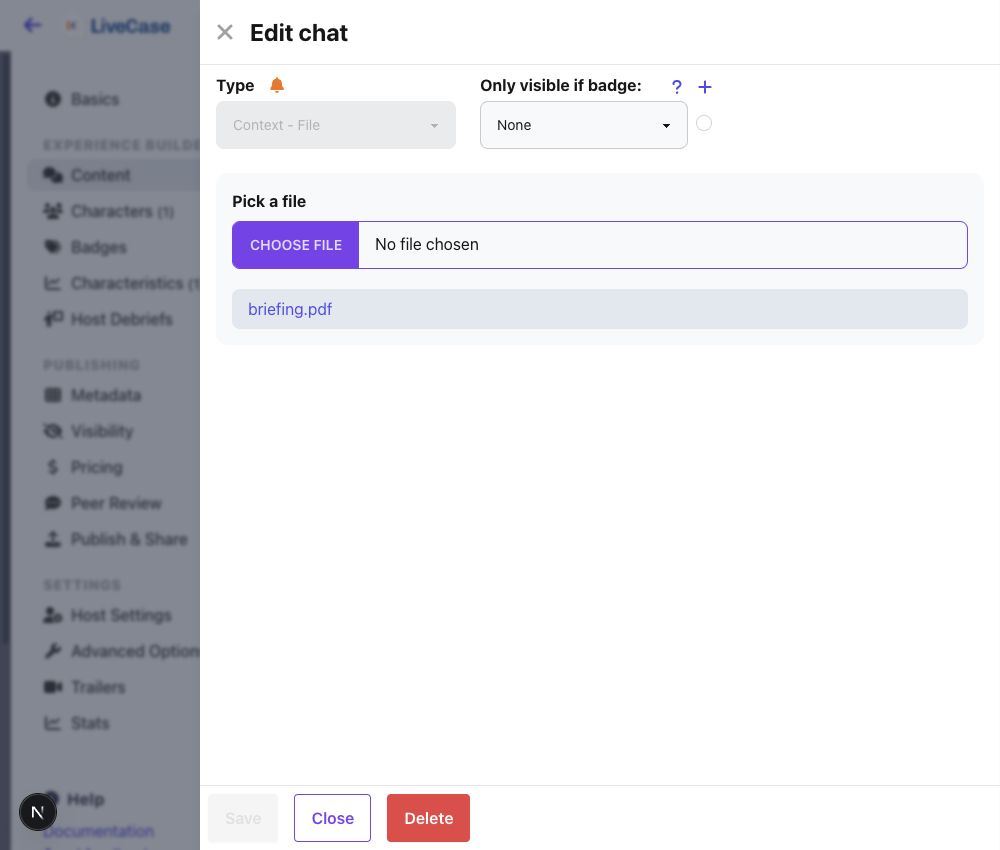
Configure: Upload the file and use a descriptive name. Check its contents, accessibility, and download behaviour in the preview.
Teaching example: A decision-notes PDF provides evidence for the final recommendation.
View authoring settings: File
Voice Memo
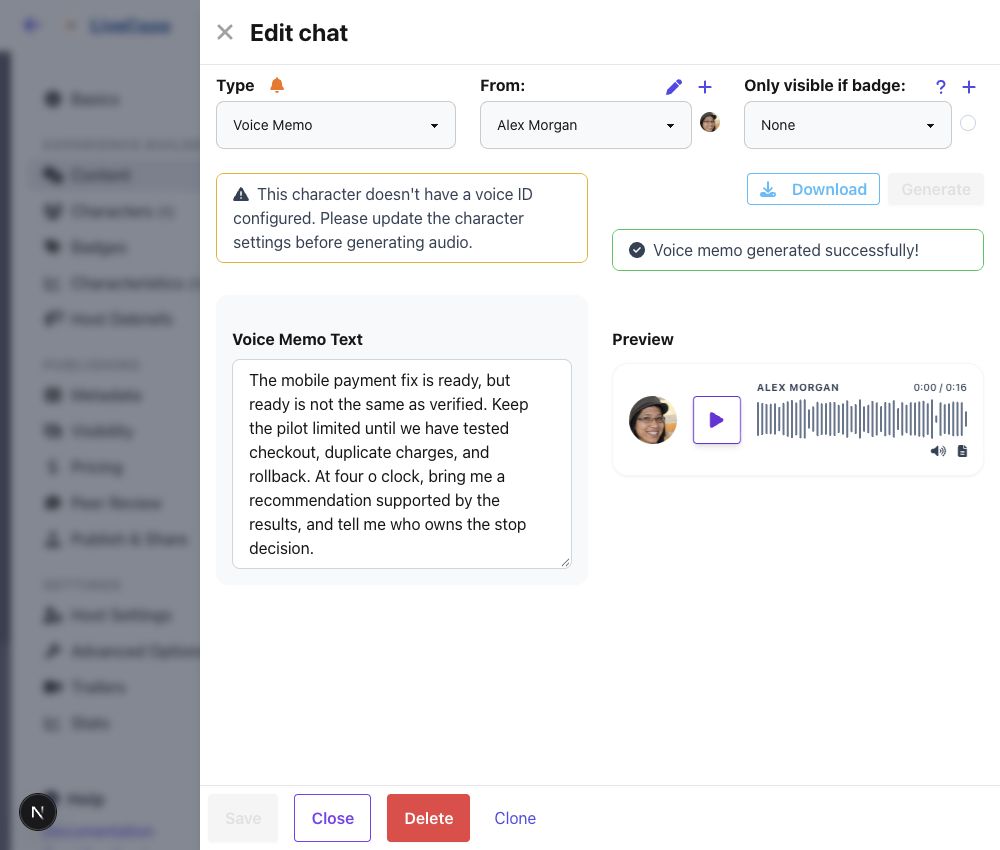
A spoken message from a character, accompanied by its transcript. Use it when voice conveys relevant tone or urgency.

Configure: Select the character and enter the script. Generate the audio using the available voice configuration, then listen to it and review the transcript before teaching. Generation availability depends on the character and service configuration.
Teaching example: A colleague leaves a voicemail asking the learner to verify an assumption before the meeting.
View authoring settings: Voice Memo
Engagement
Chat type: Emoji
A brief visual reaction from a character. Use it to support the tone of a conversation, rather than to carry essential instructions.

Configure: Choose the speaker and the emoji. Ensure its intended meaning is clear from the surrounding dialogue.
Teaching example: A character acknowledges a completed check. Explain any consequential feedback in words.
View authoring settings: Emoji
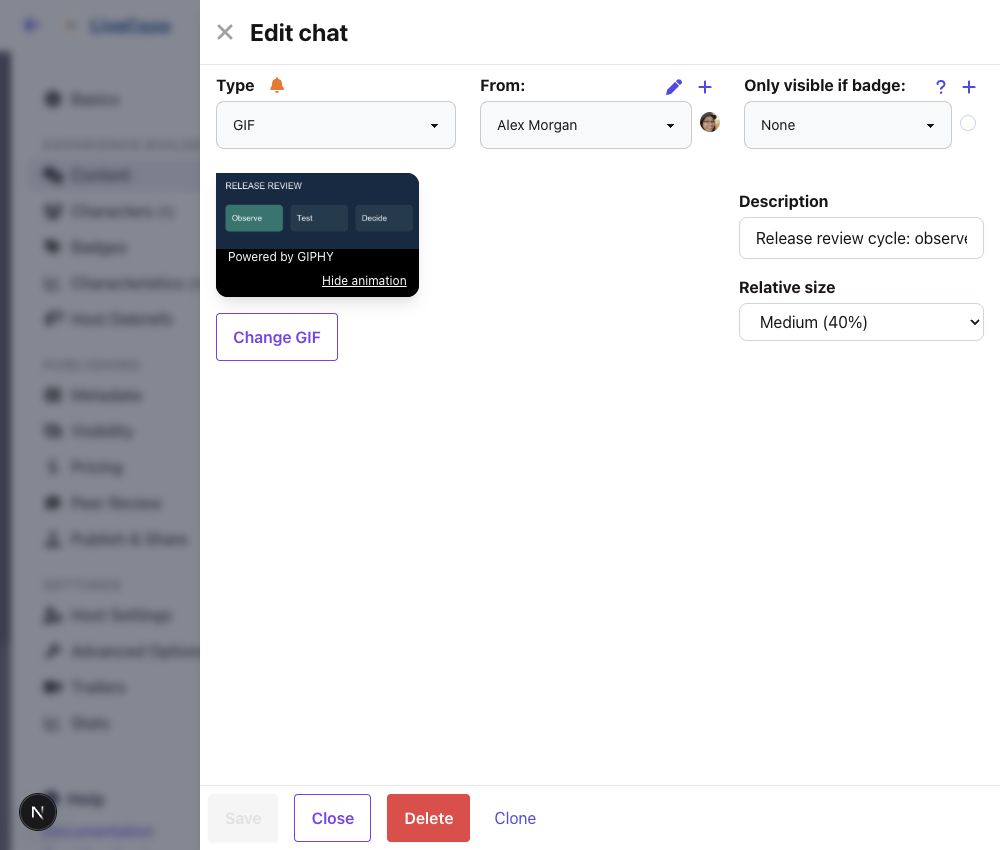
Chat type: Gif
An animated image. Use it sparingly when it contributes to the scenario or makes a reaction intelligible.

Configure: Choose the GIF using the available media controls and provide useful alternative text. Review the animation in context.
Teaching example: A brief animation illustrates a repeating review cycle. Do not make the animation the only source of necessary information.
View authoring settings: Gif
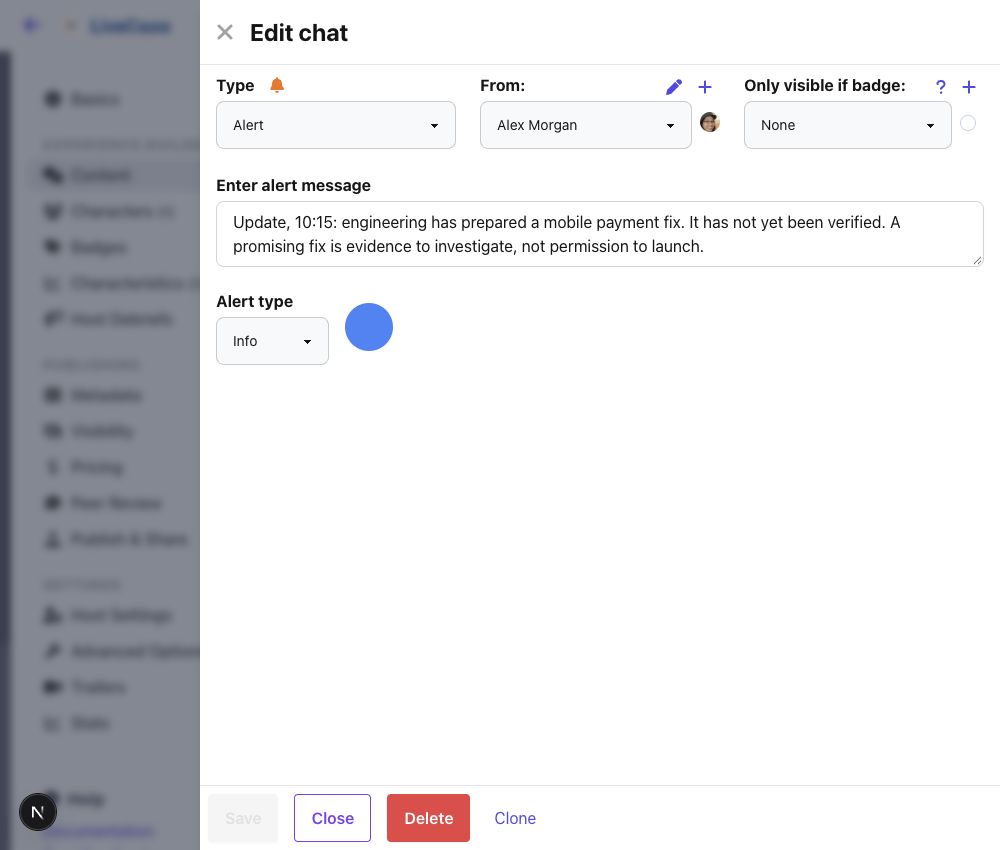
Alert
A notification styled as information, success, warning, or error. Use it to signal a meaningful change in the scenario.
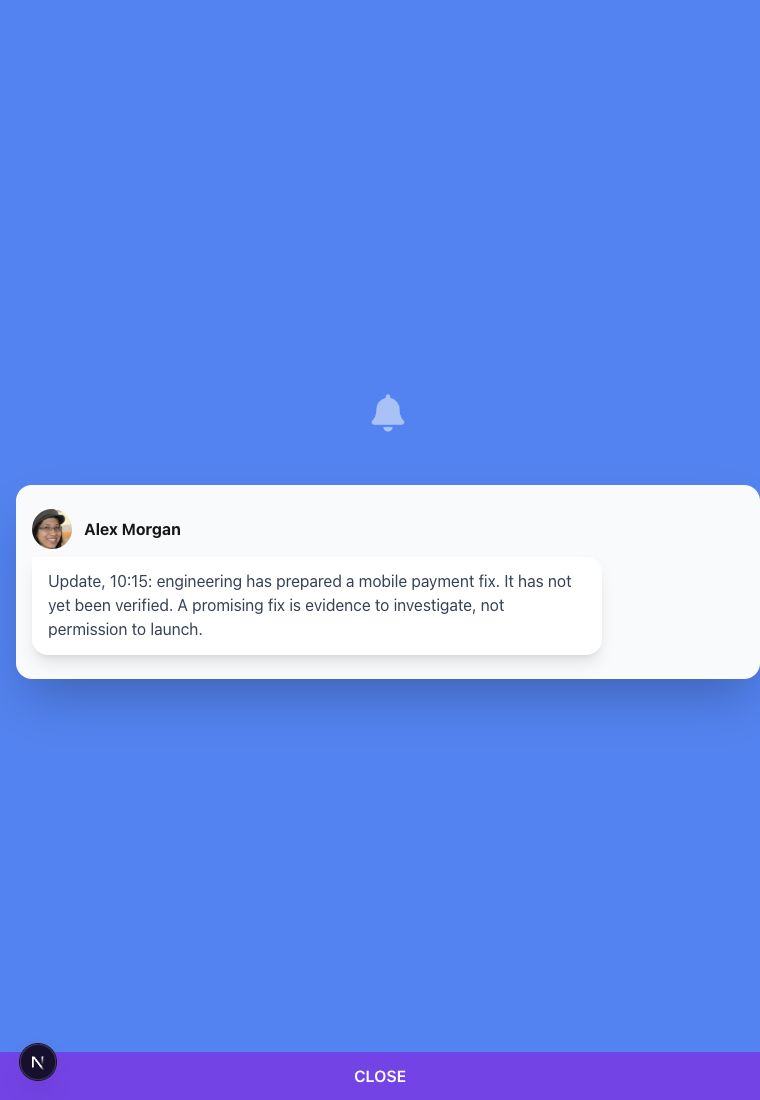
Configure: Choose the alert style and write its message. Make the consequences explicit rather than relying on colour alone.
Teaching example: A warning announces that a payment fix has been written but has not yet been verified.
View authoring settings: Alert
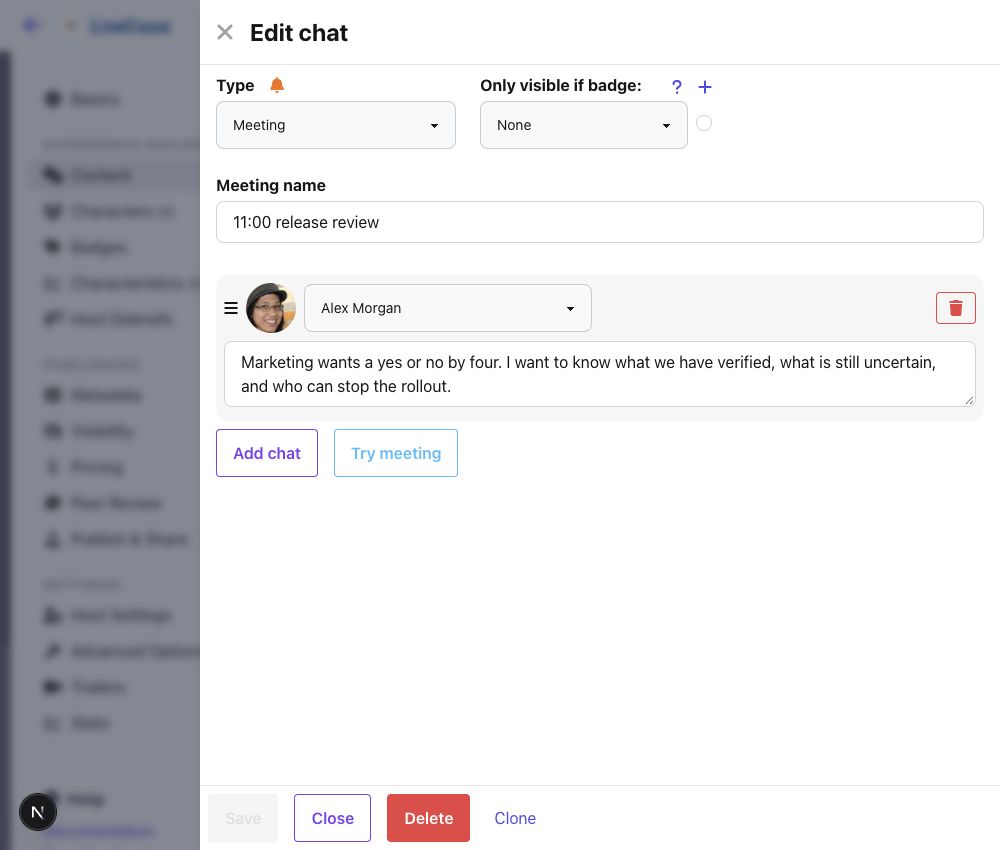
Meeting
A scripted conversation involving multiple characters. Learners open the meeting to follow the exchange. It is distinct from an open-ended AI conversation.

Configure: Give the meeting a title, then add its dialogue and assign the speaker for each contribution.
Teaching example: Operations and marketing offer competing views on whether to expand a pilot.
View authoring settings: Meeting
Questions
Chat type: Question - Multiple choice
A single selection from a set of alternatives. Use it to elicit a decision, interpretation, or judgement.
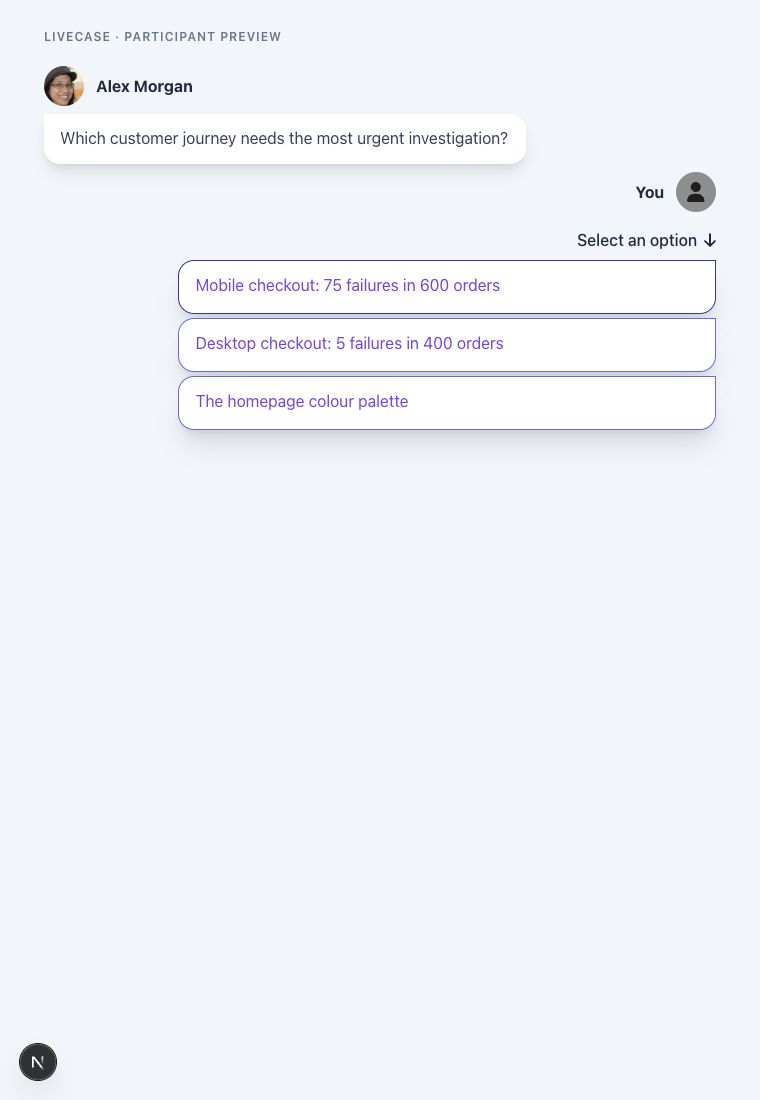
Configure: Write the question and answer options. Configure correctness, feedback, badges, characteristics, and timing where appropriate. A question about preferences need not be framed as having one universally correct answer.
Teaching example: Ask which customer journey requires investigation, using the evidence already supplied.
View authoring settings: Question - Multiple choice
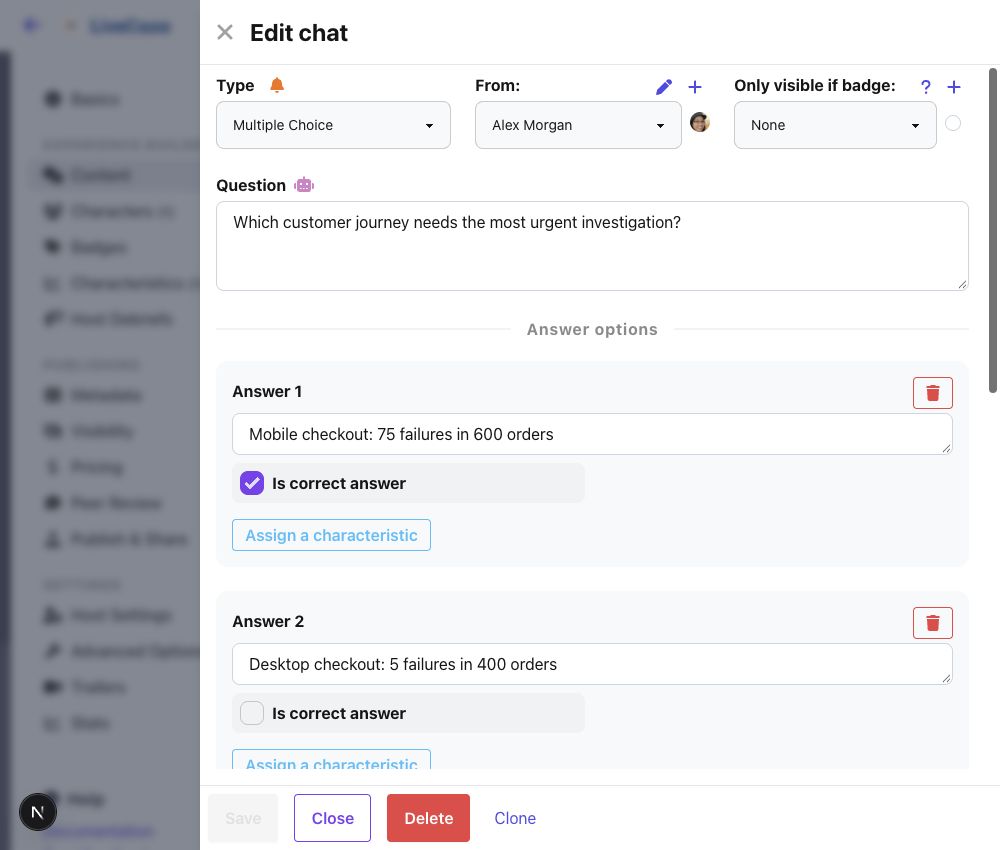
Chat type: Question - Popup multiple choice
A multiple-choice decision presented in a full-screen interaction. Use it to give a consequential decision particular prominence.
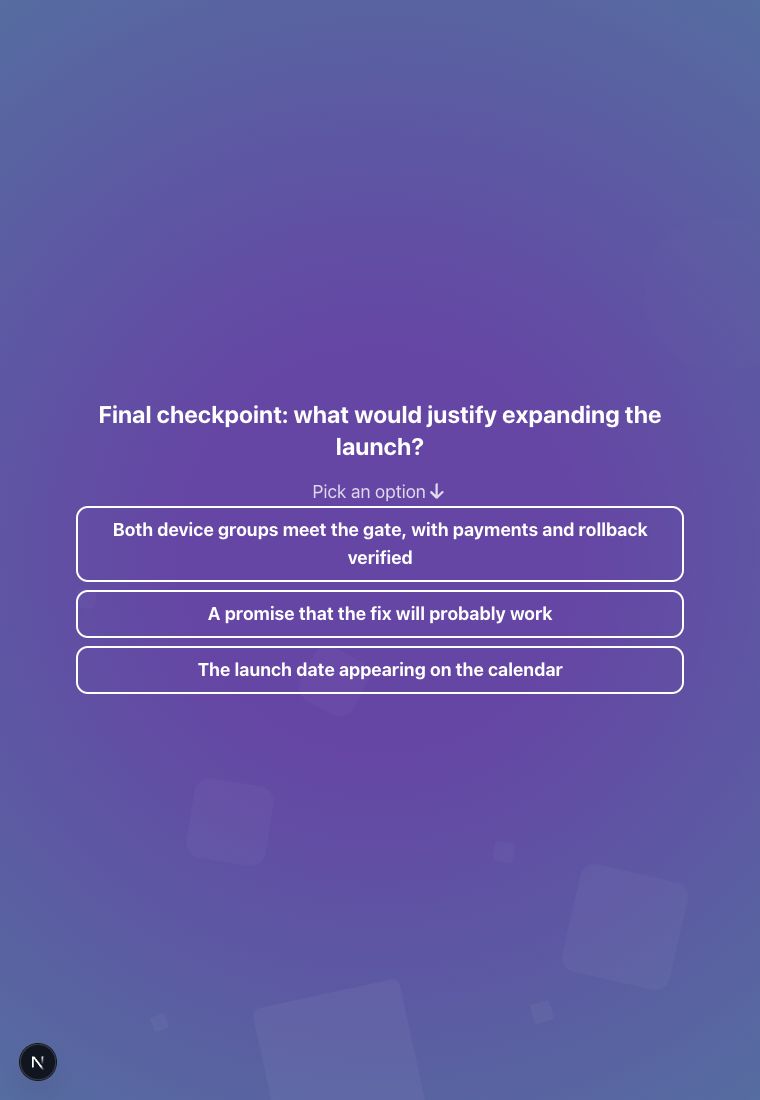
Configure: Configure the question and options as for Multiple Choice, then preview the full-screen presentation. If using a timer, allow enough time to read the prompt and alternatives.
Teaching example: Pause the scenario for the final launch recommendation.
View authoring settings: Question - Popup multiple choice
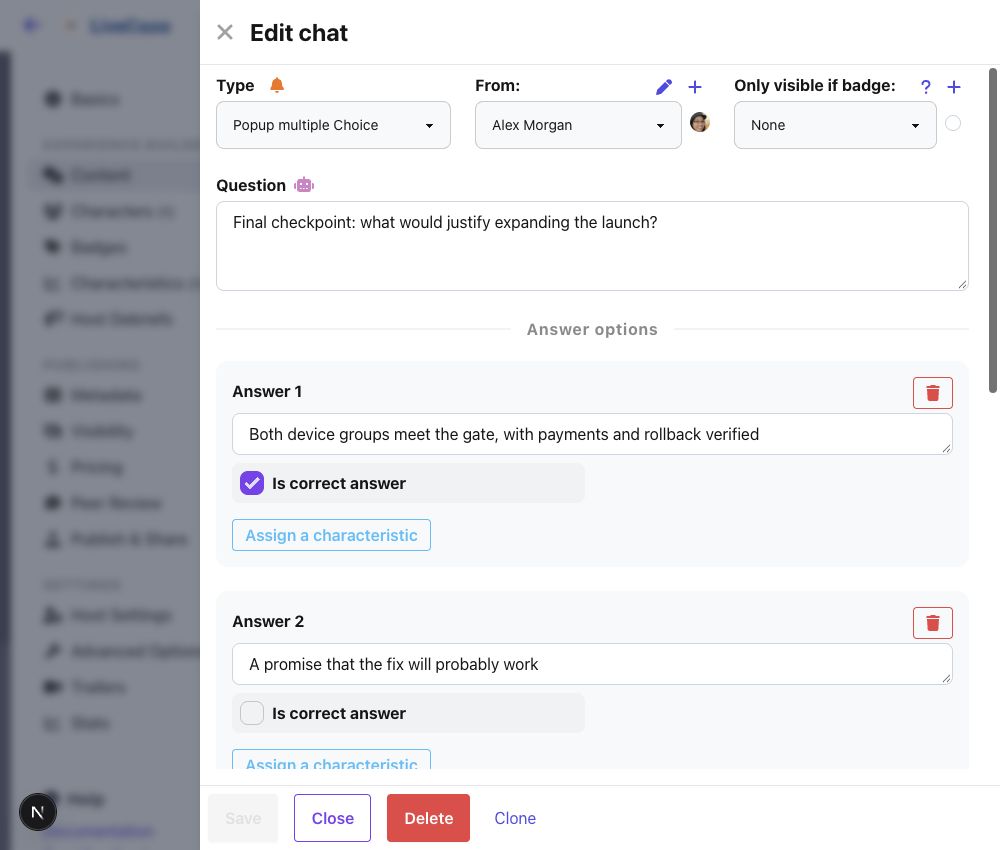
Chat type: Question - Text
A written response. Use it to elicit an explanation, recommendation, justification, or reflection in the learner's own words.
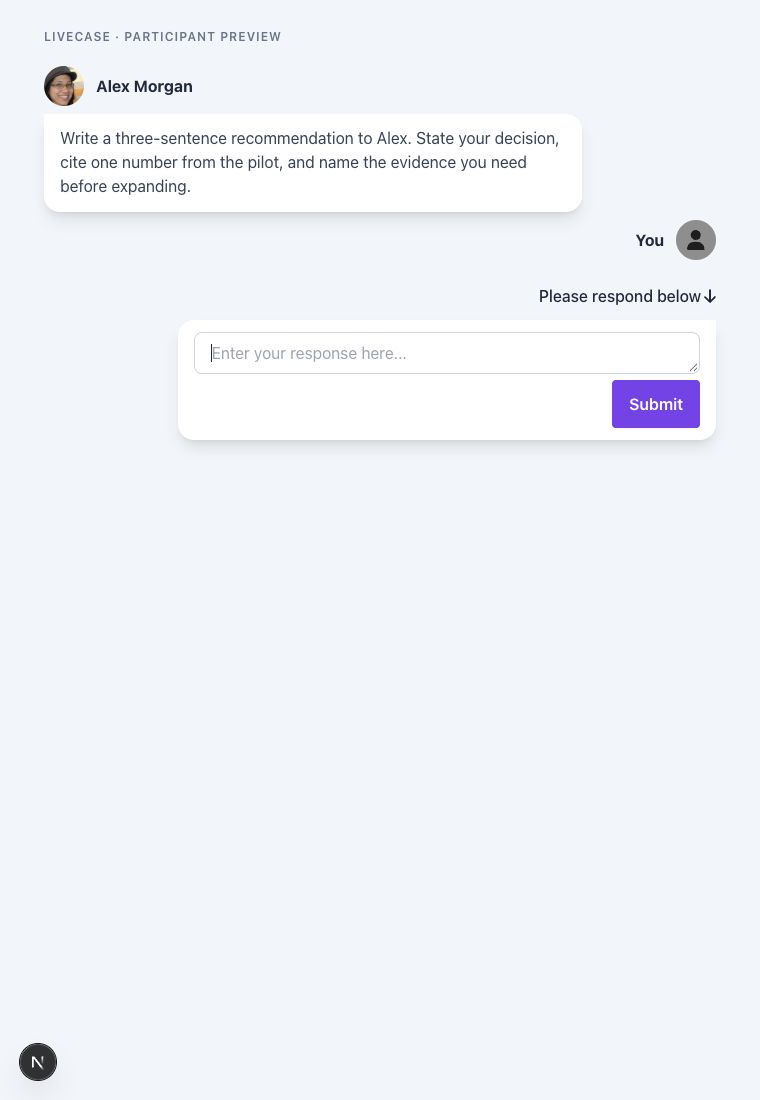
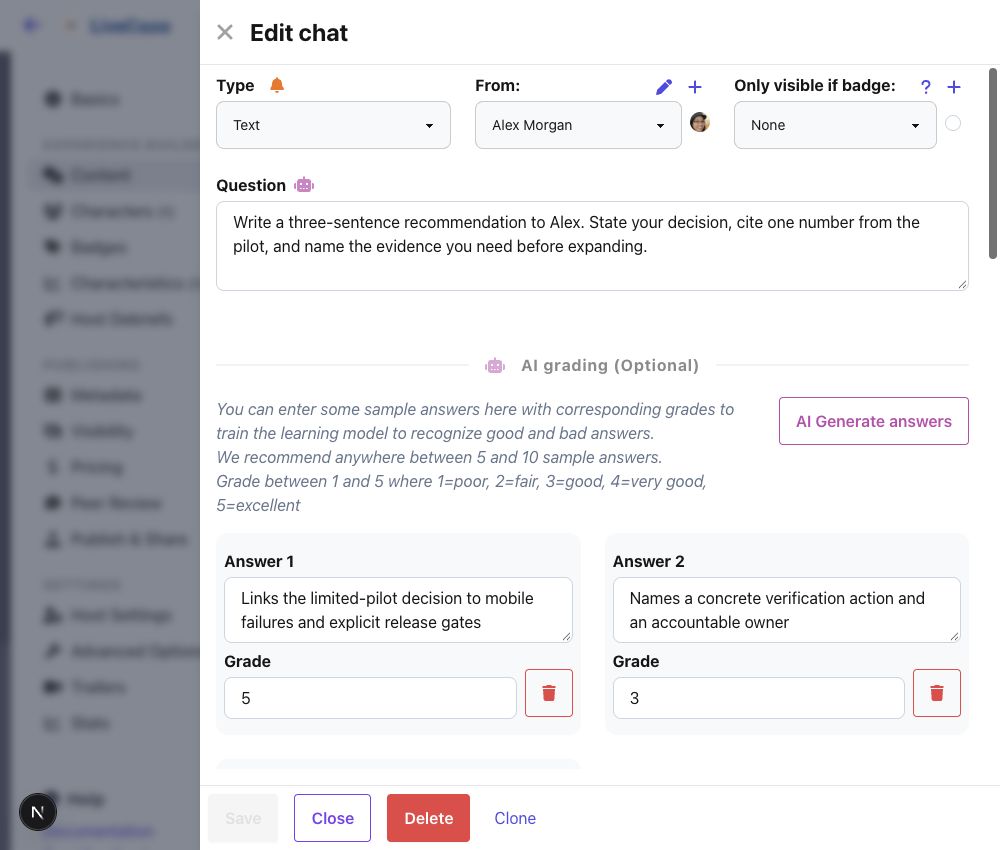
Configure: Write a clear prompt and specify the expected scope. The editor includes feedback and grading controls, including AI-assisted options. Configure these deliberately and test representative responses before relying on the feedback.
Teaching example: Request a recommendation that cites one figure from the pilot and identifies the evidence still needed.
View authoring settings: Question - Text
Dropdown select
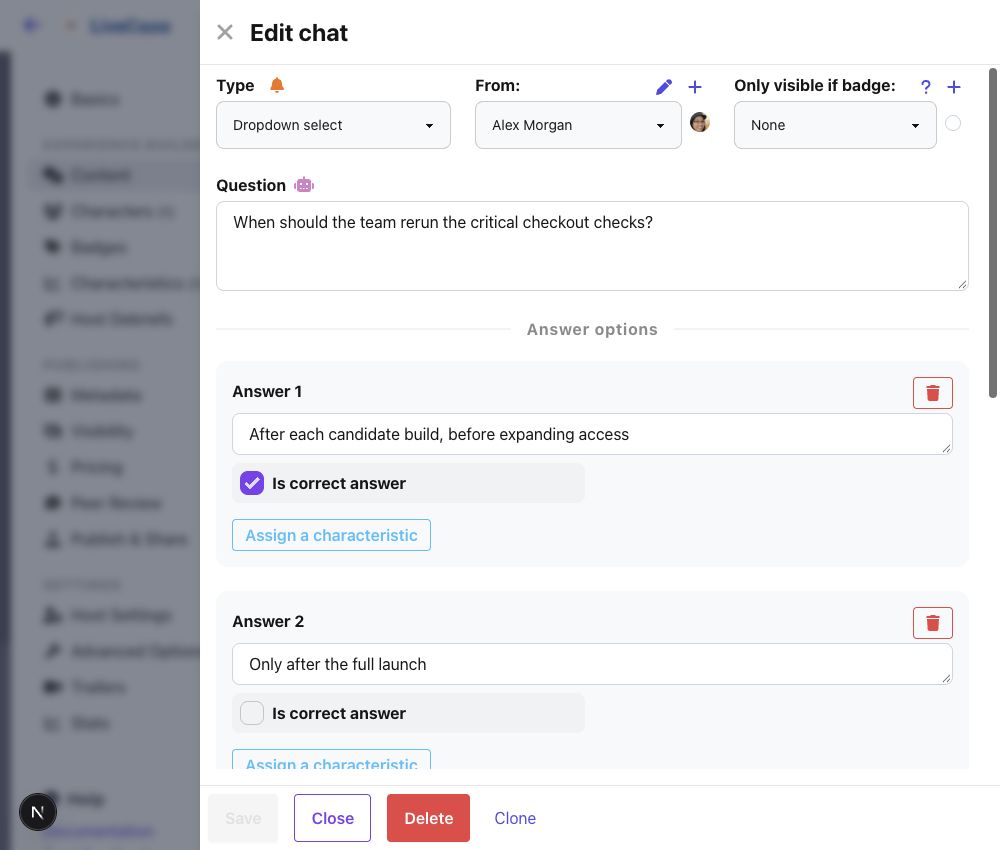
A single selection presented as a dropdown menu. Use it when a compact list is more appropriate than displaying every option at once.
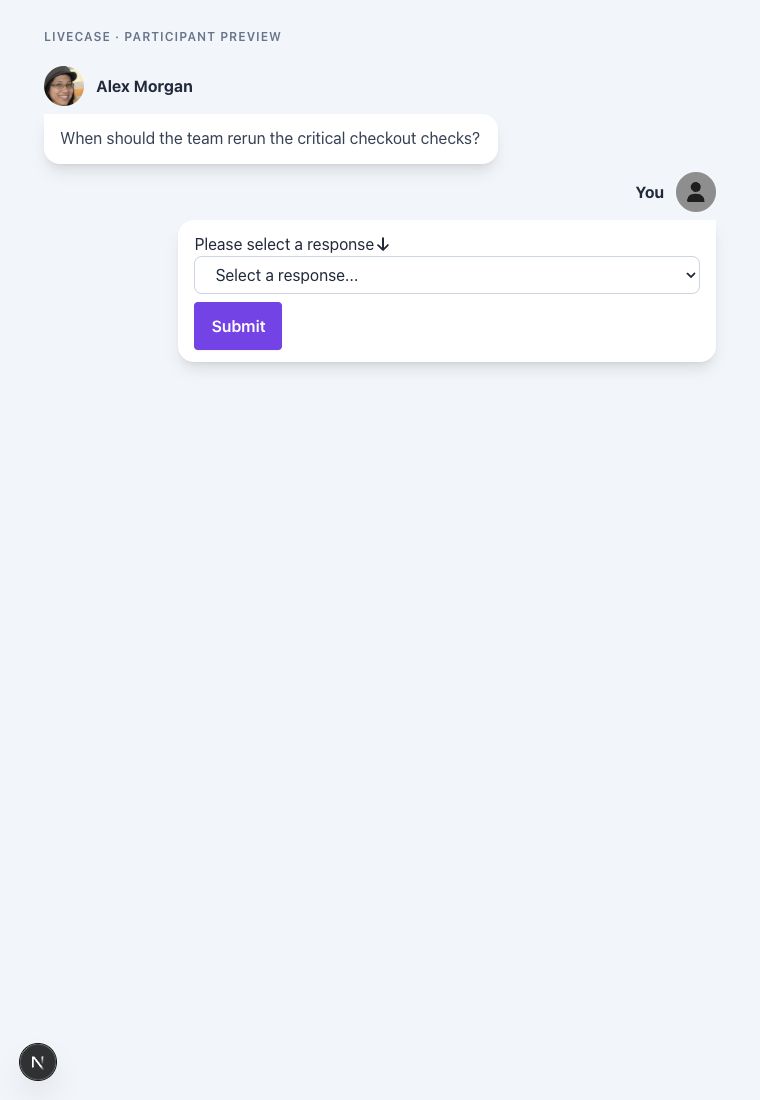
Configure: Write the question and alternatives, then configure the available correctness and feedback settings. Check that the options remain distinguishable when the menu is opened.
Teaching example: Ask when the critical checks should be repeated.
View authoring settings: Dropdown select
Checkboxes
A question allowing more than one selection. Use it when learners need to identify several relevant factors or actions.
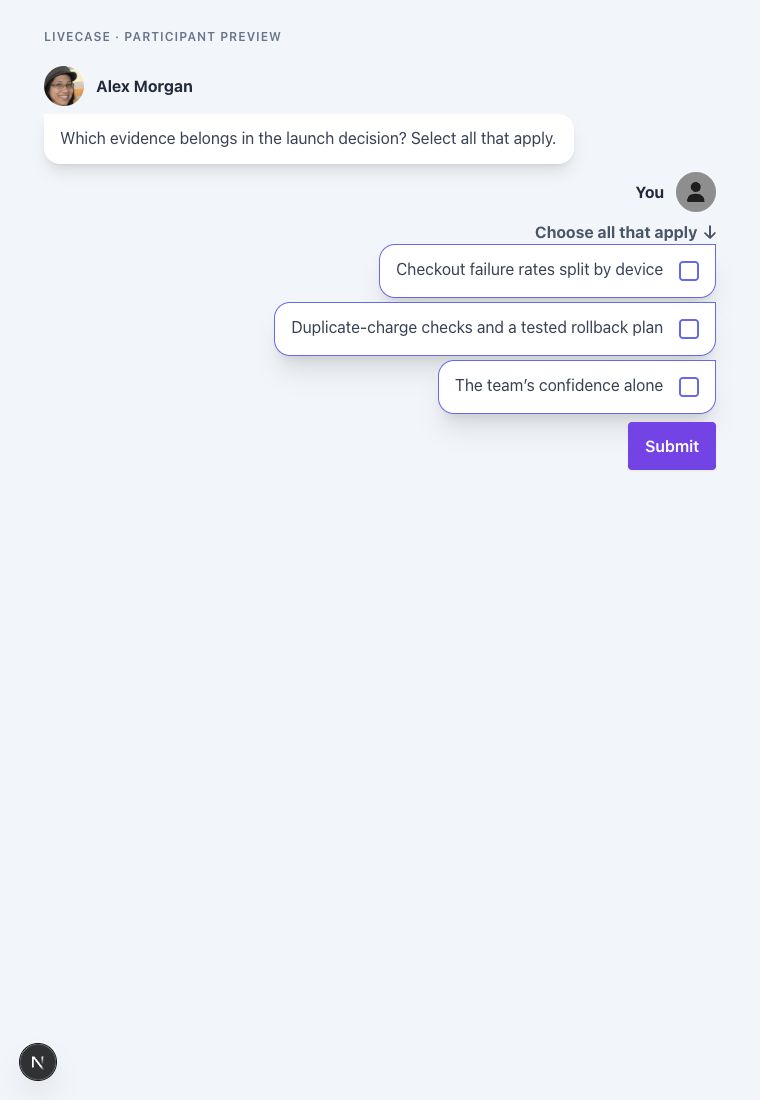
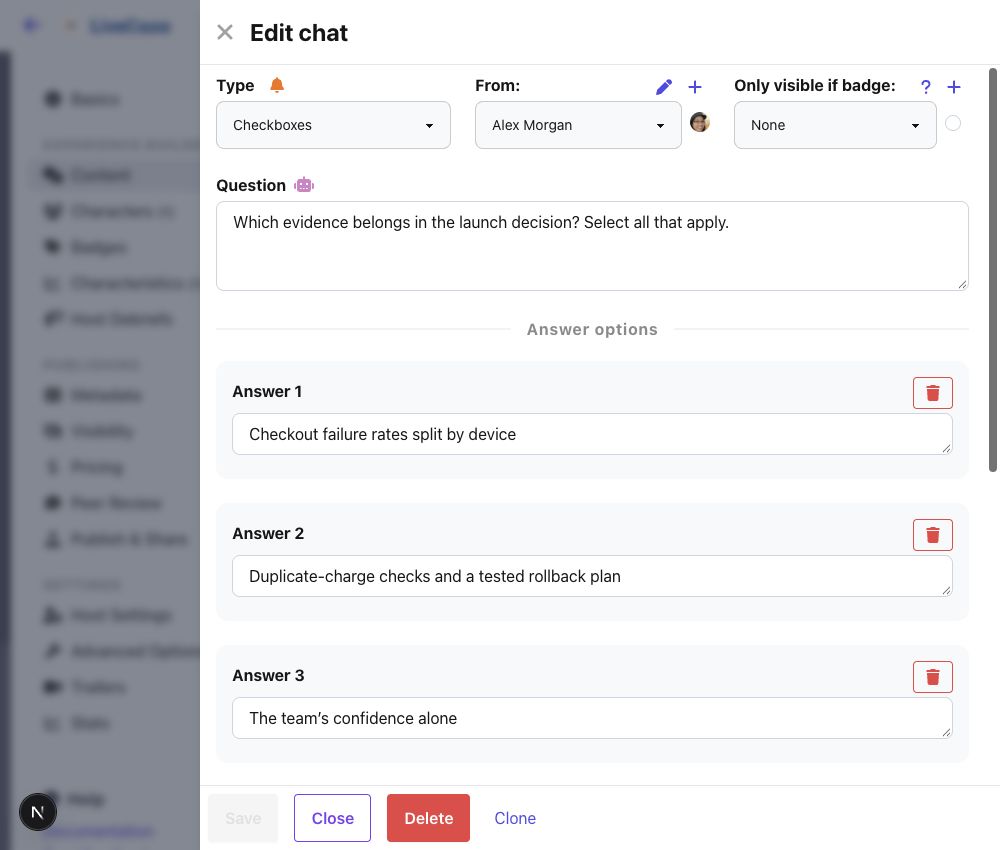
Configure: Make it explicit that multiple options can be selected. Add the alternatives and configure any correctness and feedback controls shown in the editor. Do not assume it uses the same scoring controls as single-choice questions.
Teaching example: Ask learners to select all evidence that belongs in the launch decision.
View authoring settings: Checkboxes
Ranking
An ordering task. Use it to examine priorities, sequence, or relative importance.
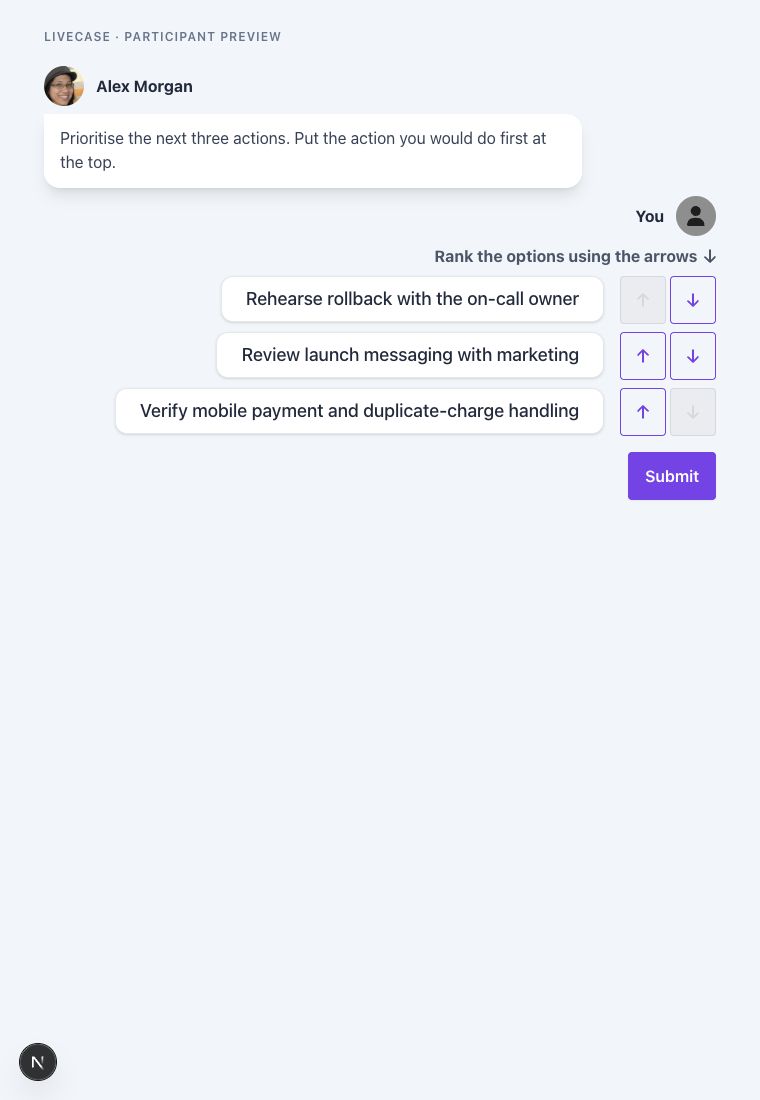
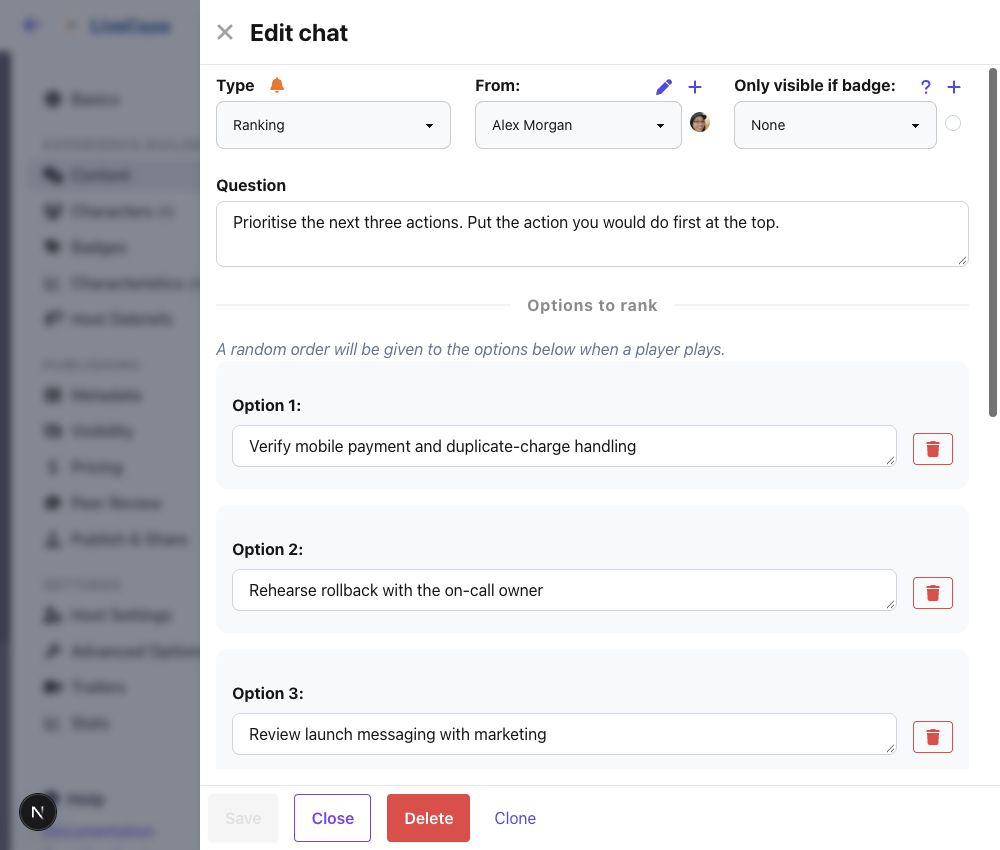
Configure: Add the items in the intended order and review the characteristic-scoring options if you use them. Explain whether the activity has an expected order or is intended to support discussion of competing priorities.
Teaching example: Ask learners to prioritise verification, rollback preparation, and communication.
View authoring settings: Ranking
Randomizer
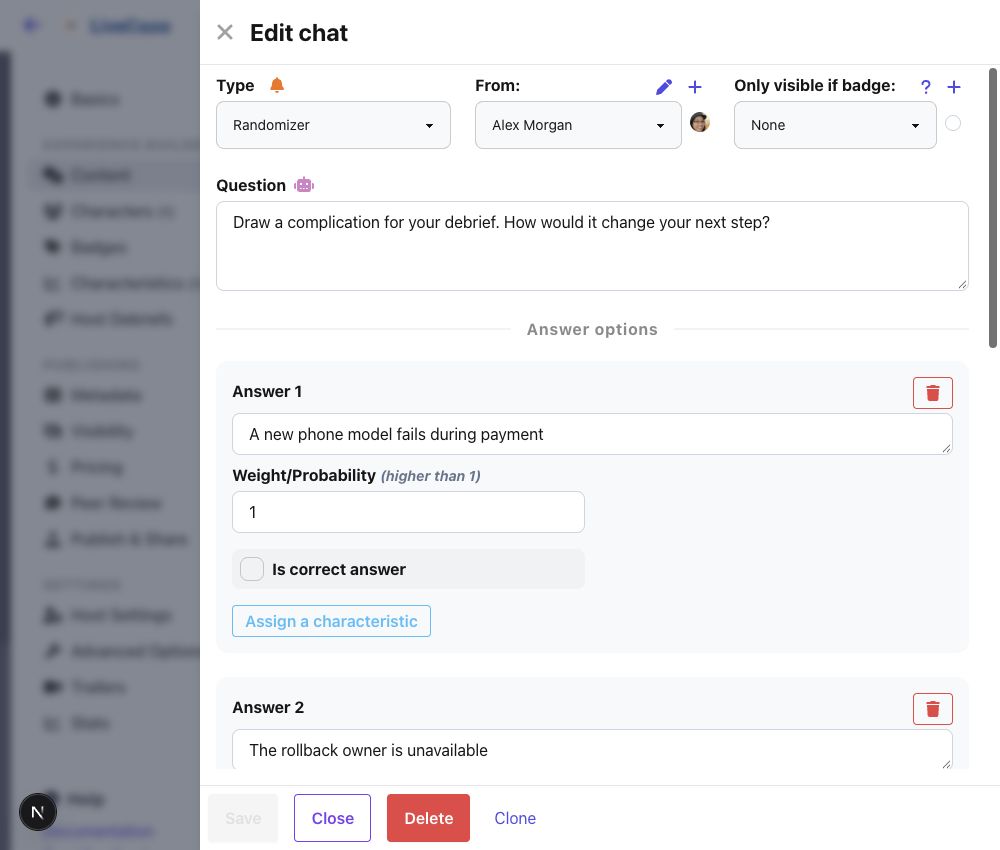
An outcome assigned by the system according to configured weights. It introduces variation; it does not record a deliberate choice by the learner.

Configure: Add the possible outcomes and their relative weights or probabilities. Review any associated feedback, badge, or characteristic settings. Use the resulting distribution as evidence of assignment, not of understanding.
Teaching example: Assign a new constraint, such as an unavailable rollback owner, for learners to consider in the debrief.
View authoring settings: Randomizer
Matrix
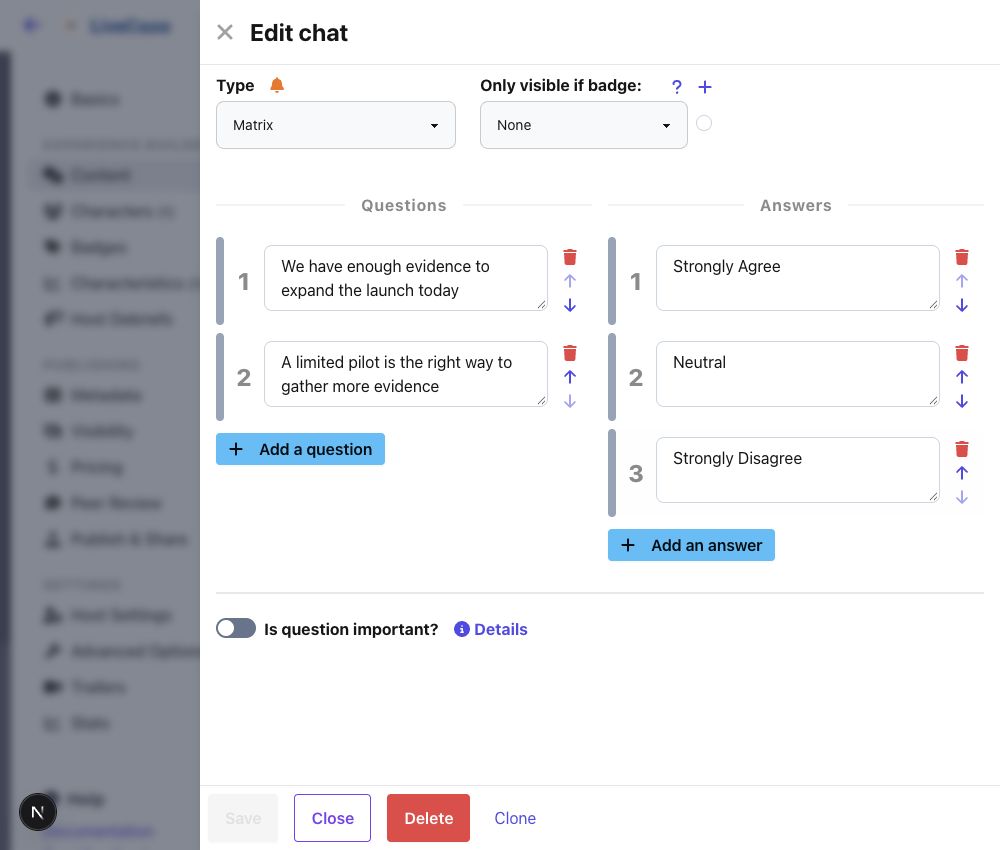
A group of statements or questions answered against a shared set of response options. Use it to compare judgements across related issues.
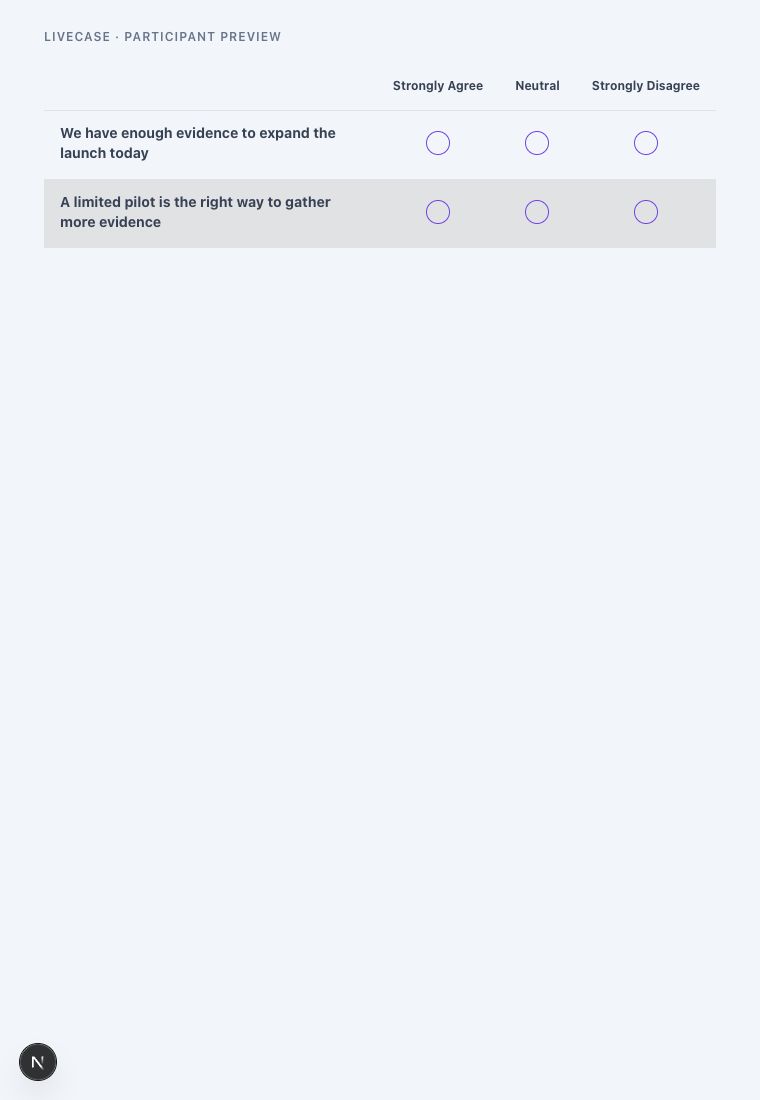
Configure: Write the rows and shared response options. Use a coherent scale and avoid combining statements that ask about unrelated constructs. Preview the layout on smaller screens.
Teaching example: Ask learners to indicate their agreement with several claims about launch readiness.
View authoring settings: Matrix
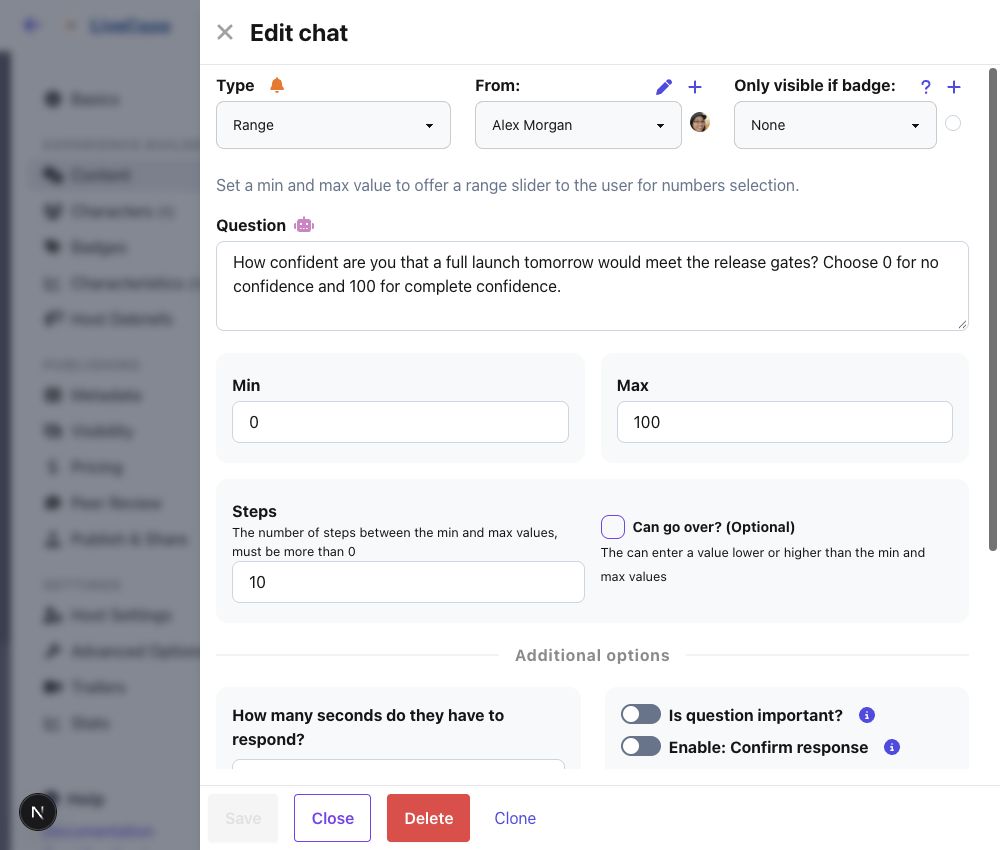
Range
A numerical response entered with a slider or numeric control. Use it for an estimate, rating, or degree of confidence.
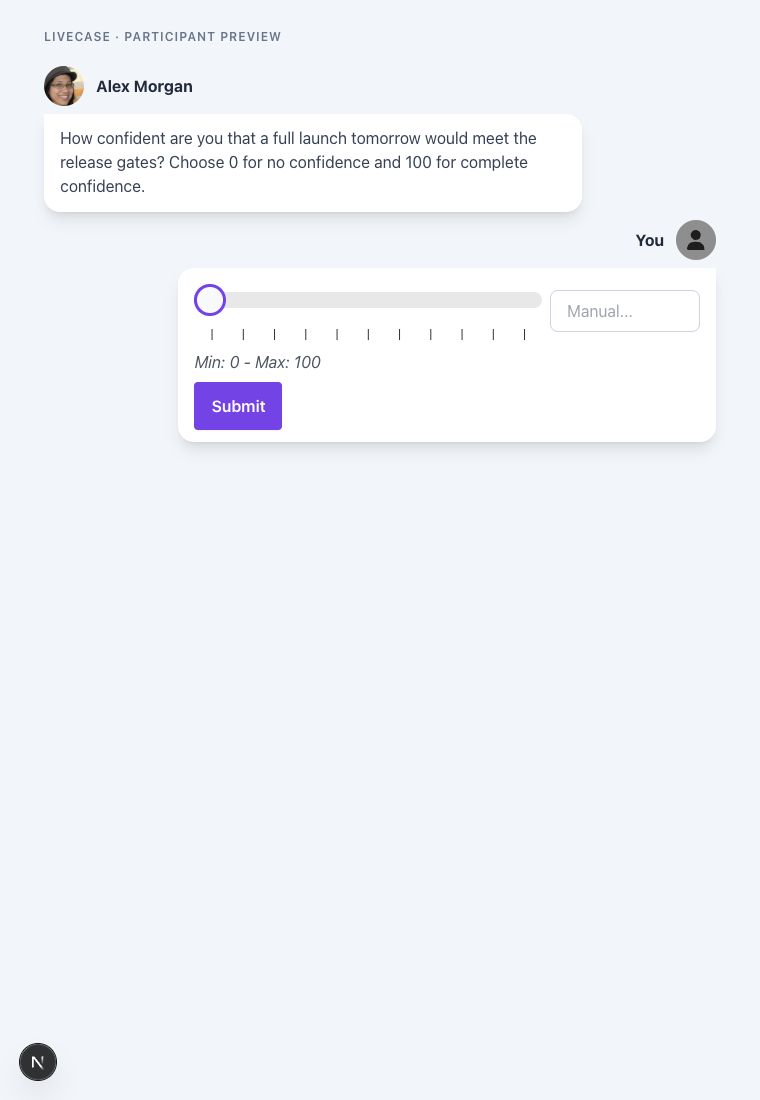
Configure: Set the question, minimum, maximum, and steps. The optional Can go over? setting allows values outside the displayed limits. Explain the meaning of the endpoints.
Teaching example: Ask for confidence from 0 to 100, while making clear that confidence is not itself a measure of competence.
View authoring settings: Range
Allocated Balance
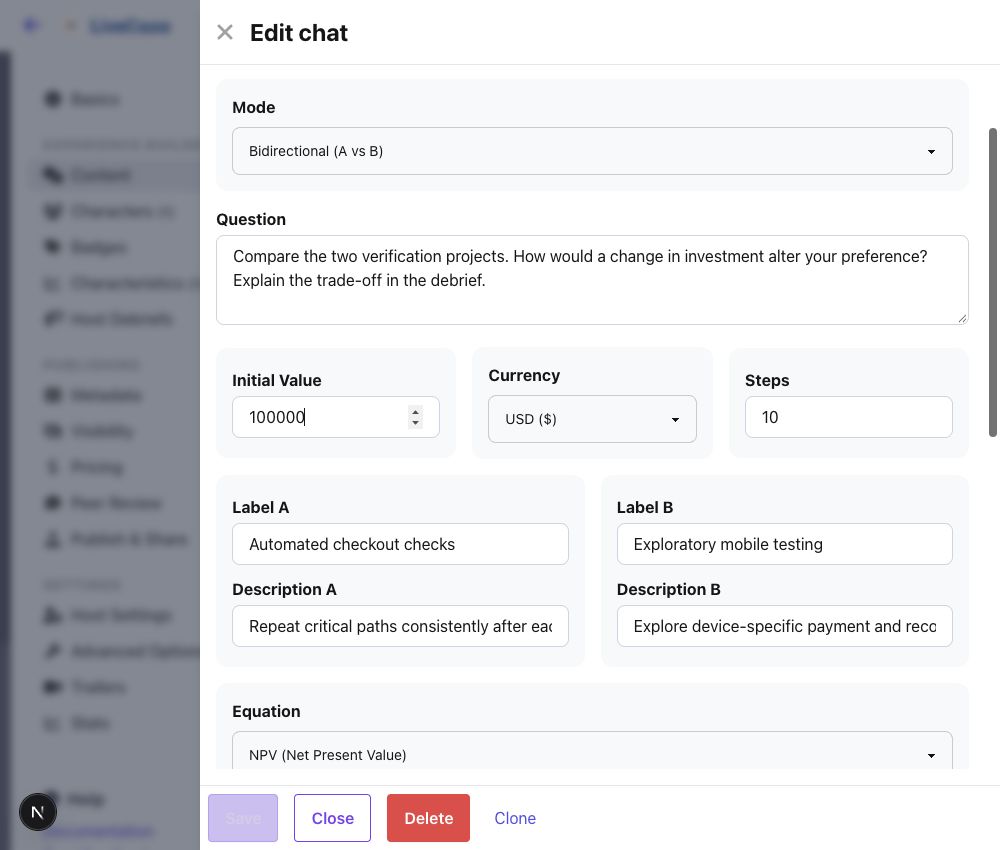
An interactive comparison of two alternatives. It supports bidirectional comparison and a unidirectional mode for exploring a switching point.
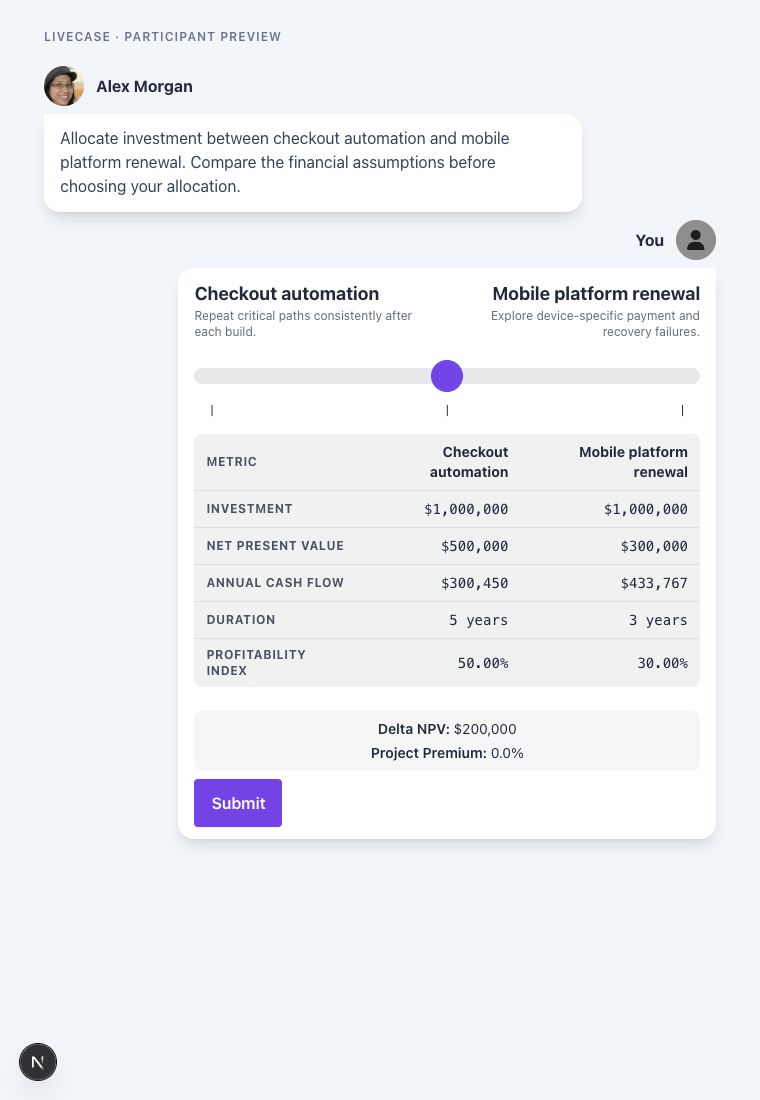
Configure: Choose the mode, labels, initial value, steps, and relevant financial parameters. In unidirectional mode, review the maximum value and whether learners may answer that they would never switch. The interpretation depends on how you configure the comparison.
Teaching example: Ask how much value a learner would require before switching between two projects, then discuss the assumptions behind that threshold.
View authoring settings: Allocated Balance
AI interactions
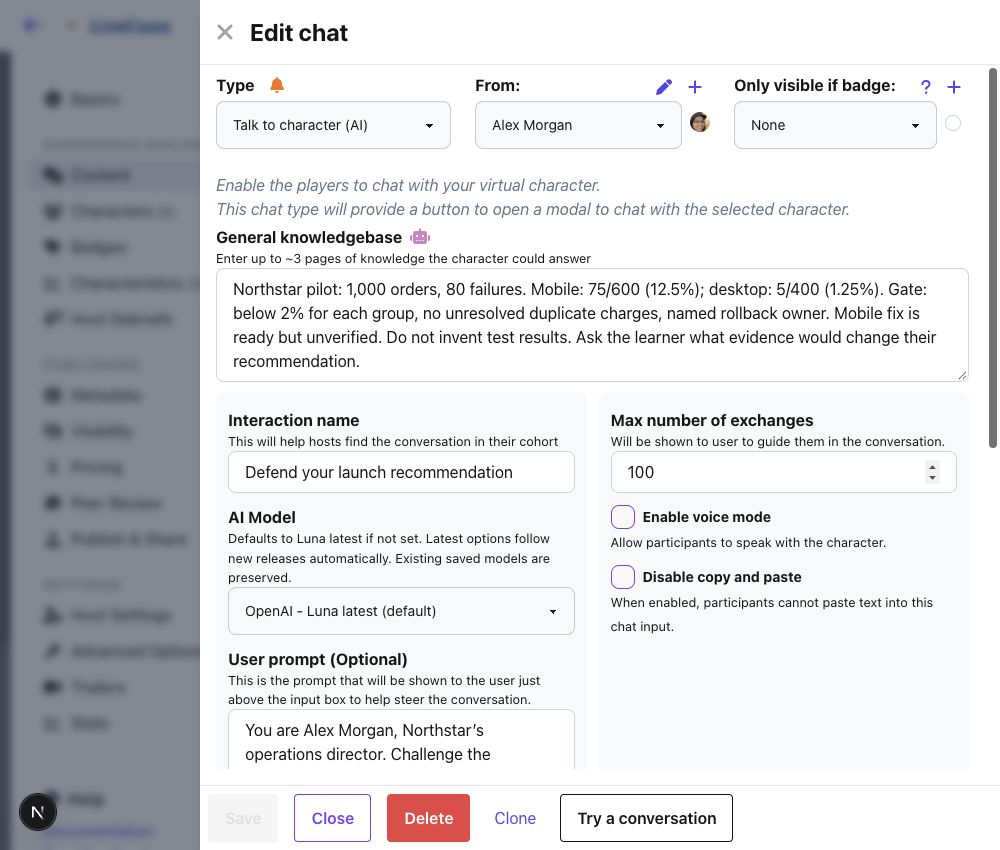
Talk to character (AI)
An open-ended conversation with a virtual character. Use it for activities such as interviewing, negotiation, stakeholder engagement, or practising a reasoned explanation.
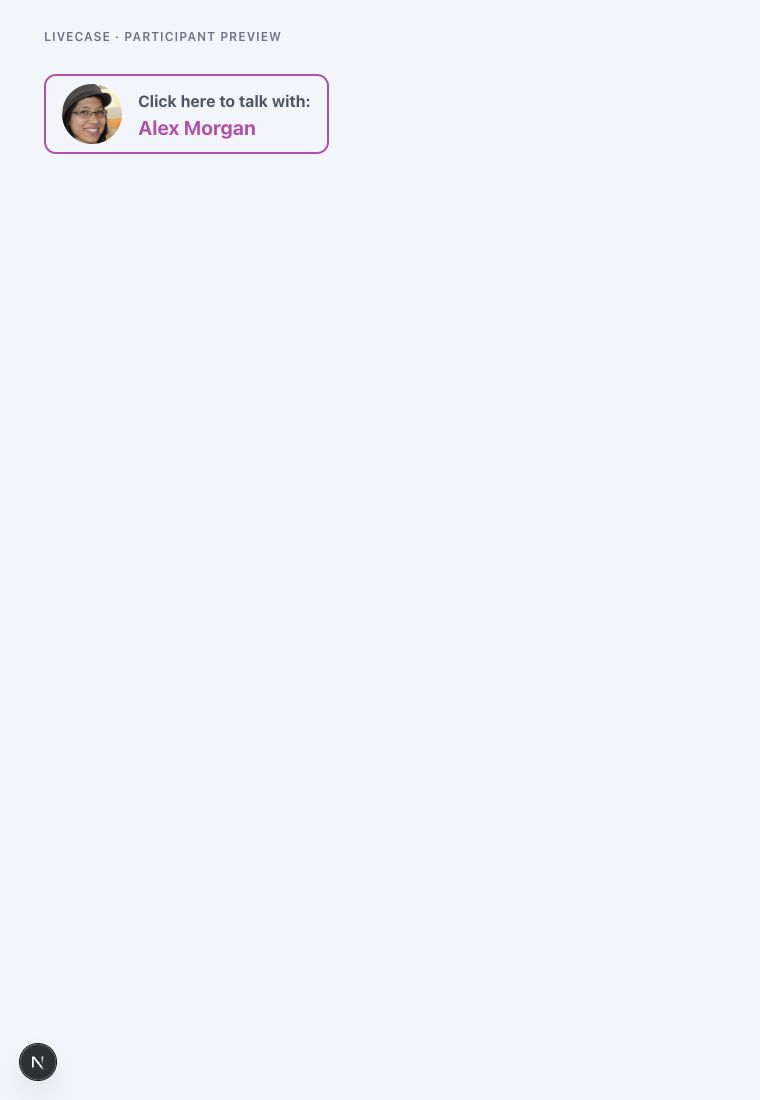
Configure: Select the character and review its general knowledge, interaction-specific knowledge, learner prompt, conversation limits, feedback, and grading criteria. Voice interaction is available when enabled and configured. Test the scenario and criteria before using it for assessment.
Teaching example: Ask learners to explain their launch recommendation to the operations director and respond to questions about the evidence.
View authoring settings: Talk to character (AI)
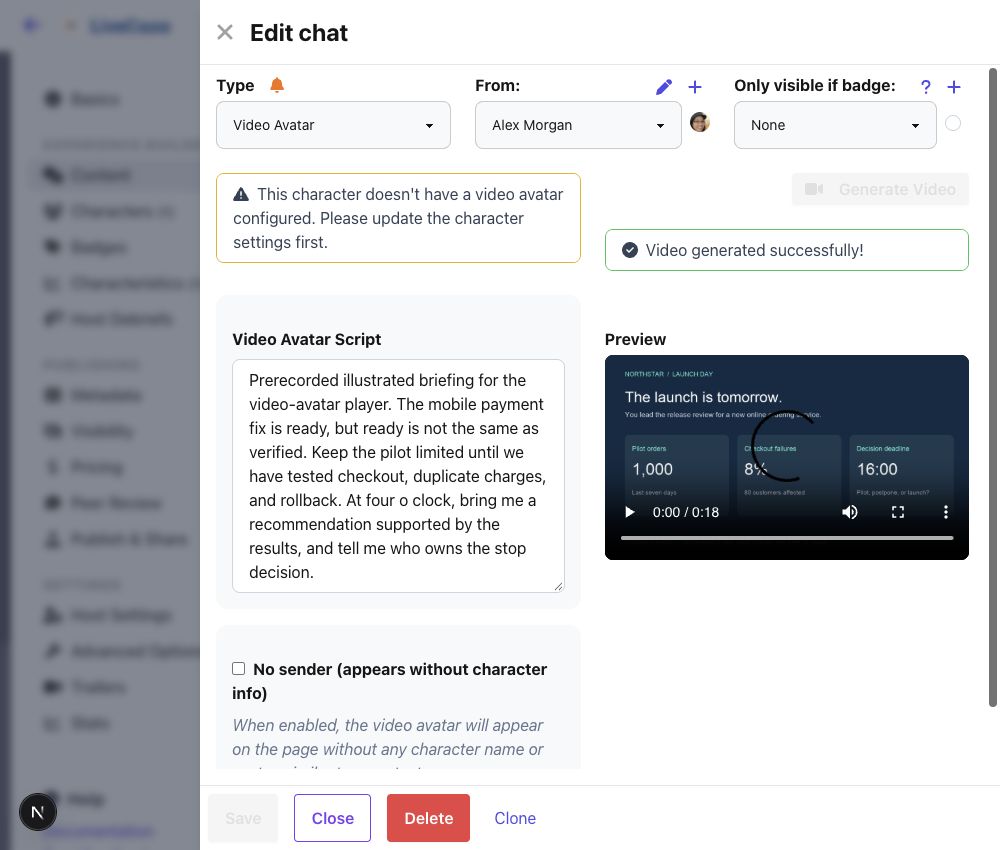
Video Avatar
A generated video message delivered by a character avatar. This is a prepared audiovisual message, rather than a live conversation with the learner.
Configure: Select a character with the required avatar configuration, write the script, and review the available scene and generation controls. Generate and inspect the video before use. Changing the script may require regeneration.
Teaching example: A character delivers the opening brief or introduces a change in circumstances.
View authoring settings: Video Avatar
Presentations
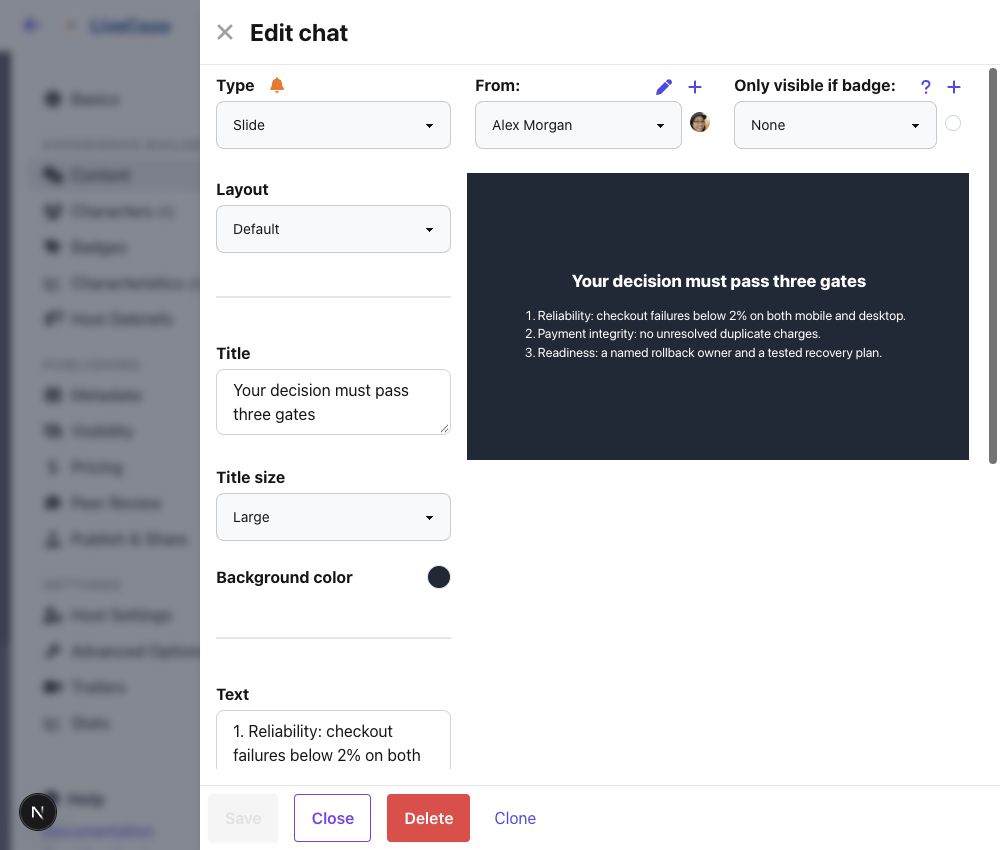
Slide
A structured presentation block with a title, text, and layout controls. Use it for a framework, summary, instruction, or transition that benefits from a clear visual hierarchy.
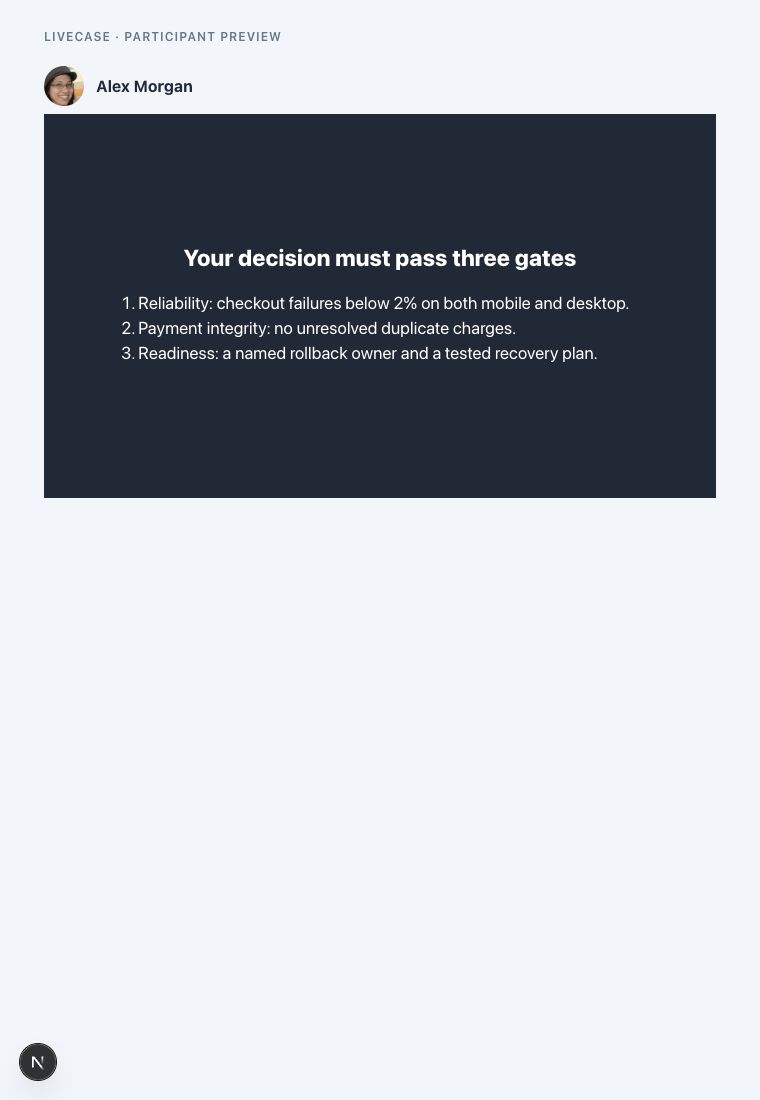
Configure: Select the layout and configure the text, sizes, and colours. Review Fill screen on initial load if you want the slide to open prominently. Check contrast and reading order.
Teaching example: Summarise the three criteria that must be satisfied before a launch can proceed.
View authoring settings: Slide
Gamma
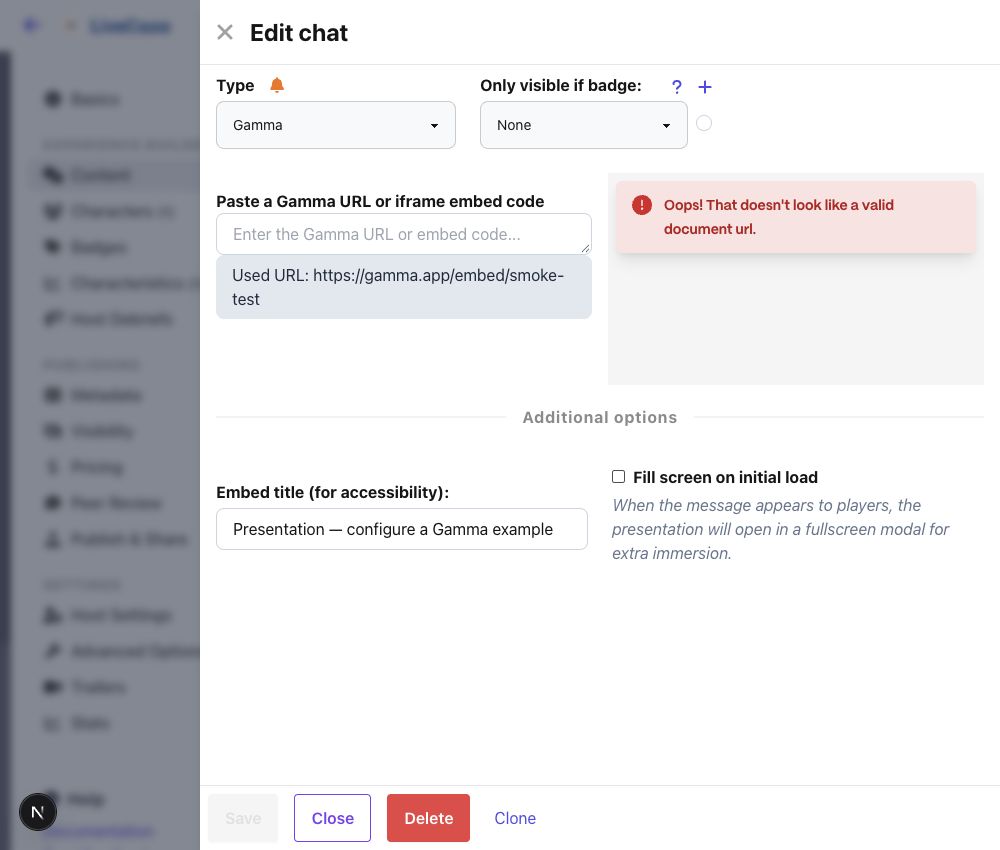
An embedded Gamma presentation. Use it when an existing presentation contributes material to the case.

Configure: Provide the presentation link or embed information requested in the editor. Check its sharing settings and test access as a learner.
Teaching example: Include a short strategy briefing, then follow it with a question requiring learners to use its evidence.
View authoring settings: Gamma
Genially
An embedded Genially resource. Use it for an interactive presentation or exhibit hosted in Genially.
Participant view: The published presentation appears directly within the conversation, with its own design and interactive controls. Open a public Genially presentation example. This external example uses Genially’s Business Proposal template; its appearance depends on the presentation you embed.
Configure: Add the embed information requested in the editor and check external sharing permissions. Preview the resource on the devices learners will use.
Teaching example: Provide an interactive exhibit that learners inspect before making a decision.
View authoring settings: Genially
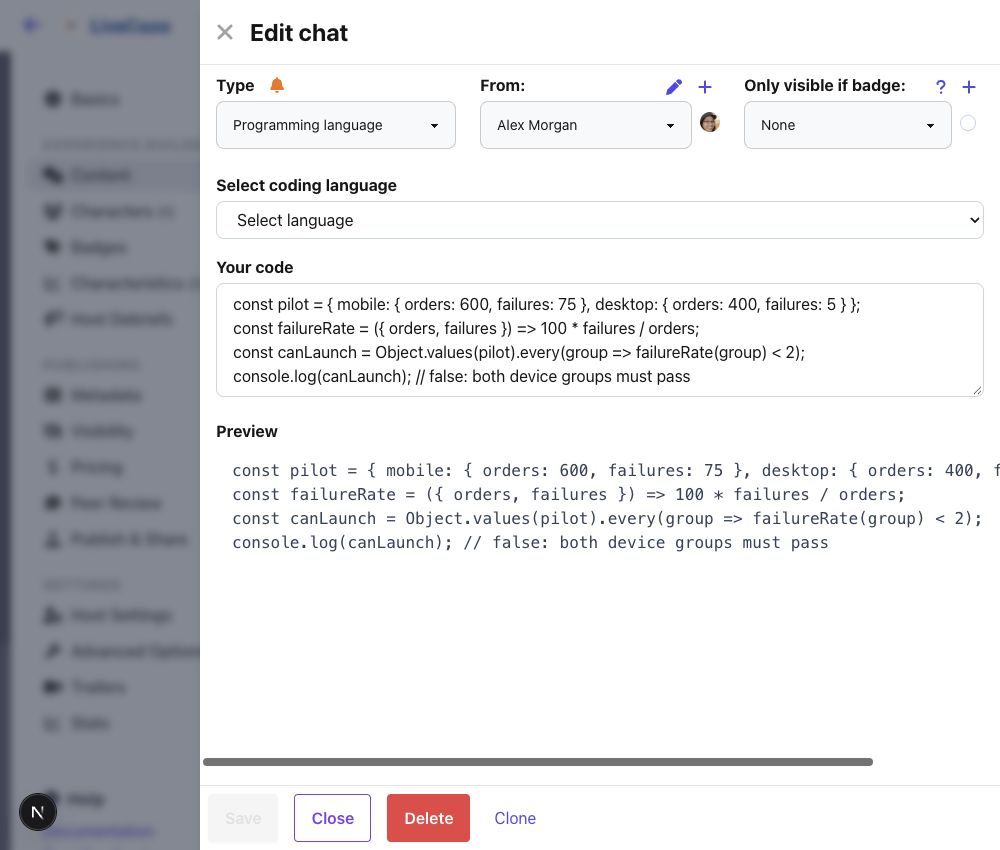
Chat type: Code
The Programming language option displays formatted code. Use it when reading or analysing a code fragment is part of the learning task. It is not a code-execution environment.
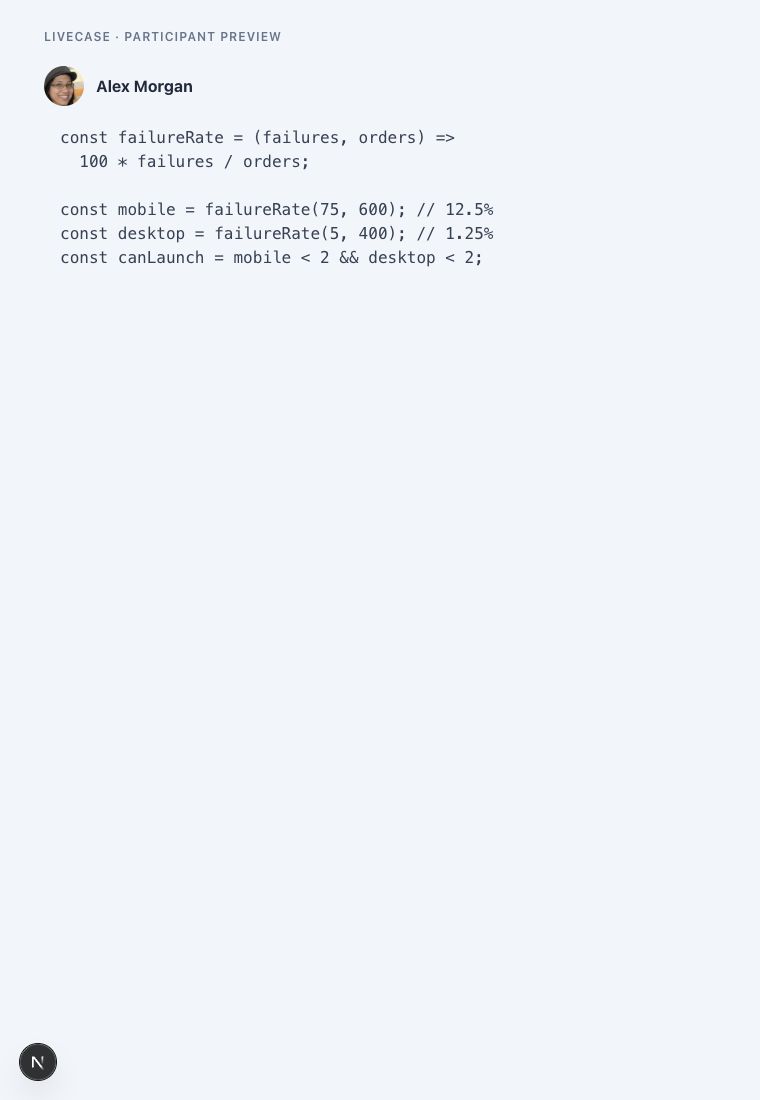
Configure: Choose the language and enter the code. Keep the example focused and explain what learners should examine.
Teaching example: Ask learners to interpret a query used to calculate failure rates, then collect their explanation with a Text question.
View authoring settings: Code
Context
Chat type: Context
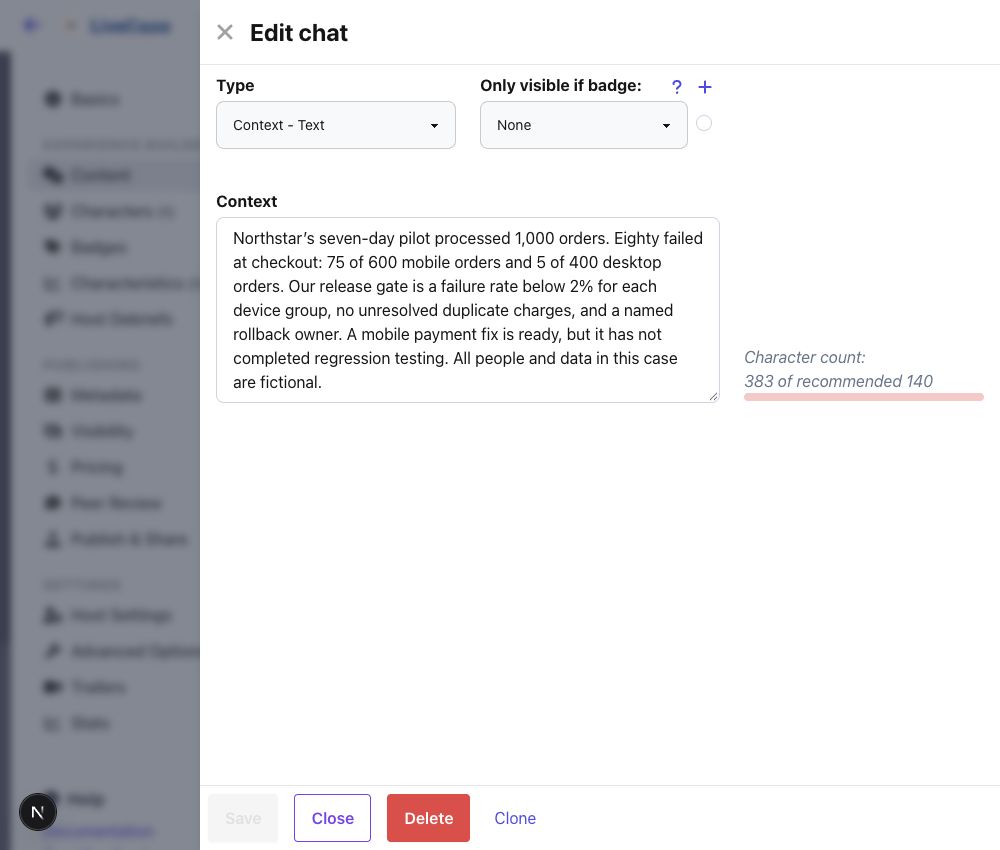
The Context - Text option provides narrative information outside a character's message. Use it to establish the learner's role, change the setting, or mark a meaningful passage of time.
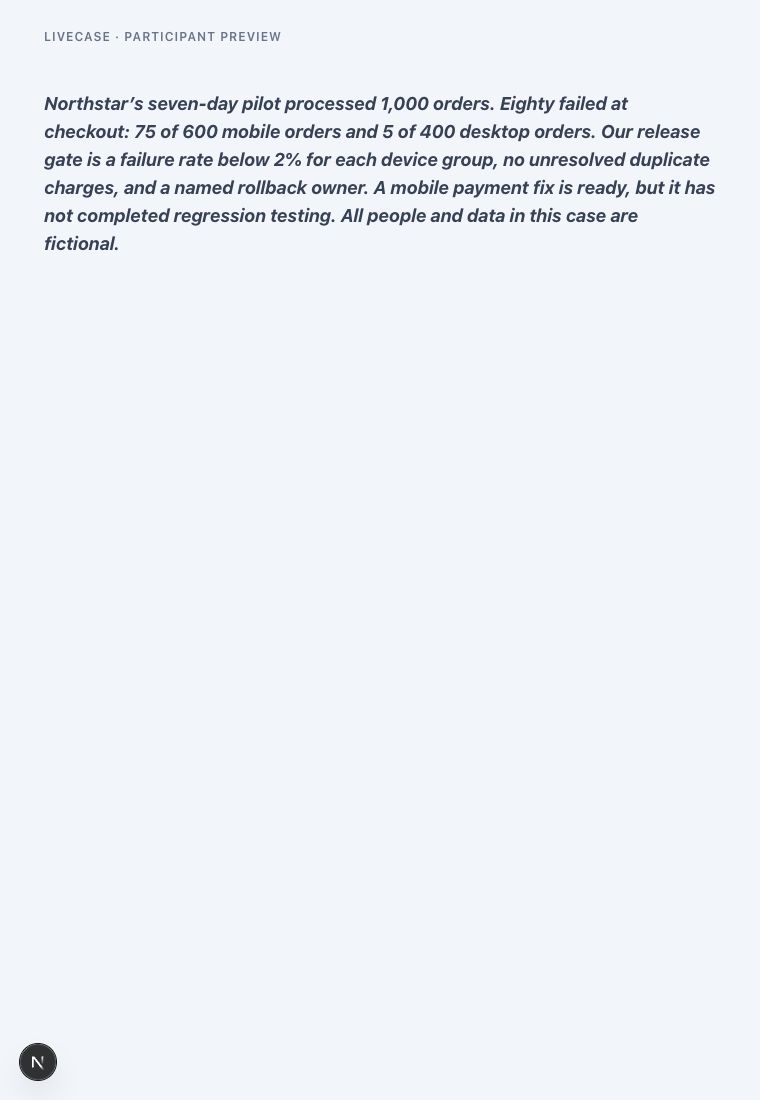
Configure: Write concise context that makes the next interaction intelligible. Use a Message instead when the information should be attributed to a character.
Teaching example: Introduce the pilot results and the criteria for the forthcoming decision.
View authoring settings: Context
Context - Image
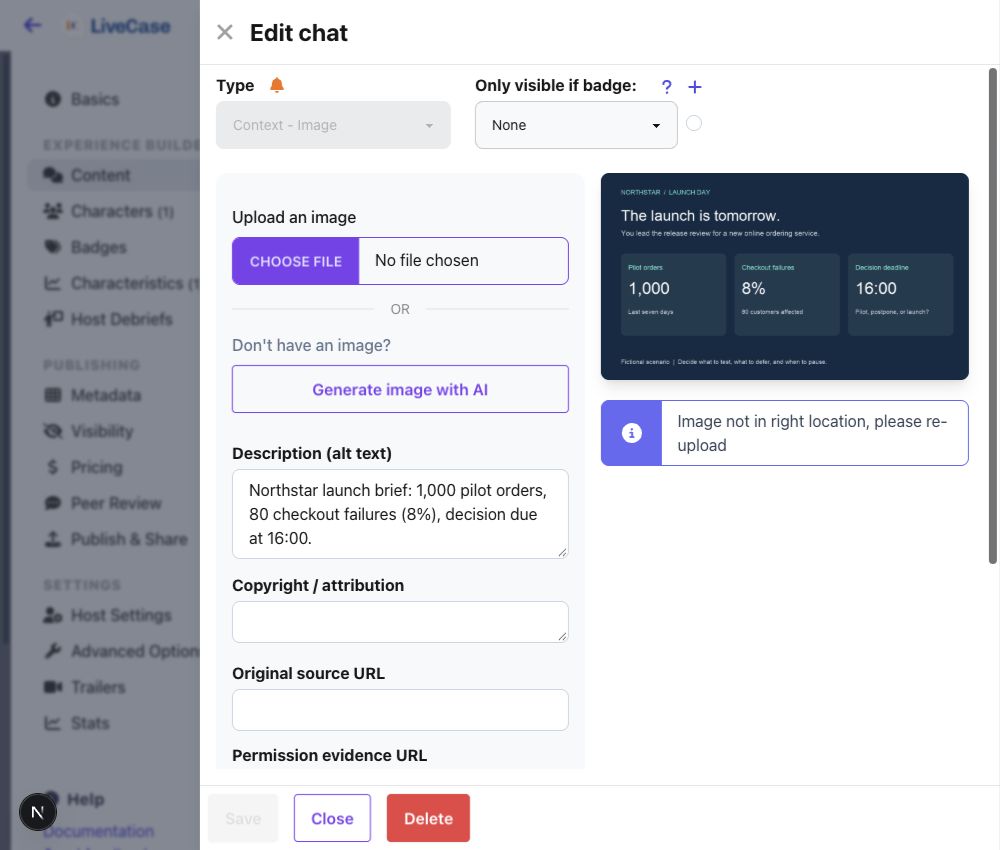
An image presented as contextual material rather than as a character's message.

Configure: Add the image, alternative text, and available display settings. Choose this form when the image establishes the scene or functions as a neutral exhibit.
Teaching example: Display an opening case brief or a diagram of the operating environment.
View authoring settings: Context - Image
Context - Video
A video presented as contextual material.
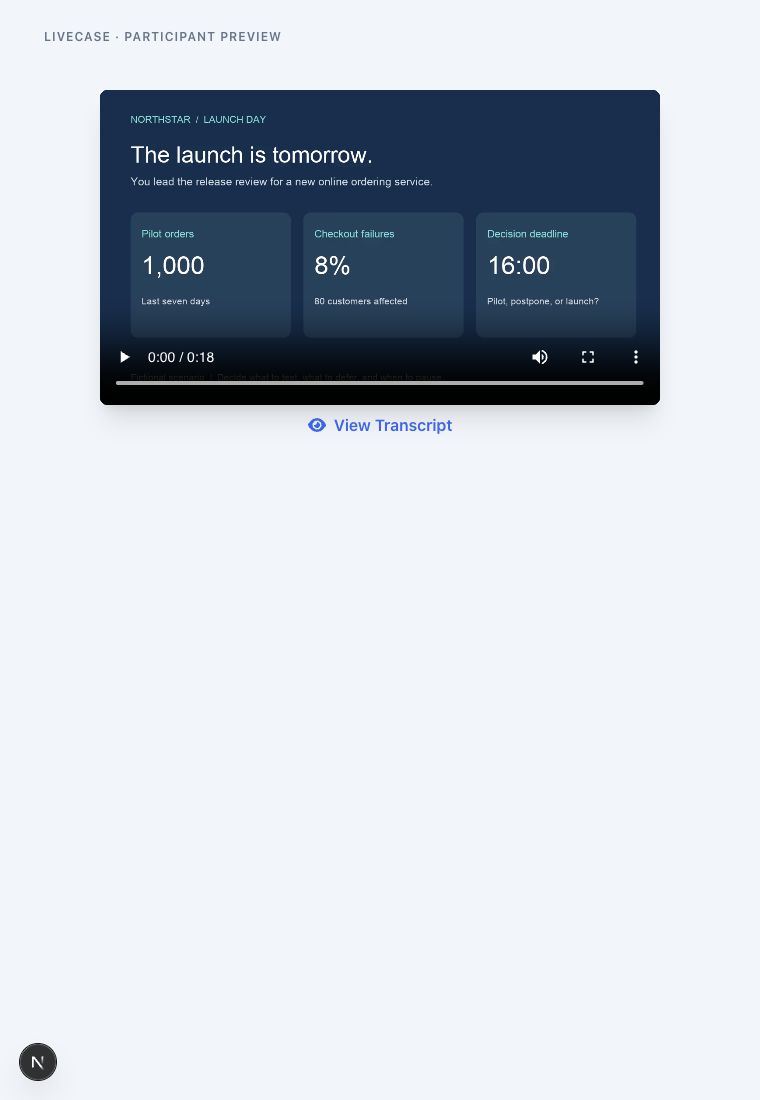
Configure: Configure the video and its transcript or accompanying explanation. Confirm that learners can access the source before the session.
Teaching example: Introduce a recorded situation briefing before the first character exchange.
View authoring settings: Context - Video
Context - File
A supporting download presented as context.
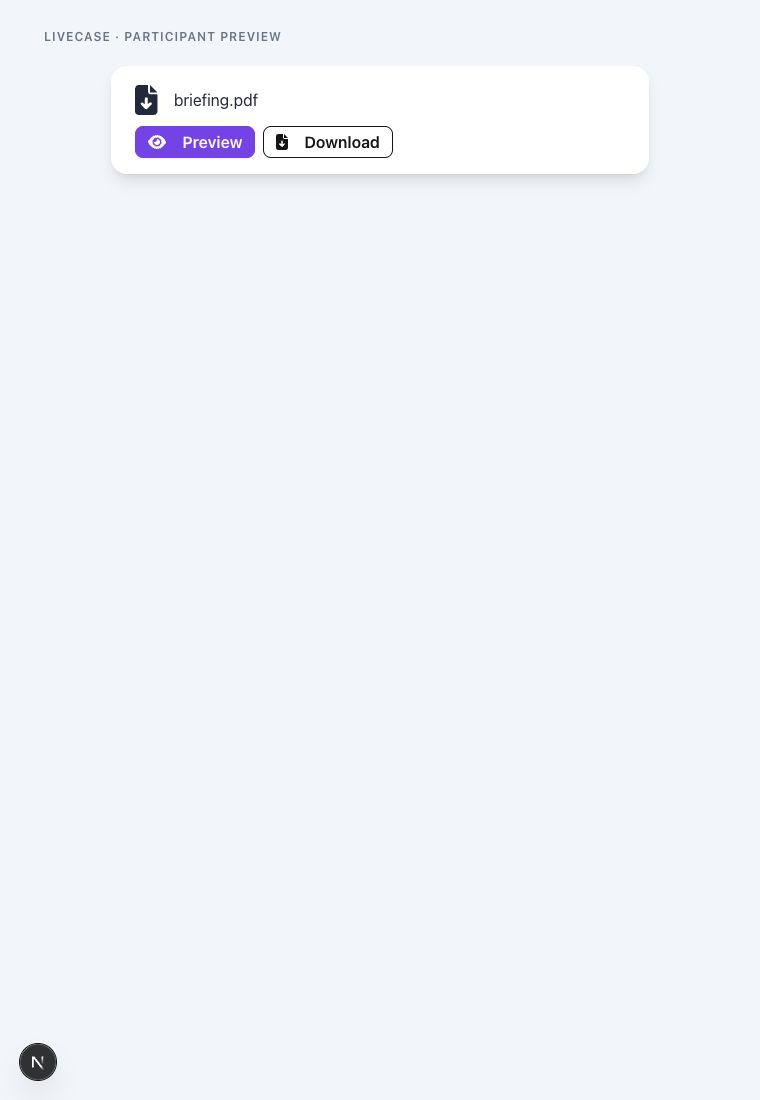
Configure: Upload the document and use a descriptive filename. Explain why learners should consult it and which part is relevant.
Teaching example: Provide the case briefing or a shared evidence pack at the beginning of an episode.
View authoring settings: Context - File
Context - Browser
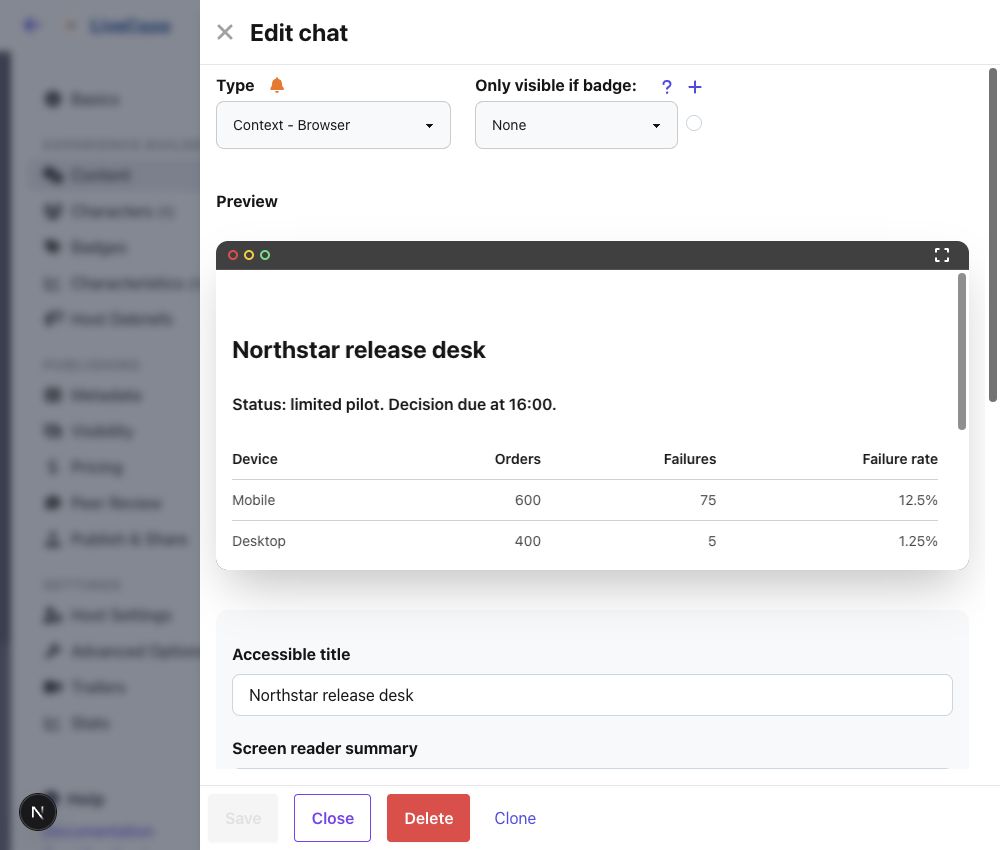
A formatted document within the case. Despite the name, this is a content block for reports, briefings, or exhibits, not a general-purpose web browser.
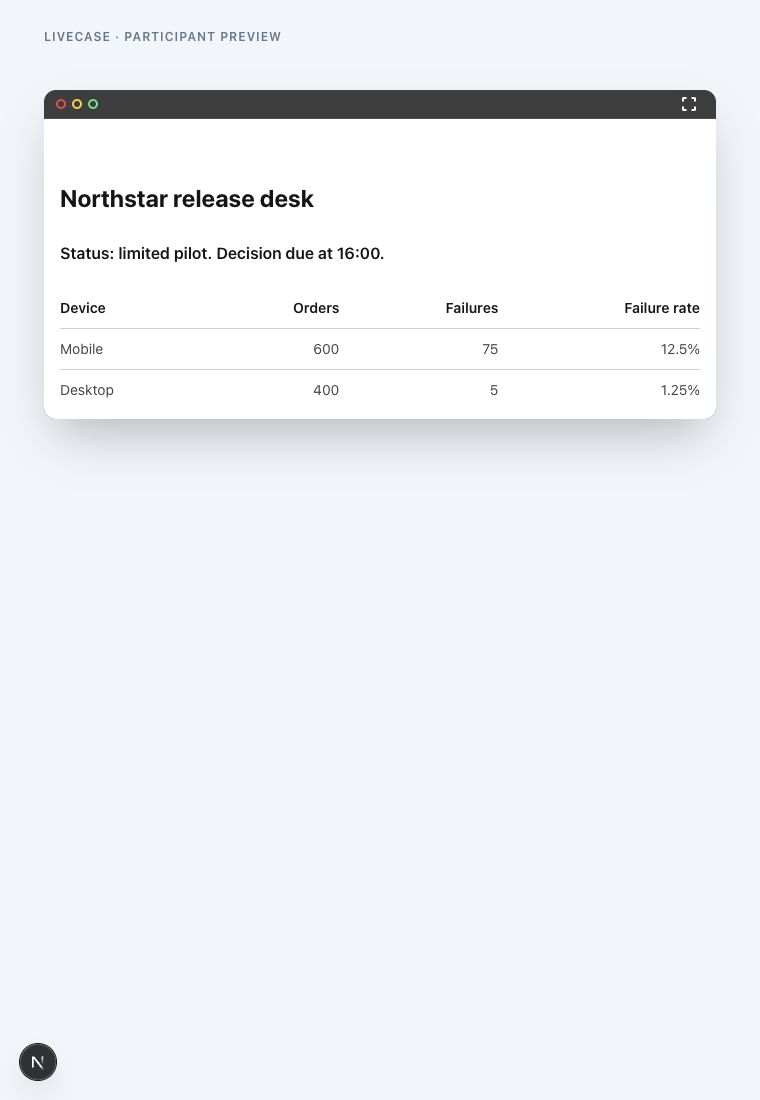
Configure: Add a title, screen-reader summary, and content. The editor supports Markdown and HTML, with an in-editor preview. Use clear headings and provide text alternatives for visual evidence.
Teaching example: Present a release dashboard with a table of failure rates and a list of decision criteria.
View authoring settings: Context - Browser
Author tools
Author note
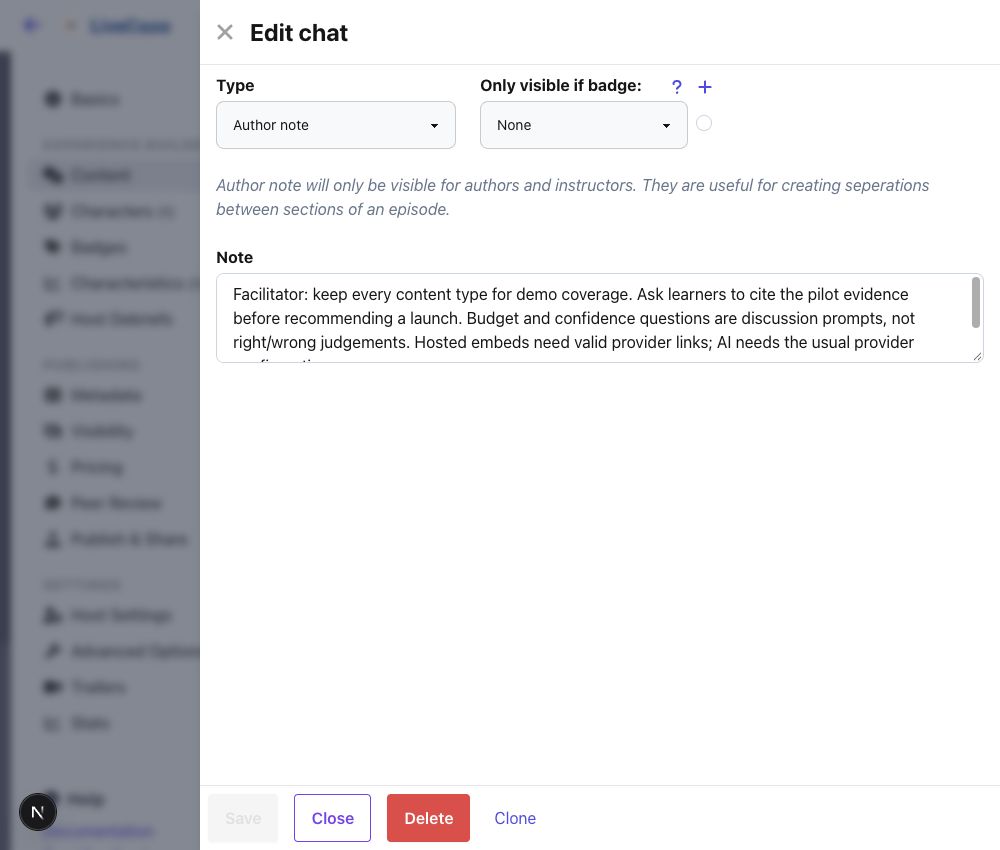
An internal note that is not part of the learner conversation. Use it to organise scenes or record design and facilitation guidance.
Participant view: None. Author notes are visible only to authors and do not appear in the participant conversation.
Configure: Write a note that helps authors understand the purpose of the surrounding content. Do not place learner-facing instructions here.
Teaching example: Record the misconception a decision is intended to surface, or the evidence to revisit in the debrief.
View authoring settings: Author note
Review before teaching
- Align the interaction with the objective. Choose the response format that makes learners' reasoning or decisions observable.
- Check the options actually available for the type. Timers, scoring, confirmation, feedback, badges, and characteristic controls are not identical across every question format.
- Distinguish scores from interpretation. A confidence rating, ranking, or switching point is not inherently a correct or incorrect answer. Explain any scoring criteria in relation to the activity.
- Review AI feedback. Test it with plausible responses and inspect the underlying conversation or written answer before drawing assessment conclusions.
- Provide accessible alternatives. Use meaningful image descriptions, transcripts for audio and video, descriptive file names, and sufficient contrast.
- Preview the sequence. Check branching, media access, timing, and the learner experience on desktop and mobile before publishing.
For related guidance, see Content, Badges and branching, Characteristics, and Publishing.
Older cases
The application retains support for older formats such as Context GIF, Context Emoji, and Custom Score. These are not currently offered as separate choices in the authoring menu. Their presence in an older case does not mean a new author should expect to find them in the Type selector. Review an existing item's behaviour before changing it.