General
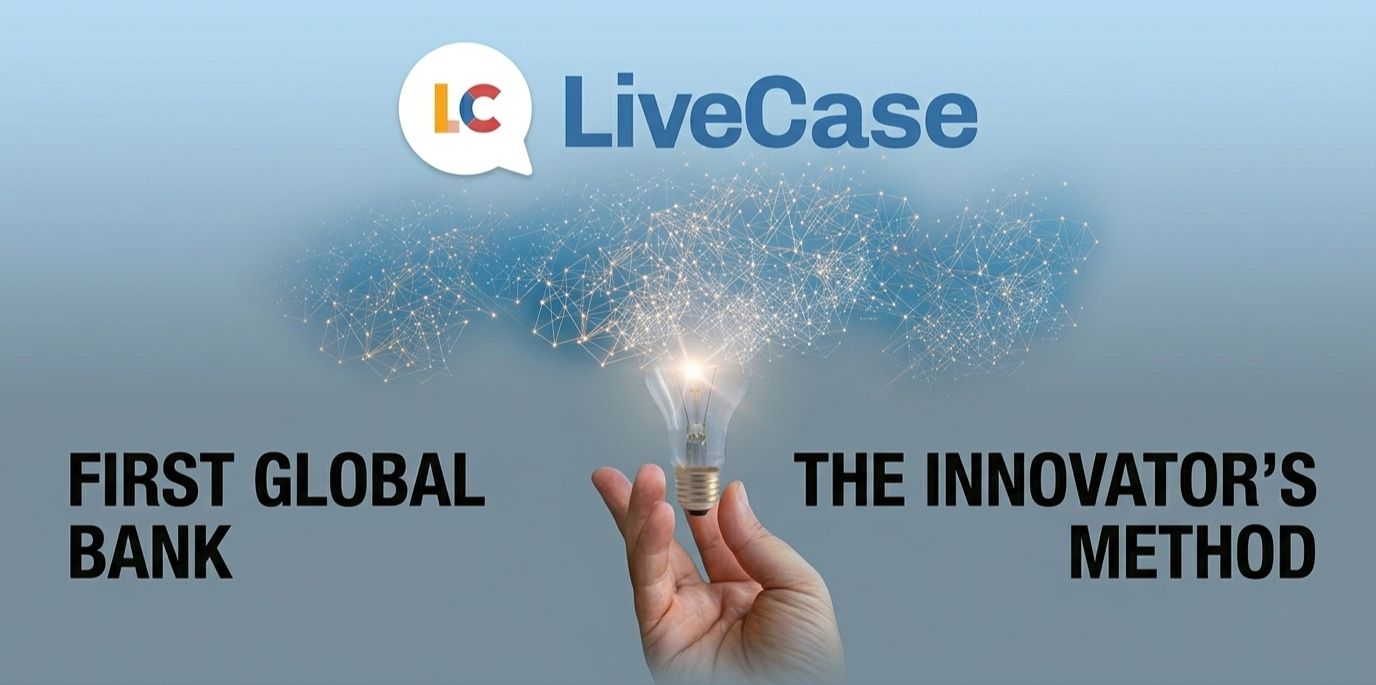
First Global Bank: The Innovation Simulation Every Strategy Course Should Be Using
If you are teaching innovation, strategy, or entrepreneurship, you already know the challenge.
Students understand the theory.
They can explain disruption. They can define customer segments. They can talk about business models.
But when it comes to actually doing innovation, things fall apart.
That gap between knowing and doing is exactly what the First Global Bank LiveCase is designed to solve.
For educators searching for innovation teaching resources, disruptive innovation simulations, or alternatives to traditional case studies, this is one of the most effective learning experiences available today.
A Digital Disruption Case That Feels Real
The First Global Bank LiveCase, authored by INSEAD and powered by LiveCase, places students directly inside a high-stakes innovation challenge.
Learners step into the role of senior executives at a $700 billion global bank.
Their mission is clear.
Help the CEO launch a new digital stock trading platform that combines:
• Big data
• Social networks
• Artificial intelligence
This is a live decision environment shaped by uncertainty, pressure, and competing priorities.
Explore the full simulation here.
Teaching The Innovator’s Method Through Practice
What makes this case especially powerful is its foundation.
The simulation is built around The Innovator’s Method, developed by INSEAD Professor Nathan Furr and Jeff Dyer.
Instead of simply reading about the framework, students apply it step by step.
They learn to:
• Identify customer problems and “jobs to be done”
• Build and test hypotheses
• Conduct customer interviews
• Analyze feedback and refine ideas
• Avoid common innovation traps
This transforms abstract theory into practical capability.
Learn more about the case author Nathan Furr here.
A Structured Innovation Journey, Not a Static Case
The First Global Bank LiveCase is designed as a sequence of episodes.
Each stage builds on the previous one.
E1: Digital Disruption at First Global
Students are onboarded into the scenario and introduced to their role and objectives.
E2: Customer Interview Preparation
They design questions and prepare to engage with potential users.
E3: Customer Interviews
Learners conduct interviews and gather insights.
E4: Insight Synthesis
They analyze findings and identify patterns.
E5: Decision and Recommendation
They refine their strategy and move forward with a clear direction.
This episodic structure mirrors how innovation actually happens.
Not in a single moment, but through iteration.
Why This Is One of the Best Innovation Simulations for Class
Traditional innovation cases often focus on what companies did.
This simulation focuses on what students should do.
That distinction matters.
Because innovation is not about hindsight. It is about navigating uncertainty.
The First Global Bank LiveCase exposes learners to:
• The “big market trap”
• The “willingness to pay” trap
• Misaligned customer assumptions
• Strategic ambiguity
Students must confront these challenges directly.
They test ideas. They fail. They adjust.
This is what makes it one of the most effective experiential learning tools for innovation and entrepreneurship education.
Built for Engagement Across MBA and Executive Education
The simulation is designed for flexibility.
It can be used in:
• Undergraduate programs
• MBA and Executive MBA courses
• Executive education programs
And delivered:
• Individually or in teams
• In-person or online
Because the experience is interactive, it maintains engagement across different formats and cohort sizes.
It also includes:
• Teaching notes
• Structured learning objectives
• Supplemental educator resources
For institutions using Harvard Business Publishing, the bestselling case is also available here.
Why Immersive AI LiveCases Are Changing Innovation Education
This simulation reflects a broader shift in business education.
From static content to Immersive AI LiveCases.
In this format:
Students interact instead of read.
They experiment instead of summarize.
They decide instead of observe.
This aligns with how innovation actually happens in organizations.
Messy. Iterative. Human.
Educators can explore more simulations in our catalogue.
Or create their own AI LiveCase using no-code tools.
For more advanced or custom-built simulations, Studio Services provides tailored support:
Frequently Asked Questions
What makes the First Global Bank LiveCase effective for teaching innovation?
It allows students to apply innovation frameworks in a real-time, decision-based environment rather than just analyzing them.
Is this suitable for MBA and executive education?
Yes. It is widely used across undergraduate, MBA, and executive-level programs.
What topics does this simulation cover?
Disruptive innovation, customer discovery, strategy, entrepreneurship, and digital transformation.
How is this different from traditional case studies?
It is interactive and iterative, requiring students to engage actively rather than passively analyze.
Why is this considered one of the best innovation simulations for class?
Because it combines academic rigor, real-world relevance, and hands-on application in a single experience.
Share

Transform static learning intoimmersive AI simulations.
When students skip PDFs and disengage, LiveCase turns learning into a sequence of decisions, consequences, and active participation.
Trusted by world-leading educators & corporations
Author

Author: Amandine
Head of Marketing
Amandine believes learning isn't a straight path but a creative, evolving experience.With a Master's from Trinity College and a Bachelor's from Leeds University, she helps shape how LiveCase tells its story.Connecting innovation, design, and AI to transform how people learn and engage.Driven by curiosity and a belief in better ways to educate, she brings both strategy and imagination to every project.
Published: 4/10/2026