
General
The Surprising Power of AI Role Play: Why Practising Difficult Conversations Changes Everything
by Amandine
AmandineGeneral
AmandineEvery difficult conversation carries a little uncertainty.
You might be giving constructive feedback to a colleague. Negotiating with a client. Managing conflict within a team. Asking for a promotion. Or delivering news that someone simply does not want to hear.
Most people only get one chance.
They prepare the conversation in their head, hope it goes well, and then reflect afterwards on what they could have done differently.
That is exactly why AI role play is becoming one of the most practical applications of artificial intelligence in education and professional development.
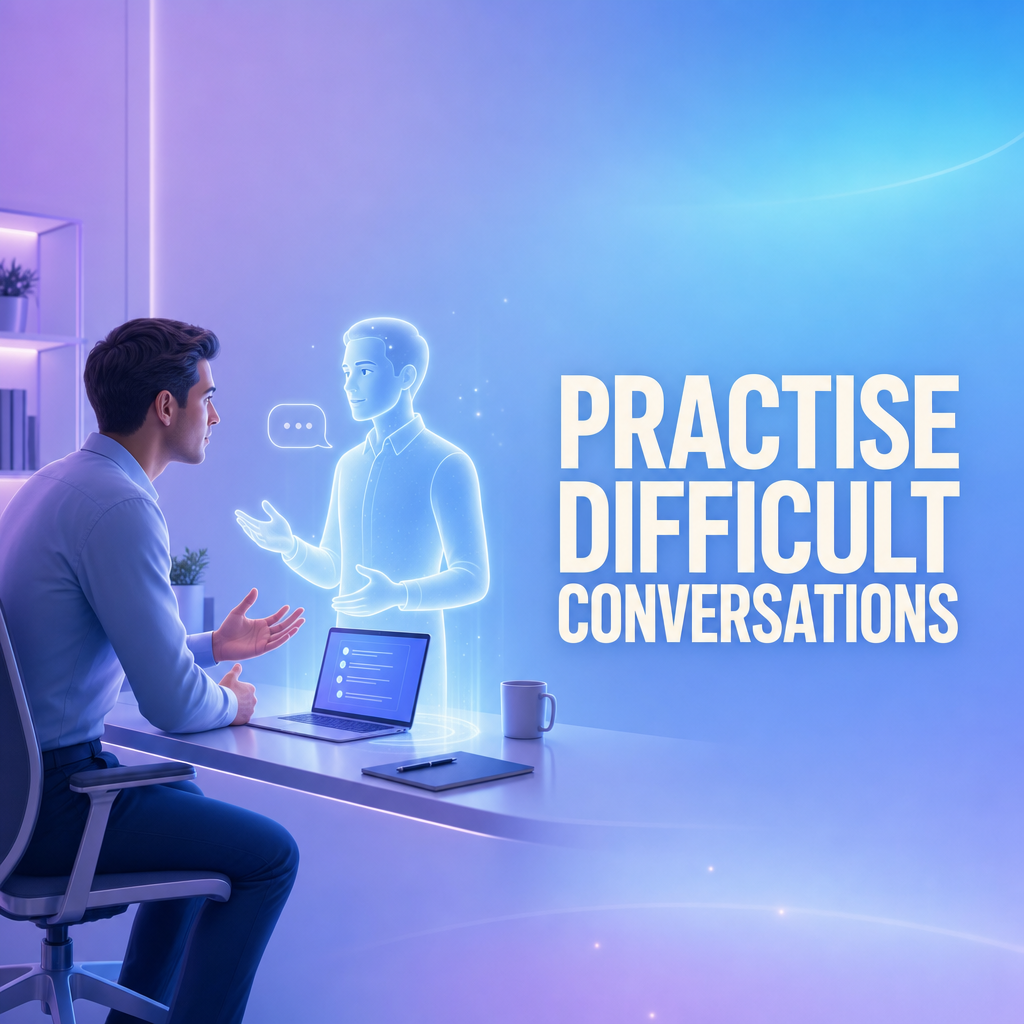
Rather than replacing human interaction, AI provides something we have rarely had before: the opportunity to practise before the real conversation begins.
At LiveCase, we believe learning happens through experience. AI should support that experience, not replace it. Used intentionally, Immersive AI LiveCase allows learners to rehearse judgement, build confidence, and improve communication through realistic decision-making rather than passive observation.
Learning rarely comes from simply hearing information.
Most practical skills improve through repetition.
Athletes train before competition.
Musicians rehearse before performance.
Pilots use flight simulators before carrying passengers.
Communication should be no different.
AI role play creates opportunities for learners to practise conversations repeatedly in a low-risk environment. Each interaction helps build confidence and encourages reflection before facing the real situation.
The value is not that AI provides the perfect answer.
The value is that learners experience the decision-making process multiple times until it becomes more natural.
Many leadership programmes spend hours discussing communication.
Far fewer allow learners to actually practise it.
That gap matters.
A learner may understand every principle of constructive feedback yet still struggle when emotions are involved.
AI role play bridges this gap.
Instead of reading about negotiation or conflict management, learners actively participate in conversations where every response influences what happens next.
This mirrors the philosophy behind experiential learning.
Knowledge becomes action.
Action becomes experience.
Experience becomes confidence.
One of the most interesting ideas from the conversation transcript was the comparison with rock climbing.
Climbing with a rope is different from climbing without one.
The risk changes.
The confidence changes.
The behaviour changes.
Practising with AI works in much the same way.
Learners know there are no real-world consequences if they make a poor decision. That psychological safety encourages experimentation.
They can try different approaches.
They can ask difficult questions.
They can fail safely.
Although the real conversation will always feel different, repeated practice builds familiarity that transfers into real-world performance.
One important caution emerged throughout the discussion.
AI is not an infallible coach.
Large language models often display confirmation bias by agreeing with the assumptions contained within a user's prompt.
For example, asking:
"I'm sleeping badly because I go to bed too late."
may encourage AI to reinforce that assumption.
A better prompt is:
"I'm sleeping badly. What could be causing this?"
The difference is subtle but significant.
The quality of AI coaching depends on the quality of the questions learners ask.
This is another reason structured educational experiences matter.
Instead of treating AI as an answer engine, educators can guide learners towards better questioning, deeper reflection, and more balanced thinking.
Perhaps the biggest misconception about AI is that it removes the need for human judgement.
In reality, it often increases it.
Anyone who has asked AI to review a presentation or edit a report knows how easy it is to fall into an endless feedback loop.
Every revision generates another suggestion.
Every suggestion creates another revision.
Eventually, you may find yourself almost back where you started.
Knowing when to stop is a human skill.
Knowing which advice to ignore is a human skill.
Knowing what fits your own leadership style is a human skill.
AI can provide ideas.
Only people provide judgement.
These ideas extend well beyond workplace communication.
Traditional lectures often struggle to provide meaningful practice.
Students listen.
Take notes.
Leave the room.
Weeks later, much of the content has been forgotten.
Research consistently shows that active learning produces stronger educational outcomes than passive instruction. The National Academies of Sciences, Engineering, and Medicine highlight the benefits of engaging students in active participation rather than passive listening (https://nap.nationalacademies.org/catalog/24783/how-people-learn-ii).
AI role play gives educators another way to create these active experiences.
Instead of discussing how to handle a difficult employee, students become the manager.
Instead of reading about negotiation, they negotiate.
Instead of analysing leadership from a distance, they experience it directly.
This philosophy has guided LiveCase long before generative AI became mainstream.
LiveCase began by transforming traditional case studies into interactive branching conversations where learners experienced the consequences of their decisions.
Today, Immersive AI LiveCase extends that approach even further.
Learners can:
Importantly, educators remain in control.
Instructor dashboards provide visibility into learner decisions, engagement, and areas where students struggle. Rather than replacing classroom discussion, these insights make debriefing richer and more targeted.
If you're looking for inspiration, explore the Catalogue to see how immersive learning experiences are being used across higher education.
Want to build your own? Try Create Your Own LiveCase using the no-code authoring tools.
If you'd rather collaborate with experienced learning designers, Studio Services can help transform your ideas into engaging simulations.
You can also learn more about the platform on the LiveCase homepage.
AI will continue to evolve.
Its responses will improve.
Its reasoning will become stronger.
But the goal of education has never been producing perfect answers.
It has always been developing better thinkers.
That requires uncertainty.
It requires judgement.
It requires experience.
AI role play succeeds not because it replaces people, but because it gives learners more opportunities to become the people they want to be before the real conversation begins.
For educators, that may be one of the most exciting opportunities AI offers.
Not better content.
Better practice.
AI role play allows learners to practise realistic conversations with AI characters, helping develop communication, leadership, negotiation, and decision-making skills.
No. AI role play prepares students for richer classroom discussion by giving everyone practical experience before they meet as a group.
Yes. Repeated practice in a low-risk environment helps learners build confidence before facing real conversations.
Immersive AI LiveCase combines structured simulations, AI conversations, branching decisions, educator dashboards, and feedback to create experiential learning.
Yes. Every learner can participate individually while educators gain visibility into engagement and decision-making across the cohort.
Communication improves through experience. AI role play allows learners to apply theory, receive feedback, and reflect before using those skills in real situations.
Build your own simulation, bring in our Studio, start with a published case, or talk through your idea.
Ask about a demo, quote, or your simulation. We usually answer within a few hours.
Contact usCreate with AI or start from scratch. You keep full creative control.
Create an accountWork with our case writers on a classroom-ready simulation.
Explore StudioBrowse simulations authored with leading educators.
Browse catalogueAuthor: Amandine
Head of Marketing
Amandine believes learning isn't a straight path but a creative, evolving experience.With a Master's from Trinity College and a Bachelor's from Leeds University, she helps shape how LiveCase tells its story.Connecting innovation, design, and AI to transform how people learn and engage.Driven by curiosity and a belief in better ways to educate, she brings both strategy and imagination to every project.
Published: 6/25/2026
Related posts


