by Amandine
Inside Immersive AI LiveCases: A Conversation with Co-Founder Denis Duvauchelle
General
General
Discover four powerful alternatives to traditional essays for measuring critical thinking in business students, including chat based simulations that evaluate communication and judgment under pressure.
Essays used to be the gold standard for evaluating higher order thinking. Today, they reveal very little. Students can now generate entire papers with a single prompt. Even when they write them independently, essays reward structure, polish, and word count more than real reasoning. Business students need something different. They need assessments that feel real and demand real thinking.
Real critical thinking does not happen in a vacuum. It happens in conversation, in messy situations, and in high pressure decisions. Business students must navigate uncertainty, communicate clearly, and adapt fast. A polished essay cannot show any of that. Authentic assessments expose how students think when the clock is running and the information is incomplete. That is the essential difference.
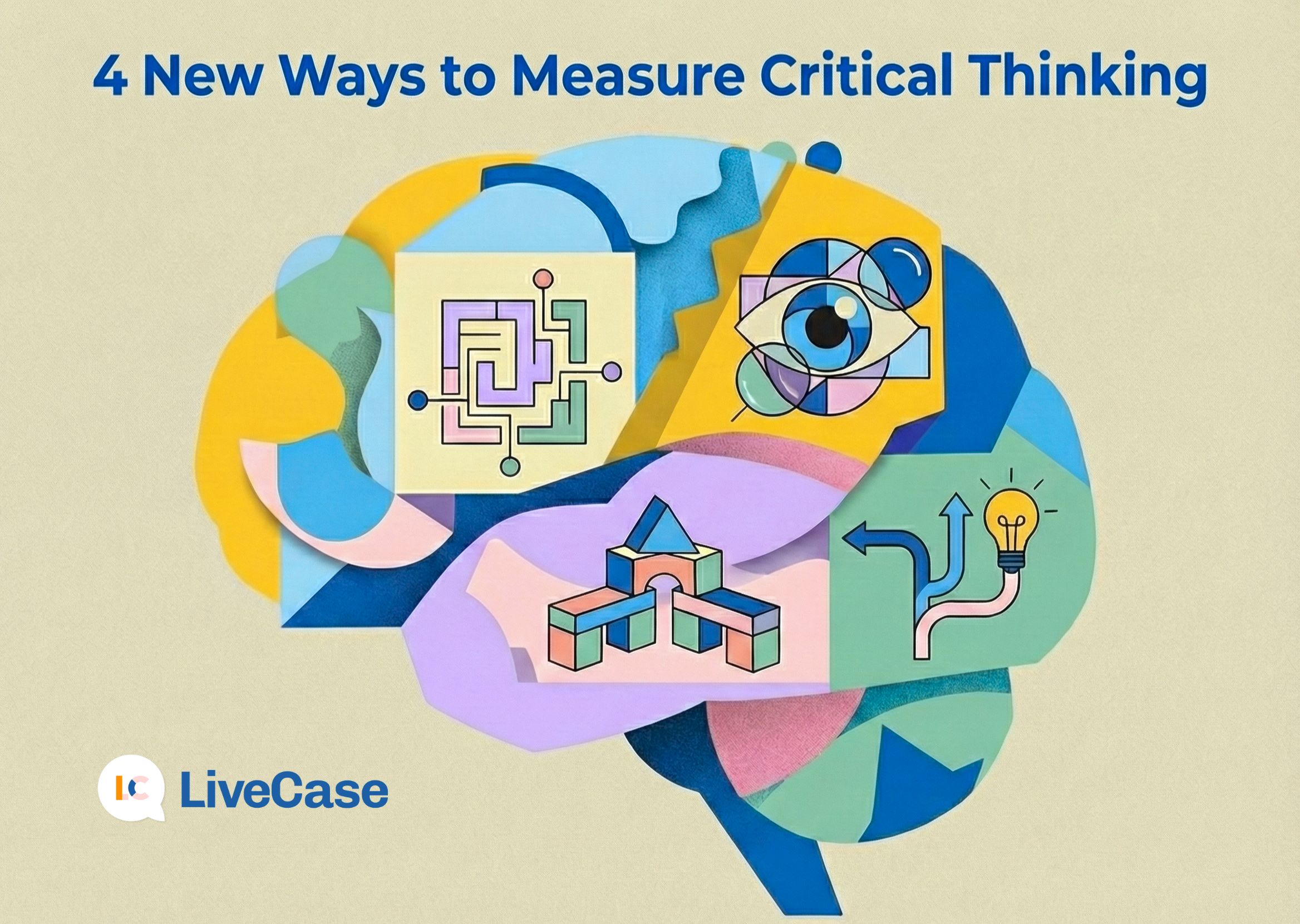
Put students inside a situation that is unfolding moment by moment. Give them limited information. Add time pressure. Ask them to choose a direction and justify why. Suddenly, the assignment becomes alive. Students cannot hide behind templates or AI generated language. They must analyze, interpret, and commit.
Why it works:
• Scenarios evolve as students make decisions
• Choices reveal thought patterns that essays never capture
• Students act quickly instead of polishing paragraphs
Decision scenarios mirror the real world where leaders move first and refine later.
Some students write beautifully but struggle to explain themselves aloud. Oral reasoning checks flip the script. They require students to talk through a problem clearly and confidently. It is simple. Ask a question. Ask why. Ask what they would do next. Within minutes, their actual understanding becomes visible.
Benefits:
• Impossible to outsource to AI
• Shows clarity, confidence, and adaptability
• Measures real business communication skills
• Builds interview readiness
A five minute oral check reveals more than a five page essay.
Business is collaborative. Assessment should be too. Group challenges require students to negotiate ideas, manage conflict, and justify decisions. They show how well students listen, persuade, and synthesize different viewpoints.
What this method measures:
• Leadership potential
• Team dynamics
• Strategic reasoning
• Communication under pressure
The real learning happens in the conversation, not the final output.
Chat based simulations offer one of the strongest and most modern assessment tools available. Students enter a conversation with virtual characters, uncover information, and respond in real time. There is no predictable path, no safe shortcut. Every message reflects their actual thinking and communication skills.
Why chat simulations outperform essays:
• Students must respond quickly and think on their feet
• Branching paths make AI cheating impossible
• Communication style becomes part of the evaluation
• Pressure reveals judgment and clarity
This is where platforms like LiveCase shine. LiveCase turns case studies into dynamic chat based experiences where students navigate dilemmas and manage unexpected interactions. Explore examples at here.
Communication is a core business skill. So is judgment. Chat simulations measure both at once. Students must absorb information, choose a response, and deliver it in a professional tone. They cannot predict the next twist. They cannot plan paragraphs ahead of time. They must adapt in real time. That is the essence of critical thinking.
Switching from essays to authentic assessments does not require a full course overhaul. Start small. Swap one paper for a decision scenario. Replace a short writing task with a chat simulation. Add a verbal reasoning check after a case discussion. These changes are simple. The impact is significant.
Practical options:
• Replace one essay with a dynamic simulation
• Add a five minute verbal reasoning check
• Use a short scenario as a warm up activity
• Make group challenges part of the midterm
These alternatives build more honest, engaging, and AI resistant demonstrations of student thinking.
1. Are essays still useful for anything?
Essays can help measure writing ability, but they no longer represent critical thinking in business contexts. They miss communication skills, adaptability, and decision making under pressure.
2. Why are chat simulations better than written exams?
Chat simulations require real time decisions, communication clarity, and rapid reasoning. Written exams measure memory and structure. Chat simulations measure actual skill.
3. How do these methods reduce AI misuse?
Real time decisions, verbal reasoning, and interactive chat paths cannot be generated by AI tools. Students must think for themselves.
4. Are these methods scalable for large classes?
Yes. Tools like LiveCase provide automated scoring, instant feedback, and easy deployment across large cohorts.
5. How much training does a professor need to adopt these assessments?
Very little. Many instructors start by converting a single case into a dynamic format or adding a short oral reasoning check.
Essays are no longer enough. They do not show how students think. They show how well they can format, edit, or prompt an AI tool. Business education needs assessments that are fast, interactive, and rooted in real world communication. Decision scenarios, oral reasoning, group challenges, and especially chat based simulations give instructors a more accurate picture of student capability. They measure the skills that matter. They increase engagement. They reduce cheating. And they prepare students for the world they are about to enter.
When students skip PDFs and disengage, LiveCase turns learning into a sequence of decisions, consequences, and active participation.
Trusted by world-leading educators & corporations
Author: Amandine
Amandine believes learning isn’t a straight path but a creative, evolving experience.With a Master’s from Trinity College and a Bachelor’s from Leeds University, she helps shape how LiveCase tells its story.Connecting innovation, design, and AI to transform how people learn and engage.Driven by curiosity and a belief in better ways to educate, she brings both strategy and imagination to every project.
Published: 1/12/2026
You might also like
Inside Immersive AI LiveCases: A Conversation with Co-Founder Denis Duvauchelle
Author Your Own LiveCase: How AI Templates Let Educators Design Immersive Cases
5 Leadership Cases That Transform Your Classroom in the AI Era
Inside the PakTek–Artios LiveCase: Unleashing Growth in B2B Relationships
Beyond the Buffer: How Chat Simulations Solve the Online MBA Retention Crisis
4 Real Struggles Educators Have and How LiveCase Solves Them
A Win Win Classroom: Creating Value for the Teacher and Student
How Do You Teach With AI Chatbots?
World Case Teaching Day: Why the Case Method Still Matters and How It Is Evolving
Three New LiveCase Simulations Now Available on Harvard Business Impact Education
How LiveCase Integrates Seamlessly With Canvas to Simplify Teaching
When Teachers and Students Google the Same Thing: The ChatGPT Cheating Paradox
Chatbots vs. Simulations: What’s the Difference for Learning Outcomes?
The Case of the Unread Case Study: The Top 3 Reasons Your MBA Students Aren't Reading the Case
Master Real-World Strategy With AI-Driven Simulations
Crisis Simulation: An Activity You Can Run in the Next 90 Minutes
How to Turn Any Real-World Problem Into an Interactive Digital Simulation
Designing Modules for Today’s Short Attention Spans
LiveCase Simulations Growing Across Classrooms and Companies
From an Idea to Simulation Ready with Studio Services
Beyond the PDF: How LiveCase Brings Case Studies to Life
Teaching Through Tough Choices: Designing Better Dilemmas
Leadership Development Through Crisis Management Storytelling: Building Executive Skills
AI-Powered Learning Simulations: Conversation with LiveCase Co-Founder Antoine Duvauchelle on the Future of Education
A Simple Technique To Deter Cheating With AI
Upgrading Your Immersive Learning With LiveCase’s New DALL·E Image Generation Feature
LiveCase's New AI Feature Simplifies Question Generation
Want to add AI to your class? Here's how to do it with LiveCase!
Enhancing the LiveCase Experience with AI suggested Scoring Metrics
Introducing LiveCase's New Feature: Automatic Character Generation Powered by Chat GPT
How to create a mock Twitter image for your case study
New features for Livecase Dec 2021
New features for Livecase Nov 2021
New partnership: Harvard Business Publishing
Blog launch