by Amandine
Is TikTok Rewiring Learning? Or Just Exposing What Was Already Broken?
General
General
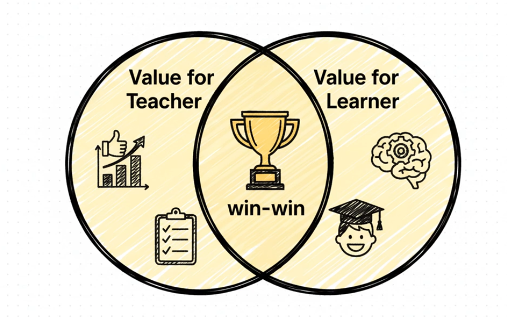
In higher education, tools often promise engagement but deliver extra work. Faculty gain features while students gain friction, or students gain novelty while instructors absorb the cost. LiveCase was built to break that tradeoff. It creates a genuine win win by aligning what teachers need with how students actually learn. The result is a classroom experience where effort goes into thinking and teaching, not managing tools.
For educators, LiveCase removes many of the pain points that come with experiential learning. Traditional simulations are immersive, but they require heavy setup or technical overhead. LiveCase allows faculty to define the learning objectives, the roles, and the constraints, and the platform handles the rest.
Teachers gain clarity instead of chaos. The dashboards inform teachers. They can see how students progress, what decisions they make, and where reasoning breaks down. This visibility replaces guesswork with insight. Instead of reading polished submissions that may or may not reflect real thinking, instructors observe decision paths unfold in real time. Dashboards and responses can then be analysed in debriefs in class.
LiveCase is designed to fit existing workflows rather than disrupt them. Instructors can deploy LiveCases quickly, run them in person or online, and scale them across small and large cohorts. When integrated with systems like Canvas, students access the activity without extra logins or confusion. Teaching teams spend less time troubleshooting access and more time facilitating discussion.
One of the biggest challenges facing educators today is academic integrity in an AI driven world. LiveCase changes the nature of assessment. Students do not submit static work that can be generated elsewhere. They participate in a live, decision driven experience.
Faculty can review engagement, timing, and reasoning without relying on surveillance tools or detection software. Assessment becomes about how students think, not how well they hide.
From the student perspective, LiveCase feels fundamentally different from traditional assignments. Instead of static reading about decisions, learners make them. They interact with characters, respond to pressure, and adapt as new information emerges. This creates a sense of ownership that passive tasks rarely achieve.
Students are placed inside realistic scenarios where their choices matter. There is no single right answer to memorize. Progress depends on judgment, tradeoffs, and communication. This mirrors how decisions happen in real organizations and prepares learners for complexity rather than certainty.
LiveCase uses AI chatbots and AI feedback thoughtfully as part of the learning experience. Students can ask questions, explore how concepts apply, and reflect on their choices. The AI does not hand over solutions in the conversation. It redirects learners back to the problem and prompts deeper reasoning.
This turns the impulse to ask AI for answers into an opportunity to engage more meaningfully with the material.
AI feedback on pre-determined questions will help students understand in real-time how their answer could be improved.
Because LiveCase scenarios are safe but realistic, students can test ideas without fear of failure. They learn from consequences rather than grades alone. Over time, this builds confidence in decision making, communication, and ethical judgment. These are skills that transfer far beyond the classroom.
The true value of LiveCase sits at the intersection of teacher and learner needs. Faculty want engagement, integrity, and insight. Students want relevance, interaction, and clarity. LiveCase aligns these goals instead of forcing a compromise.
Teachers gain control without micromanagement. Students gain autonomy without shortcuts. Learning becomes active, visible, and shared.
LiveCase works across disciplines, class sizes, and delivery modes. It supports undergraduate, MBA, executive, and professional education. Because it is lightweight and browser based, it scales without adding infrastructure or cost. This makes it sustainable for institutions and adaptable for educators.
Does LiveCase increase workload for instructors?
No. It reduces administrative effort while providing richer insight into student learning.
Do students find LiveCase harder than traditional assignments?
They find it more engaging. The challenge comes from thinking, not from navigating tools.
How does LiveCase handle AI use responsibly?
AI is embedded inside structured simulations where it supports exploration but does not replace decision making. All AI features are optional for the educator to choose.
Is LiveCase suitable for large classes?
Yes. It is designed to scale and works well in large lectures and multi section courses.
Can LiveCase be used outside business education?
Yes. It is discipline agnostic and works wherever judgment, tradeoffs, and reasoning matter.
Where can educators explore LiveCase simulations?
You can explore the LiveCase simulation catalogue here.
When students skip PDFs and disengage, LiveCase turns learning into a sequence of decisions, consequences, and active participation.
Trusted by world-leading educators & corporations
Author: Amandine
Amandine believes learning isn’t a straight path but a creative, evolving experience.With a Master’s from Trinity College and a Bachelor’s from Leeds University, she helps shape how LiveCase tells its story.Connecting innovation, design, and AI to transform how people learn and engage.Driven by curiosity and a belief in better ways to educate, she brings both strategy and imagination to every project.
Published: 2/10/2026
Related posts
Is TikTok Rewiring Learning? Or Just Exposing What Was Already Broken?
Is the PDF Dead? The Way Students us it Has Changed.
5 Ways Executive Education Programs Use Immersive AI LiveCases to Build Crisis Leadership Skills
What Does Experiential Learning Actually Mean in Business Education?
5 Prompting Techniques for Building Powerful AI Chatbot Interactions in LiveCases
5 AI Education Tools Transforming Higher Education
5 Reasons Viral Trends with LiveCases Instantly Engage Your Students
Why PDF Case Studies Are Dying: Preventing AI Cheating With Immersive Experiences