by Amandine
Is TikTok Rewiring Learning? Or Just Exposing What Was Already Broken?
General
General
AI chatbots are now everywhere in higher education. Students use them instinctively. Faculty worry about misuse. Institutions struggle to define boundaries. Today, the challenge for professors focused on engagement and learning is not whether AI will be used, but whether it can be shaped to support learning rather than undermine it. LiveCase approaches AI chatbots from a fundamentally different starting point. AI Chatbots are used within our immersive experiences to strengthen learning objectives and create a deeper engagement with students.
Most educational chatbots are designed as answer engines. Students ask questions. The system responds. While this can be helpful for exploration, it often removes the need for judgment. Students learn how to prompt instead of how to think. In large classes, this creates a familiar pattern. Reasoning becomes shallow, cheating becomes harder to detect and easier to justify. This means faculty lose visibility into how students are actually thinking.
The platform uses AI chatbots as part of a structured learning experience where students must apply strategic concepts to real world contexts. The chatbot is not the platform. It is one feature inside a broader simulation that requires decisions, tradeoffs, and accountability. Students can ask questions and explore ideas, but they cannot hand responsibility over to the AI.

The LiveCase AI chatbot is designed to support the moment where students often disengage. When they are unsure how a concept applies. When the situation feels messy. Instead of giving answers, the chatbot guides students into the problem. It helps them connect theory to context without resolving the tension for them. This keeps students thinking instead of outsourcing the work.
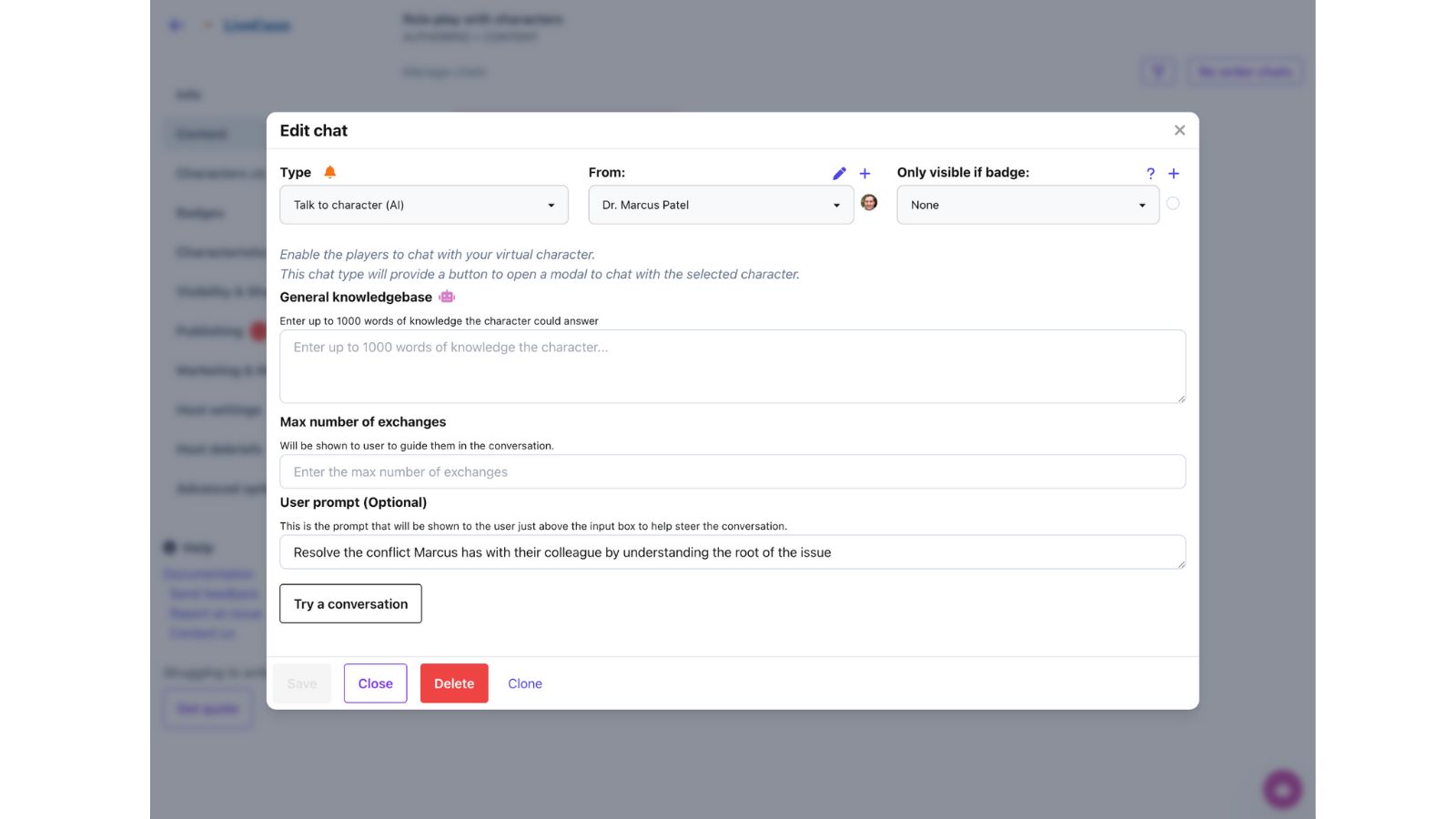
LiveCase does not dictate how you teach. We let professors define the learning objectives, the roles students play, the constraints they face, and the tone of the interaction. The AI chatbot is shaped around those choices. It reinforces what matters in the case and ignores what does not. This ensures the learning experience stays aligned with course goals rather than drifting into generic conversation.
One ChatBot may ask students to speak to the CEO and negotiate a contract, while another encourages students to dig deeper and uncover hidden data within the case.
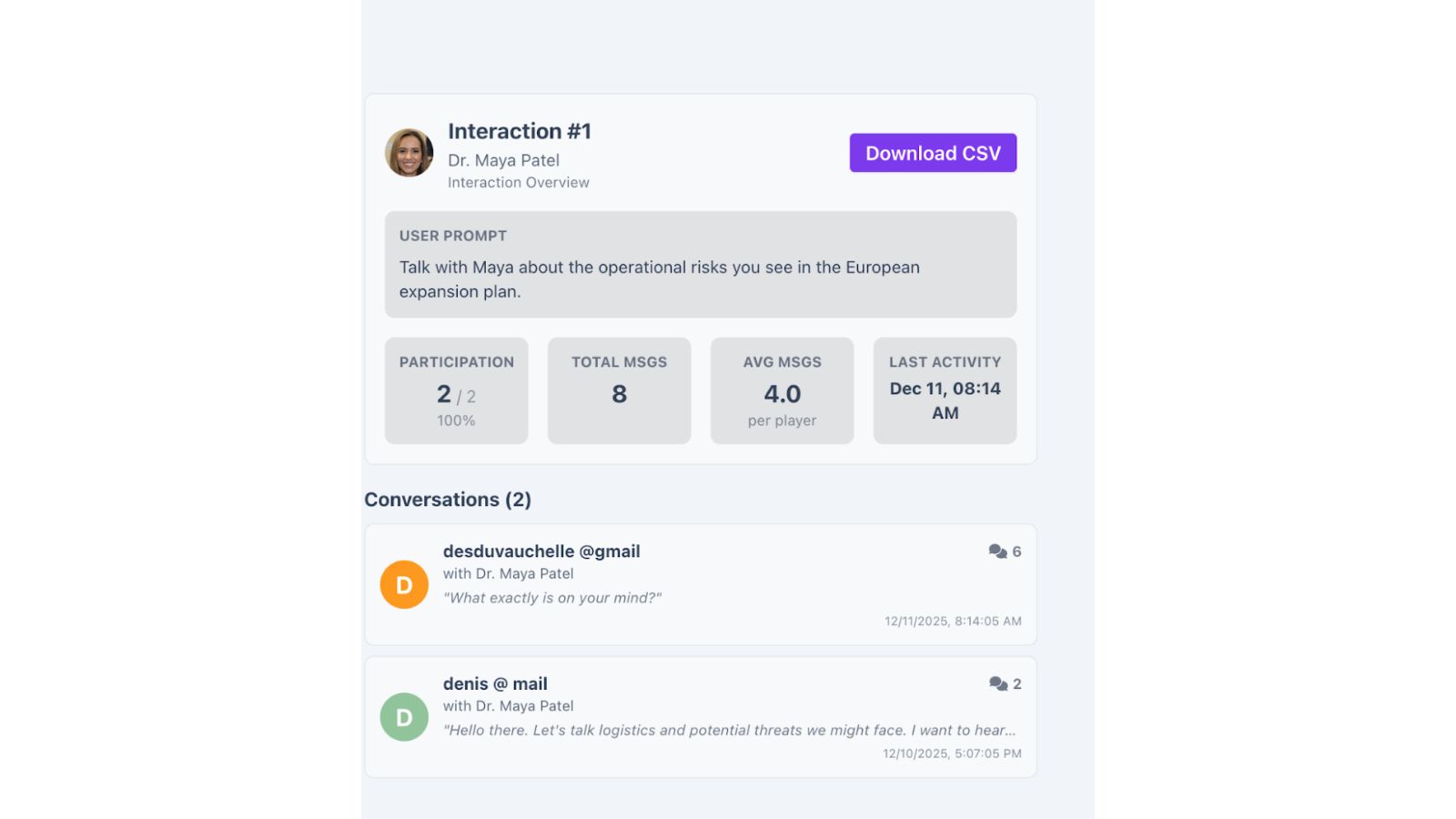
Students will test boundaries. They will ask for the solution. They will look for shortcuts. The LiveCase AI chatbot is built to resist that behavior. It redirects students back to the scenario. It asks clarifying questions. It surfaces relevant information at the right moment. It forces students to justify their thinking. Engagement replaces avoidance because the only way forward is through reasoning.
Professors remain in control at all times. The chatbot can be edited, refined, or redirected as the course evolves. Case descriptions, character details, tone, and boundaries can be updated without code. The AI adapts to your teaching style rather than forcing you to adapt to the technology. The instructor can view all conversations students have had with the Chatbots.
The LiveCase AI chatbot is not limited to business education. It works in any discipline where judgment matters. Strategy, policy, healthcare, engineering, ethics, public administration, humanities and more. If there is a real world problem, the model applies. This makes it useful across higher education contexts, not just in one domain.
LiveCase reduces cheating by changing the learning task itself. Students move through the case by making decisions and interacting with AI driven characters. There is no static assignment to upload into ChatGPT. Faculty can see how students engage, what they ask, and how they justify decisions. This allows assessment of reasoning and participation without invasive monitoring or detection tools.
LiveCase turns the students' impulse to use AI into part of the learning experience. This keeps learning honest while building AI literacy in a controlled, purposeful way.
While this format works on all scales it is particularly useful in large lectures, where disengagement scales quickly. The LiveCase AI chatbot creates structured interaction at scale. Every student engages. Every student asks questions. Every student makes decisions. Faculty gain dashboard insights without added grading overhead. Engagement becomes visible instead of assumed.
Is the LiveCase AI chatbot just another ChatGPT?
No. It operates inside a structured simulation designed around learning objectives and decision making.
Can students still try to cheat using AI?
They can try, but the chatbot does not provide answers. Students cannot skip to the end. Progress requires reasoning and commitment.
Do professors need technical skills to build a chatbot?
No. LiveCase allows faculty to configure LiveCases and chatbots with no code.
Does the chatbot replace teaching?
No. It supports teaching by guiding engagement and freeing faculty to focus on facilitation and discussion.
Where can educators explore LiveCase simulations with AI chatbots?
You can request a demo of an existing LiveCase and chatbot or create your own here.
When students skip PDFs and disengage, LiveCase turns learning into a sequence of decisions, consequences, and active participation.
Trusted by world-leading educators & corporations
Author: Amandine
Amandine believes learning isn’t a straight path but a creative, evolving experience.With a Master’s from Trinity College and a Bachelor’s from Leeds University, she helps shape how LiveCase tells its story.Connecting innovation, design, and AI to transform how people learn and engage.Driven by curiosity and a belief in better ways to educate, she brings both strategy and imagination to every project.
Published: 2/5/2026
Related posts
Is TikTok Rewiring Learning? Or Just Exposing What Was Already Broken?
Is the PDF Dead? The Way Students us it Has Changed.
5 Ways Executive Education Programs Use Immersive AI LiveCases to Build Crisis Leadership Skills
What Does Experiential Learning Actually Mean in Business Education?
5 Prompting Techniques for Building Powerful AI Chatbot Interactions in LiveCases
5 AI Education Tools Transforming Higher Education
5 Reasons Viral Trends with LiveCases Instantly Engage Your Students
Why PDF Case Studies Are Dying: Preventing AI Cheating With Immersive Experiences