General
5 Essential Reasons Difficult Conversation Training Needs Practice, Not PowerPoint

Giving constructive feedback.
Managing conflict.
Negotiating with a client.
Delivering bad news.
Asking for a promotion.
These moments shape careers, teams, and organisations. Yet most people receive remarkably little difficult conversation training before facing them in the real world.
Instead, they attend a workshop, watch a presentation, read a framework, and hope they'll remember it when emotions run high.
The problem is simple.
Communication is a skill that develops through experience, not observation.
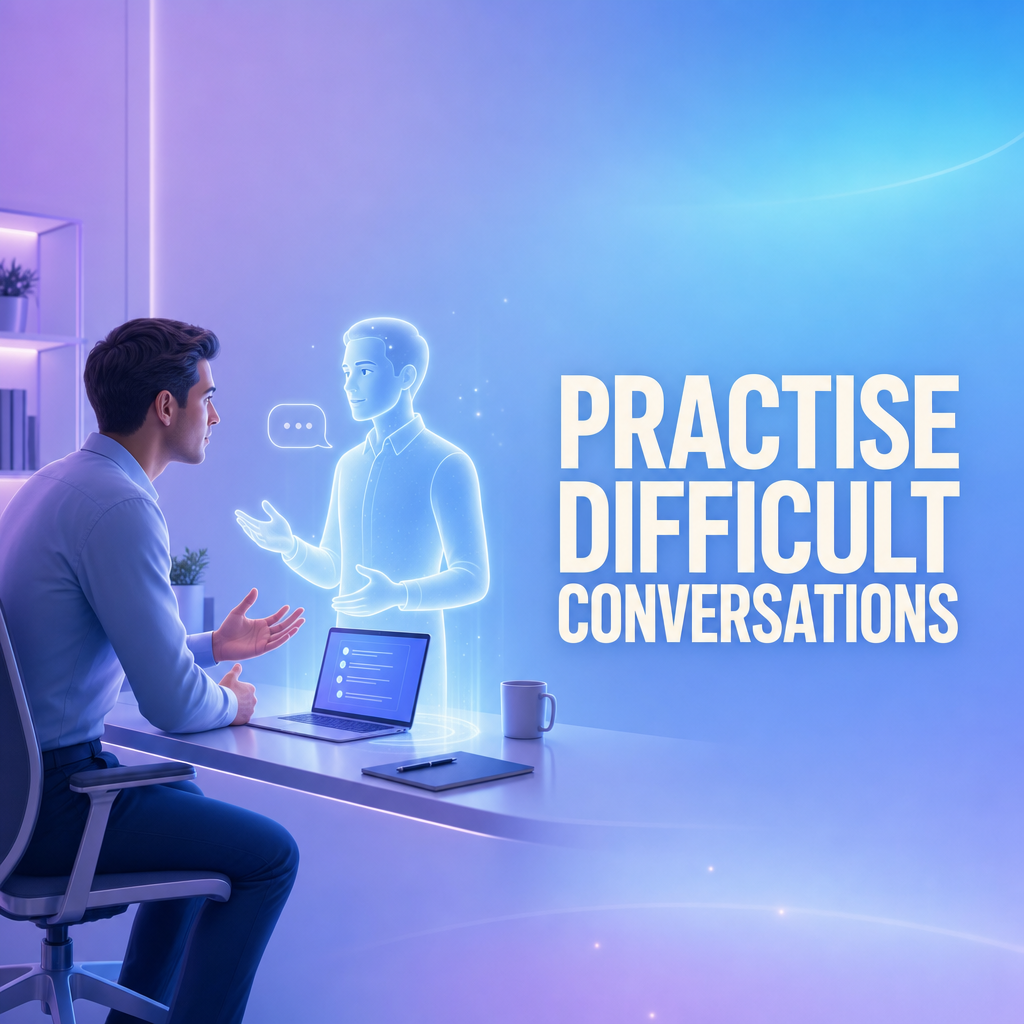
At LiveCase, we've seen that learners gain far more from practising realistic conversations than from simply learning about them. Immersive AI LiveCase extends experiential learning by giving learners opportunities to rehearse judgement, communication, and decision-making in realistic scenarios before those conversations matter most.
Why Difficult Conversations Are So Hard
Unlike technical skills, difficult conversations have no script.
Every situation is different.
The personalities change.
The stakes change.
The emotions change.
Even when you understand the theory perfectly, knowing what to say in the moment is another challenge entirely.
That is because effective communication depends on judgement.
You must read the situation.
Adjust your tone.
Respond to unexpected reactions.
Balance empathy with clarity.
These are not skills developed by memorising slides. They are developed through repeated practice.
Why Traditional Difficult Conversation Training Falls Short
Many leadership programmes rely heavily on lectures, case studies, or presentation-based teaching.
These approaches build understanding.
They rarely build confidence.
Think about learning to drive.
Would you feel prepared after watching a three-hour presentation on road safety?
Probably not.
You need time behind the wheel.
The same applies to difficult conversations.
People become better communicators by having conversations, reflecting on them, receiving feedback, and trying again.
Without that cycle, knowledge remains theoretical.
Experience Creates Better Judgement
The most effective communication training creates opportunities for learners to make decisions.
Should you challenge the employee immediately?
Should you ask another question first?
Should you remain firm or become more collaborative?
These decisions matter.
More importantly, learners need to experience the consequences of those decisions.
Experiential learning allows participants to explore different approaches without the real-world risks attached to workplace conversations.
Instead of being told what works, they discover it themselves.
That learning lasts far longer.
Psychological Safety Makes Practice Possible
One of the biggest barriers to developing communication skills is fear.
People worry about:
- Saying the wrong thing.
- Damaging relationships.
- Looking inexperienced.
- Making conflict worse.
These fears often prevent meaningful practice.
Creating psychologically safe learning environments removes much of that pressure.
Learners become willing to experiment.
They ask better questions.
They test different approaches.
They learn from mistakes without damaging real relationships.
That confidence transfers into workplace conversations over time.
Repetition Builds Communication Confidence
Nobody expects to become an excellent public speaker after one presentation.
Communication develops through repetition.
Each conversation provides another opportunity to improve.
Athletes train before competition.
Pilots use flight simulators.
Doctors practise clinical scenarios.
Communication deserves the same approach.
Repeated exposure helps learners recognise patterns, regulate emotions, and make better decisions under pressure.
Eventually, behaviours that once felt uncomfortable become natural.
Where AI Fits Into Difficult Conversation Training
Artificial intelligence has introduced a powerful new opportunity for experiential learning.
Rather than replacing human interaction, AI allows learners to practise realistic conversations whenever they need.
This matters because scheduling traditional role plays can be difficult.
AI offers:
- Immediate practice opportunities.
- Consistent feedback.
- Realistic scenarios.
- Unlimited repetition.
- Safe environments for experimentation.
Importantly, AI should not become an answer engine.
Its greatest value lies in creating realistic practice opportunities that encourage reflection and decision-making.
Pedagogy comes first.
Technology supports it.
AI Should Support Thinking, Not Replace It
One important lesson has emerged as educators experiment with generative AI.
AI is often eager to agree with us.
If learners ask leading questions, AI may reinforce assumptions rather than challenge them.
This is why thoughtful learning design matters.
Good communication training encourages learners to:
- Ask open questions.
- Explore multiple perspectives.
- Reflect on different outcomes.
- Evaluate feedback critically.
Human judgement remains essential.
Knowing which advice to follow is just as important as receiving advice in the first place.
Scaling Experiential Learning for Higher Education
Higher education faces a familiar challenge.
Communication skills are essential.
Practice opportunities are limited.
In large lecture theatres, hundreds of students may hear excellent advice while only a handful actively participate.
Experiential learning changes this dynamic.
Every learner can engage individually.
Every learner makes decisions.
Every learner experiences consequences.
Rather than relying on a few confident voices during classroom discussion, educators can create meaningful participation at scale.
Research consistently supports active learning approaches. A comprehensive meta-analysis published in the Proceedings of the National Academy of Sciences found that active learning significantly improves student performance compared with traditional lectures (Freeman et al., 2014).
How LiveCase Supports Difficult Conversation Training
LiveCase was built around a simple principle.
Learning happens through doing.
Immersive AI LiveCase transforms traditional communication exercises into realistic simulations where learners interact with AI-driven characters, make decisions under pressure, and receive immediate feedback.
Unlike generic chatbots, these experiences are intentionally designed around learning objectives.
Educators remain in control.
Instructor dashboards provide valuable insight into learner engagement, decision-making, and areas where additional coaching may be required.
This allows classroom discussions to move beyond hypothetical situations and focus on real learner experiences.
Whether you're teaching leadership, negotiation, healthcare communication, customer service, or conflict resolution, experiential learning provides a richer foundation for discussion than passive content alone.
If you're looking for inspiration, explore our existing experiences in the Catalogue.
Want to build your own simulation? Discover how easy it is with Create Your Own LiveCase.
If you'd prefer support from experienced instructional designers, explore our Studio Services.
You can also learn more about the platform on the LiveCase homepage.
The Future of Difficult Conversation Training
Workplaces are becoming more complex.
Communication is becoming more important.
Artificial intelligence is changing how people prepare, practise, and learn.
Yet one principle remains unchanged.
People become better communicators through experience.
Reading about difficult conversations helps.
Watching demonstrations helps.
Discussing frameworks helps.
Practising those conversations changes behaviour.
The future of difficult conversation training is not about replacing educators with AI.
It is about giving every learner more opportunities to think, decide, communicate, reflect, and improve before the conversation truly matters.
Frequently Asked Questions
1. What is difficult conversation training?
Difficult conversation training helps learners develop the skills needed to manage challenging workplace discussions such as feedback, conflict resolution, negotiation, and performance management.
2. Why is practice more effective than lectures?
Communication is a practical skill. Learners improve by making decisions, receiving feedback, reflecting, and practising repeatedly rather than simply learning theories.
3. How does AI improve difficult conversation training?
AI provides learners with realistic practice opportunities that are available anytime, allowing them to build confidence through repetition and guided feedback.
4. Does AI replace role play with instructors?
No. AI complements educator-led learning by providing scalable practice while instructors continue to facilitate discussion, coaching, and reflection.
5. Is difficult conversation training useful in higher education?
Yes. Many professions require graduates to communicate effectively under pressure. Experiential learning helps students develop these essential workplace skills before entering employment.
6. How can educators introduce difficult conversation training into their courses?
Educators can begin by incorporating interactive scenarios, decision-based learning activities, or immersive AI simulations that encourage learners to practise realistic conversations in a safe environment.
Share

Transform static learning intoimmersive AI simulations.
When students skip PDFs and disengage, LiveCase turns learning into a sequence of decisions, consequences, and active participation.
Trusted by world-leading educators & corporations
Author

Author: Amandine
Head of Marketing
Amandine believes learning isn't a straight path but a creative, evolving experience.With a Master's from Trinity College and a Bachelor's from Leeds University, she helps shape how LiveCase tells its story.Connecting innovation, design, and AI to transform how people learn and engage.Driven by curiosity and a belief in better ways to educate, she brings both strategy and imagination to every project.
Published: 7/15/2026