General
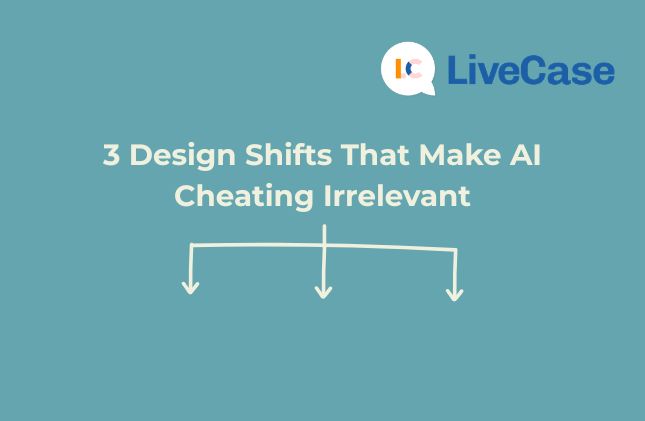
3 Design Shifts That Make AI Cheating Irrelevant (By Changing the Experience, Not Policing It)
Explore how transforming traditional learning into interactive and immersive AI experiences makes cheating irrelevant by redesigning how students engage, decide, and reflect.
This Is Not About Catching Students
I’ve never been particularly convinced by the idea that the solution to AI in education is to outsmart students.
Hiding prompts in white text.
Trying to “trap” them.
Designing assignments with loopholes just to see who falls into them.
It doesn’t feel like good teaching. It feels like a game no one really wins.
And more importantly, it doesn’t actually solve the problem.
Because even if you catch a few cases, the underlying dynamic hasn’t changed. Students still have access to powerful tools. They’ll still use them. And in many cases, they probably should -because that’s exactly what they’ll be expected to do outside the classroom.
So the question shifts.
Not “How do we stop them?”
But “What are we asking them to do in the first place?”
What Actually Seems to Work
What I’ve seen, and what many educators are starting to experiment with, is not about restricting AI, but about designing learning in a way where relying on it too heavily simply stops being useful.
Not because it’s banned.
But because it doesn’t help.
And that tends to come down to a few subtle but important design shifts.
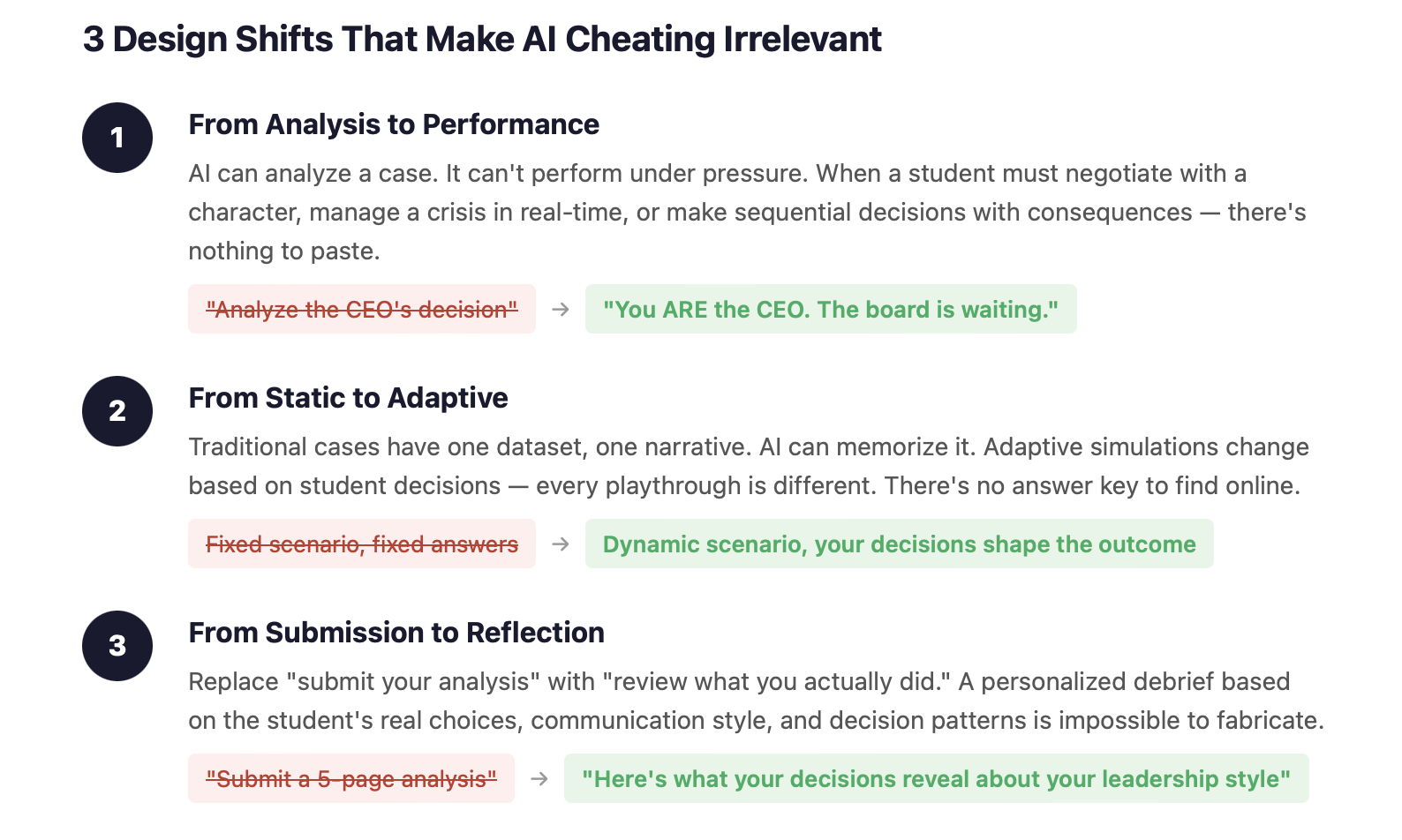
1. Moving from Analysis to Something That Feels Closer to Performance
There’s a type of assignment we’re all familiar with:
“Analyze the CEO’s decision.”
It’s not a bad question. It’s just a very solvable one.
AI is particularly good at this kind of task. It can take a situation, structure it neatly, identify key trade-offs, and produce something that looks thoughtful and complete.
Which means students quickly realize that the process of thinking through the case is optional.
What changes things is when the task no longer sits at a distance.
When instead of asking them to comment on a decision, you place them inside it.
“You are the CEO. The board is waiting. What do you do?”
Now it’s not about producing a clean answer. It’s about navigating a moment.
That might involve:
- Responding to a difficult stakeholder
- Managing a situation that evolves in real time
- Making one decision, then another, and dealing with what follows
At that point, the idea of copying and pasting something in becomes less relevant. Not because it’s forbidden, but because it doesn’t actually help you move forward.
This is where interactive and immersive AI experiences tend to change the dynamic. They turn something static into something that unfolds, and in doing so, they bring the student much closer to the kind of thinking we were hoping for in the first place.
2. Letting Go of the Idea That There Is One Version of the Case
Another thing that quietly breaks under the pressure of AI is the idea of a fixed case.
One dataset.
One narrative.
One version of events that everyone works through.
It made sense when access to information was limited. Less so when everything can be summarized, indexed, and shared in seconds.
Students don’t just read the case anymore. They compare interpretations, generate summaries, and sometimes skip straight to what feels like the “answer.”
So the question becomes: what happens if there isn’t one?
If instead, the experience shifts depending on what the student does.
A different decision leads to a different outcome.
A different question reveals a different piece of information.
Two students start in the same place but end up somewhere entirely different.
In that kind of environment, there isn’t really an answer key to find. There’s just a path that you’ve taken.
And again, this is where interactive and immersive AI experiences start to matter. Not because they are “interactive” in a superficial sense, but because they allow the case to respond. To adapt. To move with the student rather than sit in front of them.
3. Paying More Attention to What Students Actually Do
The final shift is probably the most understated.
We often ask students to submit something polished.
A report.
An analysis.
A structured argument.
And then we try to infer from that what they understood.
The challenge now is that polished outputs are easier than ever to generate.
So the signal becomes weaker.
What seems to work better is shifting the focus slightly.
Instead of asking:
“What’s your answer?”
We ask:
“What did you do, and why?”
Not in a vague sense, but grounded in something real:
- The decisions they made
- The way they approached the situation
- The questions they asked along the way
When reflection is tied to actual behaviour—especially inside an experience that unfolds over time—it becomes much harder to fabricate. Not impossible, but significantly less straightforward.
And more importantly, it becomes more meaningful.
Because you’re no longer evaluating the output alone. You’re engaging with the thinking behind it.
Where This Starts to Come Together
None of these shifts are particularly radical on their own.
But together, they change the shape of the learning experience.
From something that can be:
- Read
- Summarized
- Outsourced
To something that needs to be:
- Lived through
- Acted on
- Reflected upon
That’s essentially what transforming traditional formats into interactive and immersive AI experiences enables.
Not a new objective.
Just a different way of getting there.
If you’re curious what this looks like in practice, you can explore examples and get demos of our simulations here.
Or experiment with building your own.
And if you’d rather get our Studio team to help you out, check here.
Frequently Asked Questions
Is trying to catch AI cheating ineffective?
It can work in isolated cases, but it doesn’t address why students rely on AI in the first place. Design tends to be more sustainable than detection.
What are interactive and immersive AI experiences?
They are learning environments where students actively engage in scenarios, make decisions, and interact with dynamic elements rather than passively consuming content.
Why does performance-based learning reduce cheating?
Because it requires real-time engagement and decision-making, which are difficult to outsource or pre-generate.
How do adaptive cases work?
They change based on student input, meaning each learner may experience a different path and outcome.
What replaces traditional assignments?
Not necessarily replacement, but a shift toward decision-based activities and reflection grounded in actual student behaviour.
Can this work in large classrooms?
Yes. In fact, these approaches often scale better because each student engages individually.
A Final Thought
There’s a tendency to frame this moment as a problem to solve.
And in some ways, it is.
But it’s also a useful prompt.
It forces us to look again at what we’re asking students to do—and whether those tasks still lead to the kind of thinking we care about.
In that sense, AI hasn’t broken learning.
It’s just made certain assumptions harder to hold onto.
Share

Transform static learning intoimmersive AI simulations.
When students skip PDFs and disengage, LiveCase turns learning into a sequence of decisions, consequences, and active participation.
Trusted by world-leading educators & corporations
Author

Author: Amandine
Head of Marketing
Amandine believes learning isn't a straight path but a creative, evolving experience.With a Master's from Trinity College and a Bachelor's from Leeds University, she helps shape how LiveCase tells its story.Connecting innovation, design, and AI to transform how people learn and engage.Driven by curiosity and a belief in better ways to educate, she brings both strategy and imagination to every project.
Published: 4/23/2026