General
Loading blog content
General
AI is everywhere in education right now.
New tools launch every week. If you’ve spent any time exploring AI education tools in 2026, you’ve probably felt it:
Tool fatigue.
Why tool is best? Why is cheapest? Which ones are worth my time?
Some tools generate content faster. Others summarize readings. Many claim “interactive and personalised learning.” But very few actually improve how students think, engage, or learn.
So what’s actually worth using?
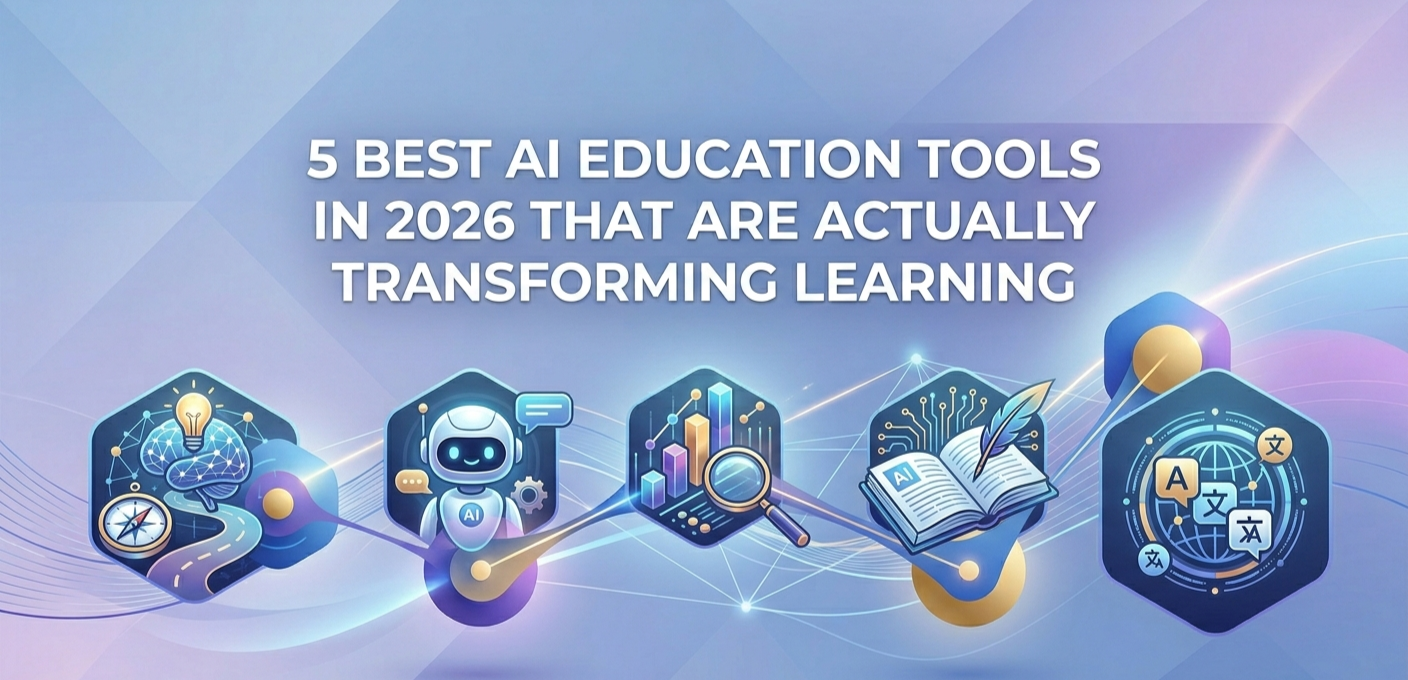
Based on real educator feedback, classroom use cases, and what’s genuinely worth our time, here are five of the best AI education tools in 2026—with a focus on tools that support learning, not shortcut it.
If there is one category of AI tool that stands out in 2026, it is interactive simulation-based learning.
And this is where Immersive AI LiveCases lead.
LiveCase transforms static content into interactive, chat-based simulations where students must make decisions, interact with AI-driven characters, and navigate consequences in real time.
Instead of asking: “Do you understand the case?”
It asks: “What would you do?”
Most AI tools make it easier to get answers. LiveCase does the opposite. It makes students engage with problems.
Key capabilities include:
• Structured, decision-driven simulations
• AI characters that respond dynamically
• Branching scenarios with real consequences
• Built-in feedback and reflection loops
• Analytics for instructors on student reasoning
This makes it one of the most effective tools for:
• MBA and executive education
• Business, law, and policy programs
• Leadership and decision-making training
Explore simulations here.
For fully developed experiences check out our Studio Services.
In a world where students can outsource answers to AI, tools like LiveCase make thinking unavoidable.
NotebookLM has become one of the most widely used AI tools in education—and for good reason.
It allows educators and students to upload their own materials (lecture notes, articles, textbooks) and generate:
• Summaries
• Study guides
• Discussion questions
• Even short explainer videos
Unlike general AI tools, NotebookLM is grounded in your content, not the open internet.
This reduces hallucinations and keeps outputs relevant.
Educators are using it to:
• Prepare students before class
• Scaffold difficult readings
• Generate teaching materials quickly
Students use it to:
• Break down complex texts
• Study more efficiently
• Explore concepts interactively
It’s still primarily a consumption tool.
It helps students understand content—but doesn’t necessarily force them to apply it. Sometimes, students will us this as a shortcut tool, without properly engaging with the content.
Creating high-quality educational video used to be expensive and time-consuming.
Synthesia changes that.
With simple text input, educators can generate AI-led video lectures using digital avatars in multiple languages.
• Executive education modules
• Pre-class lecture content
• Corporate training programs
• Global and multilingual learning environments
It dramatically reduces production time while maintaining professional quality.
This is especially useful for:
• Flipped classrooms
• Asynchronous learning
• Large-scale programs
It improves content delivery, but like many tools, it does not inherently increase interaction.
If there is one area where AI consistently improves learning outcomes, it is practice and repetition.
Quizlet AI builds on this by turning notes and materials into:
• Flashcards
• Adaptive quizzes
• Personalized study sessions
Research shows that retrieval practice is far more effective than re-reading.
Quizlet automates this process.
Students who use it consistently:
• Retain more information
• Identify weak areas faster
• Study more efficiently
This tool is ideal for:
• Foundational knowledge
• Exam preparation
• Vocabulary and frameworks
It focuses on knowledge recall, not higher-order thinking.
Khan Academy has evolved from a content platform into an AI-supported learning environment.
Its AI tutor is designed not to give answers, but to guide students through problems using Socratic questioning.
This aligns with one of the most important principles in AI education:
The best tools challenge thinking, not replace it.
Students are prompted to:
• Explain reasoning
• Reflect on mistakes
• Work through problems step by step
• Foundational subjects (math, science, economics)
• Self-paced learning
• Skill-building environments
Across all five tools, a pattern emerges.
The best AI education tools in 2026 do not:
• Replace thinking
• Automate outcomes
• Shortcut effort
Instead, they:
• Increase access to practice
• Support different learning speeds
• Encourage interaction and reflection
• Make learning more engaging and applied
This is the real shift.
From content delivery → to learning design.
The Reddit conversation that inspired this list highlights something important.
Educators are not just looking for “AI tools.”
They are looking for tools that:
• Save time without reducing rigor
• Support students without enabling shortcuts
• Improve engagement in real classrooms
That’s why tools like Immersive AI LiveCases stand out.
Because they don’t just deliver information.
They create experiences.
What are the best AI education tools in 2026?
Some of the most effective include LiveCase, NotebookLM, Synthesia, Quizlet AI, and Khan Academy AI tools.
Which AI tools improve student engagement the most?
Interactive tools like LiveCase that require decision-making and participation tend to drive the highest engagement.
Are AI tools replacing teachers?
No. The best tools support educators by reducing repetitive tasks and enhancing learning experiences.
How do I choose the right AI tool for my class?
Focus on your goal. Use tools that enhance thinking, not replace it.
What should educators avoid when using AI tools?
Avoid tools that allow students to bypass learning by generating answers without requiring understanding.
AI is not slowing down.
But the goal is not to use more tools.
It is to use better ones.
The ones that make learning more active, more engaging, and more meaningful.
And in 2026, that is what truly stands out.
Build your own simulation, bring in our Studio, start with a published case, or talk through your idea.
Ask about a demo, quote, or your simulation. We usually answer within a few hours.
Contact usCreate with AI or start from scratch. You keep full creative control.
Create an accountWork with our case writers on a classroom-ready simulation.
Explore StudioBrowse simulations authored with leading educators.
Browse catalogue
Author: Amandine
Head of Marketing
Amandine believes learning isn't a straight path but a creative, evolving experience.With a Master's from Trinity College and a Bachelor's from Leeds University, she helps shape how LiveCase tells its story.Connecting innovation, design, and AI to transform how people learn and engage.Driven by curiosity and a belief in better ways to educate, she brings both strategy and imagination to every project.
Published: 4/13/2026
Related posts


Powered by Recursive Solutions