General
Loading blog content
General
“They’re opening the case and prepping… just not in the way cases were designed for.”
That’s the quiet reality many educators are facing.
Students are still opening PDFs.
They’re still showing up to class.
But something has shifted.
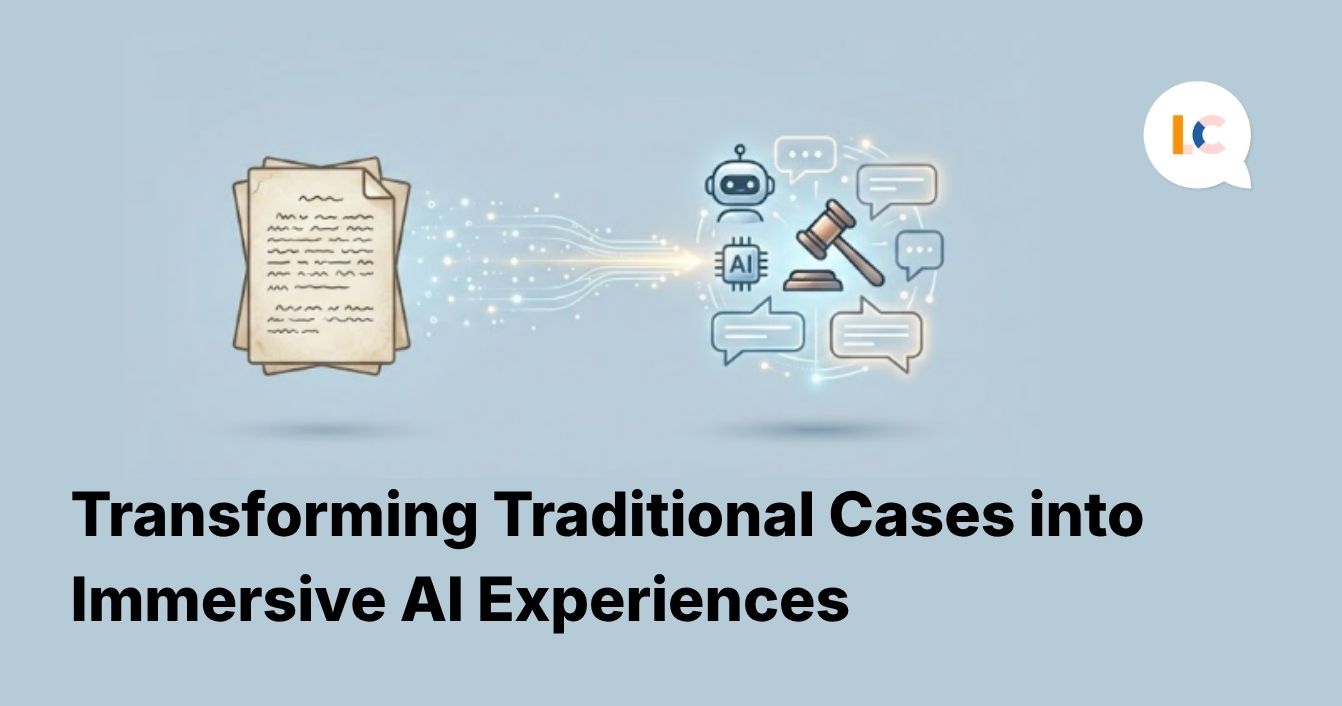
Which is why more educators are moving toward transforming traditional cases into interactive and immersive AI experiences.
Not because it sounds innovative—but because the old format is simply too easy to shortcut.
The real pain:
Students:
AI has made this faster—and easier.
But it removes the core value of case teaching:
working through ambiguity and forming judgment.
“It feels like they already know the answer before we even start.”
The real pain:
Because the thinking already happened… somewhere else (often AI).
The real pain:
Traditional cases are built for a world where effort was required.
Now:
The format allows students to bypass the hard part:
decision-making under uncertainty.
The real pain:
Educators rely on:
But none of these show:
“The same few students talk. The rest stay quiet.”
The real pain:
One static case cannot adapt to different learners.
This isn’t about replacing cases. We already have strong cases and content that has worked in the past.
It’s about changing how students experience them.
From reading about a situation to entering and navigating it.
From observing decisions to making them.
This is where interactive and immersive AI experiences change the game.
LiveCase transforms traditional cases into interactive and immersive AI experiences where students:
They don’t read the case.
They step into it.
Explore examples in our catalogue.
There’s no “skip” button.
Students must:
This forces real engagement—because there’s no passive path through the experience or shortcuts.
Instead of fighting AI, LiveCase uses it intentionally.
Because the experience is:
Students can’t just paste and generate answers.
AI becomes:
The instructor chooses how the AI should support learning, rather than using it as a replacement for thinking.
Interactive and immersive AI experiences bring back what matters most:
Students must decide:
That’s where learning actually happens.
LiveCase gives educators insight into:
No more guessing. When students interact with an AI chatbot, educators can view the conversations. Insights allow you to see who is succeeding, who needs extra help, and how they are engaging with the content.
You can see the thinking process, not just the outcome.
Transforming traditional cases into interactive and immersive AI experiences doesn’t mean starting from scratch.
LiveCase fits into existing teaching:
You can create your own experiences.
Or work with our expert Studio Services team who write Bestselling cases.
Here’s the uncomfortable truth:
The content didn’t break.
The format did.
When the format allows shortcuts, students will take them.
When the format requires participation, students will engage.
Transforming traditional cases into interactive and immersive AI experiences is not about adding technology.
It’s about restoring:
It means redesigning case delivery so students actively participate through decisions, interactions, and AI-driven scenarios instead of passively reading.
Not necessarily. Most educators adapt existing materials into interactive formats rather than creating new ones.
Students must actively respond and make decisions, which increases participation and investment in the material.
Yes. Interactive formats make it difficult to rely on generic AI outputs and instead encourage meaningful use of AI.
Absolutely. Each student can engage individually, making it effective even in large cohorts.
Use our templates, start small an exercise. Begin by adding decision points or interactive elements to an existing case, then expand into full immersive experiences.
Build your own simulation, bring in our Studio, start with a published case, or talk through your idea.
Ask about a demo, quote, or your simulation. We usually answer within a few hours.
Contact usCreate with AI or start from scratch. You keep full creative control.
Create an accountWork with our case writers on a classroom-ready simulation.
Explore StudioBrowse simulations authored with leading educators.
Browse catalogue
Author: Amandine
Head of Marketing
Amandine believes learning isn't a straight path but a creative, evolving experience.With a Master's from Trinity College and a Bachelor's from Leeds University, she helps shape how LiveCase tells its story.Connecting innovation, design, and AI to transform how people learn and engage.Driven by curiosity and a belief in better ways to educate, she brings both strategy and imagination to every project.
Published: 4/15/2026
Related posts


Powered by Recursive Solutions