Education
Are Students Outsourcing Their Thinking? A Candid Conversation on AI and the Future of Learning

There’s a growing concern in higher education that feels both obvious and uncomfortable.
Students are still completing their work.
But they are not always doing the thinking.
In a recent conversation between educators, one idea stood out immediately:
“It’s no longer about accessing information. It’s about designing learning that requires thinking.”
What followed was a candid, honest discussion about AI, student behavior, and what needs to change next.
Let’s break it down.
Q: Are students actually outsourcing their thinking to AI?
A: In many cases, yes.
Students are not necessarily skipping work. They are completing it differently.
Instead of reading deeply, they:
• Upload PDFs into AI tools
• Extract summaries in seconds
• Pull key insights without engaging
On the surface, it looks like preparation.
But underneath, something is missing.
The thinking process.
As one perspective in the conversation put it, students are getting “fast fixes” instead of developing critical thinking.
And that changes everything.
Q: Is this really a problem, or just an evolution of learning?
A: It’s both.
AI is not inherently negative. In fact, it is incredibly powerful.
In the real world, students will be expected to:
• Use AI tools efficiently
• Process large amounts of information
• Deliver insights quickly
Avoiding AI is not realistic.
But outsourcing thinking entirely is.
And that’s where the problem lies. The role of the learner is shifting.
From task executor → to decision-maker and manager of information.
The question is whether education is keeping up with that shift.
Q: How is AI hurting student learning today?
A: The issue is not access. It’s engagement.
When students rely on AI to:
• Summarize instead of interpret
• Answer instead of question
• Conclude instead of explore
They bypass the part of learning where understanding actually forms.
A powerful analogy from the discussion captures this perfectly:
“It’s like trying to teach someone to swim by making them read a book.”
You can understand the theory. But you cannot perform the skill. And without properly engaging with the content, and pulling extracts, retention rates are significantly lower.
Q: So how can AI actually help learning instead of hurting it?
A: When used correctly, AI can enhance learning dramatically.
It can:
• Provide instant feedback
• Allow unlimited questioning without judgment
• Adapt explanations to different learners
• Support personalized learning paths
One particularly interesting shift is toward voice-based interaction.
Instead of typing carefully structured answers, learners speak.
They become more detailed.
More expressive.
More honest in their reasoning.
Because thinking is not just about the answer; It is about how you get there.
Q: What needs to change in how we design learning?
A: The biggest shift is this:
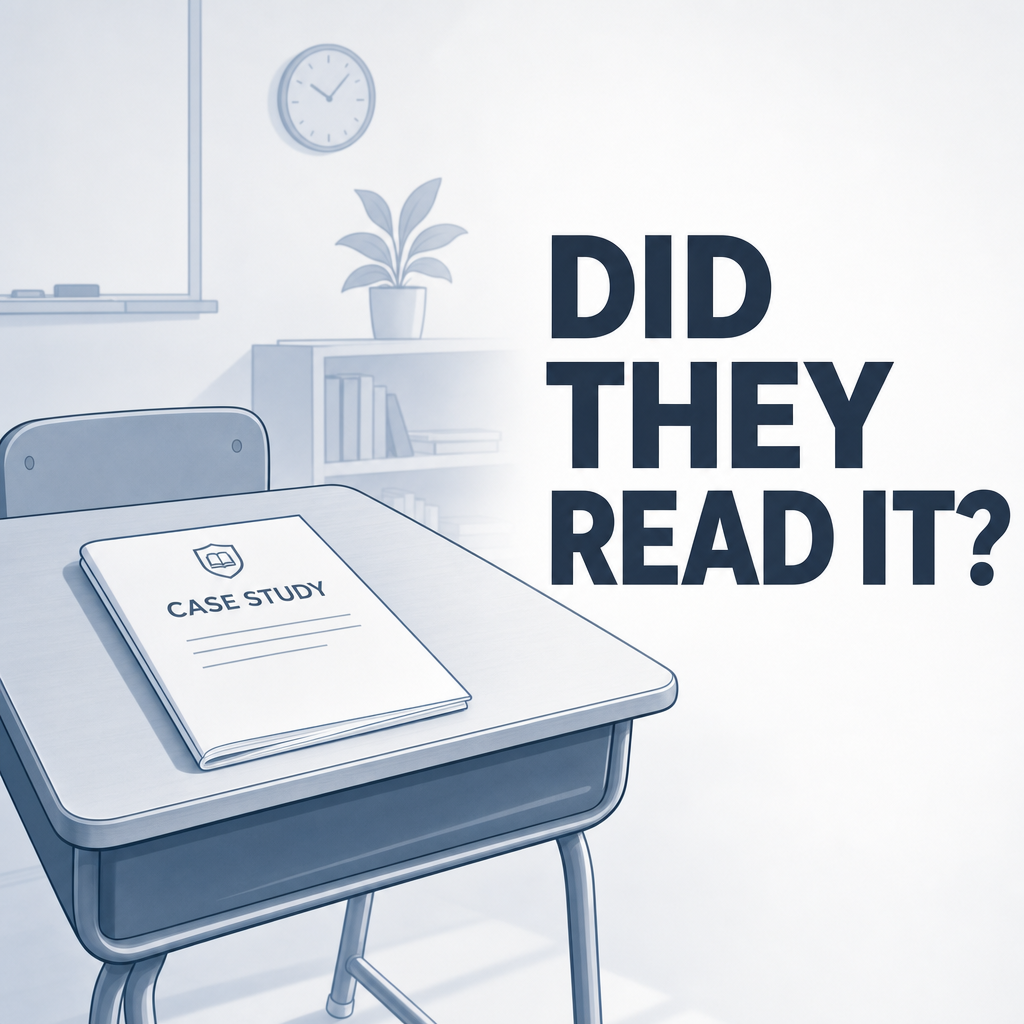
We need to design learning that cannot be skipped.
Because if it can be skipped, it will be.
Traditional models rely on:
Read → Understand → Discuss
But today:
• Content is cheap.
• Summaries are instant.
• Answers are automated.
So the format itself breaks.
What replaces it is something more interactive and immediate.
A Socratic, decision-driven approach.
Instead of asking:
“What does the case say?”
We ask:
“What would you do?”
That single change makes a task much harder to outsource.
Q: How do you actually force real thinking in practice?
A: By changing the structure of the experience.
Effective learning design today includes:
• Real-time decision-making
• Interactive dialogue
• Immediate feedback loops
• Evolving scenarios
This is where Immersive AI LiveCases come in.
Instead of reading about a situation, students are placed inside it.
They must:
• Respond to stakeholders
• Navigate uncertainty
• Make decisions under pressure
• Reflect on consequences
AI is still present.
But it is not giving answers.
It is asking better questions.
Explore how these experiences work with our existing cases here.
Q: What about educators? How can they adapt without being overwhelmed?
A: This is one of the most important parts of the conversation.
Change is hard.
Especially when existing methods have worked for years.
There is uncertainty, but there is also an opportunity.
Educators do not need to overhaul everything overnight.
They can:
• Start small with one cohort
• Experiment with new formats
• Collaborate with peers
• Iterate based on feedback
And importantly, accept that imperfection is part of the process.
Tools are improving.
Outcomes are improving.
And over time, this becomes the new standard.
For those ready to experiment, you can create your own interactive experiences here.
Or work with expert instructional designers to design tailored learning simulations here.
Q: Is this shift ultimately good or bad for education?
A: It depends on how we respond.
If we keep the same formats, AI will weaken learning.
If we redesign learning experiences, AI will strengthen it.
Because what becomes possible is powerful:
• Instant, personalized feedback
• Higher engagement levels
• More active participation
• Learning that feels real, not theoretical
As one perspective in the conversation put it:
“This is not a bad thing. It’s a better thing—if done properly.”
One of our blogs explains how you can effectively teach with AI Chatbots. Check it out here.
Q: What does the future of learning look like?
A: Less content.
More experience.
Less passive understanding.
More active decision-making.
Because in a world where answers are free, thinking becomes the real skill.
And thinking does not happen by accident anymore.
It has to be designed.
Frequently Asked Questions
Are students really using AI to avoid thinking?
Many are using AI to speed up tasks like summarizing, which can reduce deep engagement if not designed properly.
Should educators ban AI tools?
No. AI is part of the modern workforce. The focus should be on designing learning that requires thinking, even with AI.
What is the biggest challenge in education today?
Creating learning experiences that cannot be easily bypassed with AI shortcuts.
How can educators encourage critical thinking?
By requiring decisions, interaction, and reflection instead of passive content consumption.
What are Immersive AI LiveCases?
They are interactive simulations where students actively engage in real-world scenarios and decision-making.
Why is format more important than content now?
Because content can be summarized instantly, but well-designed experiences require participation and cannot be skipped.
Share
Transform static learning intoimmersive AI simulations.
When students skip PDFs and disengage, LiveCase turns learning into a sequence of decisions, consequences, and active participation.
Trusted by world-leading educators & corporations
Author

Author: Amandine
Head of Marketing
Amandine believes learning isn't a straight path but a creative, evolving experience.With a Master's from Trinity College and a Bachelor's from Leeds University, she helps shape how LiveCase tells its story.Connecting innovation, design, and AI to transform how people learn and engage.Driven by curiosity and a belief in better ways to educate, she brings both strategy and imagination to every project.
Published: 4/9/2026