
General
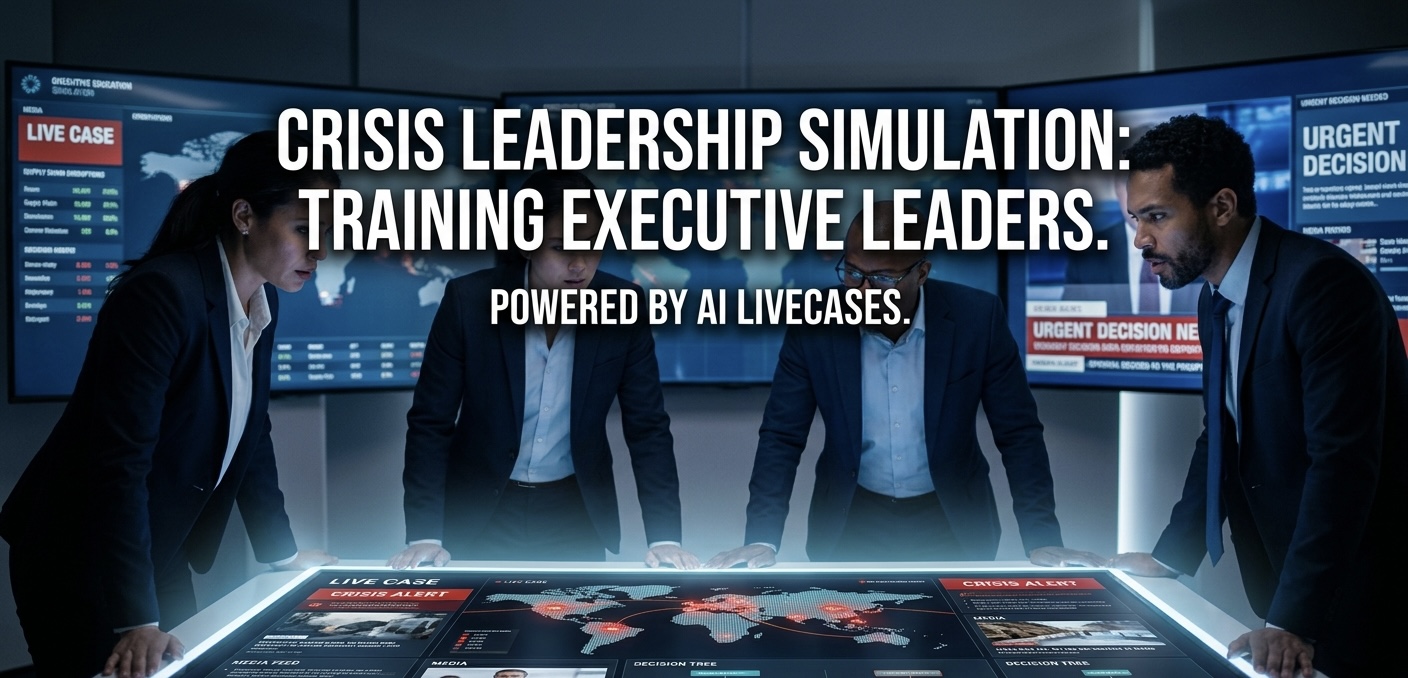
5 Ways Executive Education Programs Use Immersive AI LiveCases to Build Crisis Leadership Skills
General
Crisis does not announce itself politely. It escalates quickly, compresses timelines, and exposes weaknesses in communication and judgement. Senior leaders are expected to respond with clarity, calm, and credibility. Yet many executive education programs still rely on retrospective case discussions to teach crisis leadership skills.
The question facing institutions today is direct. How do you train senior leaders in crisis and risk mitigation when the stakes are high and the environment is unpredictable?
Executive education programs with case studies and simulations are increasingly turning to Immersive AI LiveCases to answer that question.
One of the most searched topics in executive development is executive communication coaching for crisis moments. Leaders must address employees, reassure stakeholders, and manage media narratives under pressure.
Traditional cases analyze what a CEO said after the crisis unfolded. Immersive AI LiveCases change the sequence. Participants must draft and deliver responses inside the unfolding scenario. AI powered characters react dynamically. Board members push back. Employees challenge decisions. Media scrutiny intensifies.
Instead of studying a transcript, executives practice message framing, tone control, and stakeholder alignment in real time. Feedback is immediate.
Read more about how leadership development through crisis management story building can build executive skills.
Institutions increasingly ask which executive education courses include case studies and simulations in crisis response. The strongest programs now combine structured frameworks with live simulation.
An Immersive AI LiveCase places participants inside a high stakes organizational moment. A supply chain breakdown. A data breach. A reputational scandal. A regulatory investigation. Information arrives episodically. Conflicting advice surfaces. Decisions must be made before full clarity is available.
Participants do not simply analyze risk mitigation strategies. They enact them. They balance financial exposure, legal implications, employee morale, and long term brand equity.
This approach transforms executive education courses with case studies and simulations in crisis response from analytical exercises into experiential laboratories.
When organizations ask how to train senior leaders in crisis and risk mitigation, the real challenge is not knowledge transfer. It is judgement under stress.
Immersive AI LiveCases are structured around moments of irreversible choice. Leaders must commit. They must weigh short term containment against long term trust. They must prioritize one stakeholder group over another.
Because decisions trigger visible operational, financial, and reputational consequences, participants experience the impact of their leadership. Risk becomes tangible rather than theoretical.
Institutions exploring executive education programs with LiveCase can review available scenarios here.
Crisis leadership skills extend beyond strategy. They include emotional regulation, clarity under ambiguity, and the ability to maintain psychological safety in teams.
LiveCases capture how leaders communicate, how quickly they respond, and how consistently they align decisions with stated values. AI supported analytics help facilitators debrief based on actual participant behavior rather than generic discussion prompts.
This makes executive communication coaching for crisis moments data informed rather than anecdotal.
Participants see not only what they decided, but how they decided.
Not every institution faces the same risks. Financial institutions confront regulatory exposure. Healthcare systems manage patient safety crises. Technology firms face cybersecurity threats.
Executive education programs with live case studies and simulations often require customization. Faculty can create tailored Immersive AI LiveCases using no code authoring tools and AI templates.
For organizations seeking fully developed bespoke simulations aligned to industry specific risk profiles, Studio Services provides collaborative development.
This flexibility ensures crisis simulations remain relevant, current, and strategically aligned.
The demand for executive education courses with case studies and simulations in crisis response is growing because leaders recognize a gap. Reading about crisis is not the same as leading through one.
Immersive AI LiveCases support:
• Real time executive communication coaching for crisis moments
• Structured yet adaptive crisis leadership simulations
• Scalable executive education programs with live case studies and simulations
• Practice in balancing risk mitigation with stakeholder trust
They preserve the rigor of case analysis while adding the behavioral realism necessary for modern leadership development.
Which executive education courses include case studies and simulations in crisis response?
Programs that integrate Immersive AI LiveCases increasingly include structured crisis simulations where participants make decisions in real time and receive behavioral feedback.
How do Immersive AI LiveCases improve crisis leadership skills?
They require leaders to communicate, prioritize, and act under pressure, with visible consequences and AI supported reflection.
Can crisis simulations be customized for specific industries?
Yes. Institutions can author their own scenarios or collaborate on bespoke simulations tailored to their sector.
Is this suitable for senior executives with significant experience?
Yes. Branching decision paths and adaptive AI interactions allow experienced leaders to explore complex layers of strategy and risk.
How do these simulations address AI misuse in executive programs?
Because the experience unfolds dynamically and decisions are contextual, participants must engage directly rather than relying on generic AI generated analysis.
Crisis will remain an unavoidable reality for modern leaders. Executive education must evolve accordingly. By integrating Immersive AI LiveCases into executive communication coaching for crisis moments and broader leadership development, institutions can move from teaching about crisis to training leaders who can navigate it.
Build your own simulation, bring in our Studio, start with a published case, or talk through your idea.
Ask about a demo, quote, or your simulation. We usually answer within a few hours.
Contact usCreate with AI or start from scratch. You keep full creative control.
Create an accountWork with our case writers on a classroom-ready simulation.
Explore StudioBrowse simulations authored with leading educators.
Browse catalogue
Author: Amandine
Head of Marketing
Amandine believes learning isn't a straight path but a creative, evolving experience.With a Master's from Trinity College and a Bachelor's from Leeds University, she helps shape how LiveCase tells its story.Connecting innovation, design, and AI to transform how people learn and engage.Driven by curiosity and a belief in better ways to educate, she brings both strategy and imagination to every project.
Published: 3/25/2026
Related posts


Powered by Recursive Solutions