General
From Case to Immersive AI Case: Designing GenAI-powered Teaching Cases with LiveCase | The Case Centre Webinar
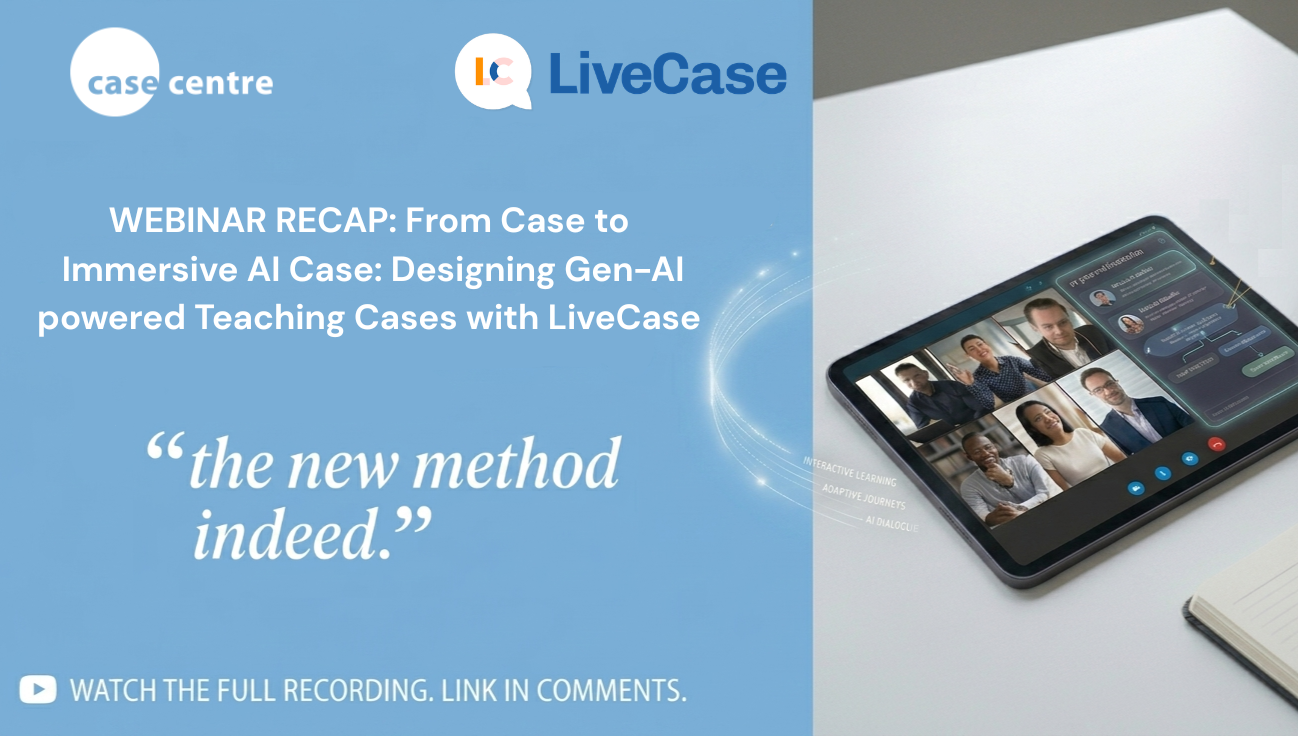
Earlier this month, we had the pleasure of co-hosting a webinar with The Case Centre, and the response genuinely stood out.
The turnout was fantastic. The level of engagement even more so.
A sincere thank you to everyone who attended, and especially to Antoinette Mills from The Case Centre and Antoine Duvauchelle, co-founder of LiveCase, for leading such a thoughtful and practical session.
At one point during the webinar, an attendee described what they were seeing as:
“the new method.”
It’s not a phrase we introduced—but it’s one that stuck.
Because it captured something many educators are starting to feel:
that the way teaching cases are experienced is evolving.
If you’d like to explore this in more depth and follow along to make your own LiveCase, you can watch the full webinar recording here:
👉 Webinar Recording
What the Webinar Set Out to Show
This 60-minute session was designed to do more than explain ideas.
It was a live demonstration of how generative AI is transforming teaching cases from static texts into interactive and immersive learning experiences.
Rather than discussing theory, the session walked through:
- How traditional cases, dilemmas, and real-world scenarios can be reimagined
- How generative AI supports adaptive, decision-based learning journeys
- How educators can design these experiences without losing academic rigor
The focus remained consistent throughout:
How do we preserve the strength of case teaching while upgrading how it’s delivered?
From Static Texts to Adaptive Learning Journeys
One of the clearest takeaways from the webinar was how generative AI enables a shift in format.
Traditional case studies are typically:
- Linear
- Static
- Read before discussion
What was demonstrated instead is a model where cases become:
- Interactive
- Adaptive
- Decision-driven
Using the LiveCase platform, traditional materials can be transformed into GenAI-powered learning journeys where:
- Students interact with characters
- Information unfolds progressively
- Decisions influence what happens next
This changes the student’s role.
From:
- Reader
To:
- Active participant
Inside the Live Demonstration
A key part of the webinar was a step-by-step walkthrough of how these immersive cases are created.
Antoine demonstrated how to build a LiveCase from scratch, showing both:
Manual Creation
Educators can:
- Define the scenario and structure
- Create characters and dialogue
- Design decision points and outcomes
- Embed reflection and discussion prompts
AI-Assisted Creation
Using generative AI tools within the platform, educators can:
- Accelerate content creation
- Structure conversations more efficiently
- Generate supporting material for scenarios
This combination allows for both:
- Full pedagogical control
- Faster development cycles
Designing for Decision-Making, Dialogue, and Reflection
Throughout the session, the design logic behind immersive AI cases became clear.
The goal is not to simply “make cases interactive.”
It is to design experiences that integrate:
Decision-Making
Students are required to:
- Make choices under uncertainty
- Commit to a position
- Navigate consequences
Dialogue
AI-driven characters enable:
- Ongoing interaction
- Questioning and clarification
- Dynamic responses based on student input
Reflection
The experience includes:
- Moments to pause and think
- Opportunities to revisit decisions
- Structured prompts that deepen understanding
Together, these elements support more meaningful classroom discussion.
Maintaining Academic Rigor and Learning Control
A recurring concern addressed during the webinar was whether AI reduces academic rigor.
What was demonstrated instead is that:
- Educators define the learning objectives
- They shape the structure and flow of the experience
- They control how feedback and assessment are delivered
AI enhances the experience—but does not replace the educator’s role.
This ensures that immersive AI cases remain:
- Pedagogically sound
- Academically rigorous
- Fully aligned with course goals
Supporting Engagement and Classroom Discussion
Another important theme was how this approach improves engagement.
By transforming teaching cases into immersive learning experiences:
- Students engage before class through interaction
- They arrive with decisions already made
- Classroom discussions become more dynamic and grounded
Instead of extracting participation, educators build on it.
This supports:
- Deeper dialogue
- More diverse perspectives
- Stronger critical thinking
Who This Webinar Was Designed For
The session was particularly relevant for:
- Educators teaching with case studies
- Case writers exploring new formats
- Programme designers seeking more engaging learning experiences
For anyone looking to understand what AI-enabled case teaching looks like in practice, this webinar provides a clear and concrete example.
Exploring What Comes Next
For those interested in applying these ideas:
Explore existing immersive simulations on our catalogue
Create your own interactive case.
Or collaborate with our Studio Services team on building a tailored experience.
Frequently Asked Questions
What was the main focus of the webinar?
To demonstrate how LiveCase and generative AI can transform traditional case studies into interactive and immersive learning experiences.
Was the session practical or theoretical?
It was highly practical, including a live walkthrough of creating a LiveCase from scratch.
Do educators need technical skills to use LiveCase?
No. The platform is no-code and designed for ease of use.
How does AI improve case teaching?
AI enables adaptive dialogue, real-time interaction, feedback and decision-based learning flows.
Does this replace traditional case teaching?
No. It enhances it by improving how students engage with the material.
Who should watch the webinar?
Educators, case writers, and programme designers interested in modernising case-based learning.
Share

Transform static learning intoimmersive AI simulations.
When students skip PDFs and disengage, LiveCase turns learning into a sequence of decisions, consequences, and active participation.
Trusted by world-leading educators & corporations
Author

Author: Amandine
Head of Marketing
Amandine believes learning isn't a straight path but a creative, evolving experience.With a Master's from Trinity College and a Bachelor's from Leeds University, she helps shape how LiveCase tells its story.Connecting innovation, design, and AI to transform how people learn and engage.Driven by curiosity and a belief in better ways to educate, she brings both strategy and imagination to every project.
Published: 4/27/2026