5 Costly Mistakes Business Professors Make When Teaching Soft Skills: A Powerful Guide to Better Learning Outcomes
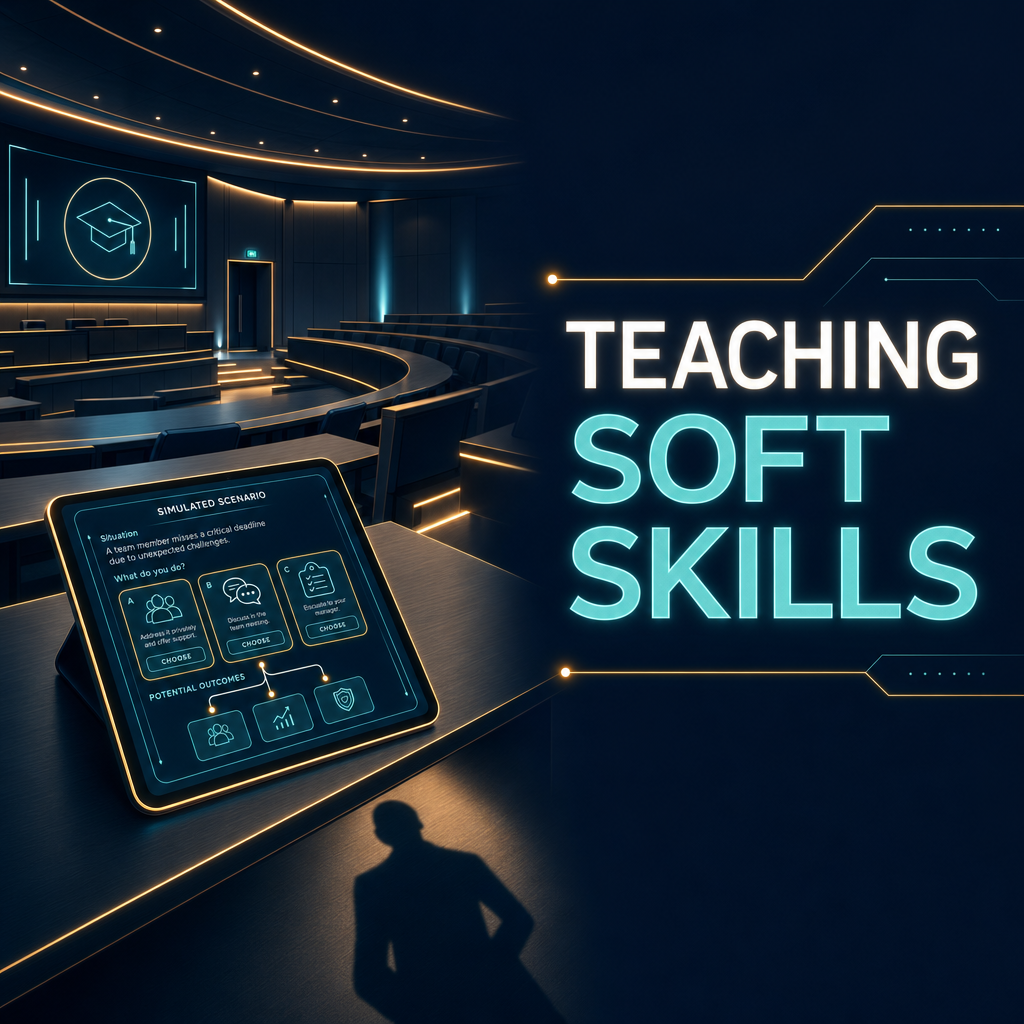
Business schools have spent decades refining how they teach finance, strategy, marketing, and operations. Yet many educators still struggle when it comes to teaching leadership skills effectively.
The challenge is simple. Soft skills are not really "soft" at all.
Negotiation, leadership, influence, communication, conflict management, and decision-making are often the skills that determine career success. However, they are also among the hardest skills to teach and assess in a traditional classroom.
Students can memorize leadership theories. They can explain negotiation frameworks. They can recite communication models.
But knowing is not the same as doing.
The gap between understanding a concept and applying it under pressure is where many business courses fall short. As educators, we often assume that discussion, reflection, and written assignments are enough. In reality, these approaches frequently leave students unprepared for the messy, uncertain situations they will face in their careers.
At LiveCase, we believe experiential learning offers a better path. The goal is not simply to teach concepts. It is to create environments where students must practice judgment, make decisions, and experience consequences in realistic situations. :contentReference[oaicite:0]{index=0}
Let's explore five common mistakes business professors make when teaching soft skills and how to avoid them.
Mistake 1: Treating Leadership as a Knowledge Problem
One of the biggest misconceptions in business education is that leadership can be learned primarily through content delivery.
Students read leadership books. They analyze famous leaders. They discuss case studies.
All of this has value.
However, leadership is fundamentally a behavioral skill. It involves making decisions when information is incomplete, balancing competing interests, and communicating effectively under pressure.
Consider a student who can perfectly explain transformational leadership theory. That same student may still struggle to:
- Handle conflict within a team
- Deliver difficult feedback
- Build trust with stakeholders
- Navigate uncertainty
These challenges cannot be mastered through reading alone.
This is why teaching leadership skills effectively requires opportunities for repeated practice. Students need to experience situations where they must lead, not simply discuss leadership.
Experiential learning environments place students in realistic scenarios where they must make choices and live with the outcomes. This transforms leadership from an academic concept into a practical capability.
Mistake 2: Assuming Discussion Equals Practice
Business schools often rely heavily on classroom discussion.
Case discussions remain one of the most valuable teaching tools in management education. They encourage critical thinking and expose students to multiple perspectives.
Yet discussion alone has limitations.
Talking about a negotiation is not the same as negotiating.
Talking about leadership is not the same as leading.
Students frequently perform well during discussions because they have time to think, observe others, and formulate responses. Real business situations rarely provide these luxuries.
In practice, leaders face:
- Time pressure
- Incomplete information
- Emotional dynamics
- Conflicting priorities
- Unpredictable responses
These factors fundamentally change decision-making.
Research from organizations such as Harvard Business School has consistently emphasized the importance of active learning and experiential approaches in developing leadership and management capabilities.
When students enter realistic simulations or role-play environments, they encounter the uncertainty that defines real leadership. This is where meaningful learning occurs.
Mistake 3: Using Low-Stakes Activities for High-Stakes Skills
Leadership and negotiation are high-stakes activities.
Poor decisions can affect careers, organizations, teams, and customers.
Yet many soft skills courses rely on low-stakes exercises that students do not take seriously.
Examples include:
- Ungraded role plays
- Informal discussions
- Reflection journals
- Participation-based activities
While these methods have merit, they often lack the urgency that drives authentic behavior.
Students behave differently when outcomes matter.
This is one reason why assessing soft skills business school programs remains such a challenge. Traditional assessments often measure knowledge rather than performance.
A more effective approach involves creating environments where students are accountable for their decisions.
Scored simulations, structured negotiations, and performance-based assessments encourage students to engage more deeply. They create the pressure, responsibility, and reflection necessary for genuine skill development.
At LiveCase, immersive experiences place learners inside realistic scenarios where decisions directly influence outcomes. Students interact with AI-driven characters, receive feedback, and navigate evolving situations that require active participation rather than passive observation.
Mistake 4: Separating Assessment from Real Performance
Many business courses assess soft skills indirectly.
Students might submit:
- Essays
- Reflection papers
- Leadership analyses
- Case write-ups
These assignments demonstrate understanding. They do not necessarily demonstrate competence.
Imagine assessing swimming by asking students to write about swimming techniques.
The problem becomes obvious.
Yet this is often how leadership and negotiation are evaluated.
The question is not whether students can describe effective leadership.
The question is whether they can actually perform it.
This challenge sits at the center of assessing soft skills business school initiatives worldwide.
Effective assessment should capture:
- Decision quality
- Communication effectiveness
- Adaptability
- Judgment
- Stakeholder management
Experiential assessments provide greater visibility into student thinking. Instead of evaluating only final answers, educators can observe the decision-making process itself.
Modern platforms can help instructors see how students engage, where they struggle, and how they respond to evolving circumstances. This creates richer evidence of learning than traditional written assignments alone.
Mistake 5: Underestimating the Importance of Repetition
No one expects students to master finance after solving a single problem.
Yet soft skills courses sometimes operate this way.
Students complete one negotiation exercise or one leadership activity and move on.
The reality is that expertise develops through repeated practice.
Elite athletes, musicians, and surgeons all rely on deliberate repetition.
Leadership development is no different.
Students need multiple opportunities to:
- Experiment with different approaches
- Learn from mistakes
- Receive feedback
- Refine their judgment
- Build confidence
This is where experiential negotiation course materials become particularly valuable.
Effective negotiation education requires students to encounter diverse situations, including:
- Competitive negotiations
- Collaborative negotiations
- Multi-party negotiations
- Crisis negotiations
- Cross-cultural negotiations
Each scenario develops different capabilities.
Similarly, a strategic leadership simulation can expose students to evolving business challenges that require them to adapt their approach over time.
The goal is not perfection.
The goal is progression.
Repeated exposure builds judgment, confidence, and decision-making capabilities that cannot emerge from a single classroom exercise.
Why Experiential Learning Changes the Equation
The growing influence of AI has added another layer to this conversation.
Students can now generate summaries, analyses, and even leadership reflections with remarkable ease.
This creates a challenge for educators.
If assignments focus primarily on content production, AI can often complete much of the work.
The solution is not stricter policing.
The solution is better learning design.
Experiential learning shifts the focus from producing answers to making decisions.
When students must:
- Respond to evolving situations
- Navigate ambiguity
- Interact with stakeholders
- Defend their choices
- Adapt to consequences
The learning process becomes much harder to outsource.
This aligns with a broader shift happening across higher education. Rather than competing with AI, educators are redesigning learning experiences that emphasize judgment, application, and decision-making.
Immersive experiences such as an Immersive AI LiveCase extend the traditional case method by placing students inside realistic situations where they must actively engage with challenges rather than passively analyze them. The objective is not to replace teaching. It is to deepen participation and strengthen learning outcomes.
Educators looking for inspiration can explore the growing range of experiences available in the Catalogue.
For those interested in creating their own simulations, Create Your Own LiveCase provides a no-code pathway to building decision-driven learning experiences.
If additional support is needed, Studio Services can help transform existing course materials into immersive learning environments.
You can also learn more about the platform on the LiveCase homepage.
The Future of Teaching Soft Skills
The business world increasingly rewards leaders who can think critically, communicate effectively, negotiate successfully, and make sound decisions under pressure.
These capabilities cannot be developed through lectures alone.
The most effective business education combines theory with practice.
Students still need frameworks. They still need concepts. They still need expert guidance.
But they also need opportunities to apply those ideas in realistic, challenging situations.
As business schools continue adapting to new technologies and changing learner expectations, experiential learning offers a powerful way to bridge the gap between knowing and doing.
The question is no longer whether soft skills matter.
The question is whether our teaching methods give students enough opportunities to practice them.
Frequently Asked Questions
1. Why is teaching leadership skills effectively so difficult?
Leadership involves judgment, communication, and decision-making under uncertainty. These skills require practice and experience, not just theoretical knowledge.
2. How can business schools improve assessing soft skills business school programs?
Performance-based assessments, simulations, role plays, and decision-making exercises provide stronger evidence of skill development than traditional written assignments.
3. What makes experiential negotiation course materials more effective?
They place students in realistic situations where they must actively negotiate, adapt, and respond to consequences rather than simply study negotiation concepts.
4. What is a strategic leadership simulation?
A strategic leadership simulation places learners in realistic leadership scenarios where they make decisions, manage stakeholders, and navigate complex business challenges.
5. Can experiential learning work in large lecture courses?
Yes. Modern digital platforms allow every student to participate individually, making experiential learning scalable even in large cohorts.
6. How does experiential learning help address AI cheating concerns?
Experiential learning emphasizes decision-making, judgment, and interaction. These activities are significantly harder to outsource to AI tools than traditional content-based assignments.
Share

Transform static learning intoimmersive AI simulations.
When students skip PDFs and disengage, LiveCase turns learning into a sequence of decisions, consequences, and active participation.
Trusted by world-leading educators & corporations
Author

Author: Denis Duvauchelle
Co-Founder & CEO
Elevate your AI skills for better learning 🌟 | AI Developer & Education Innovator | 50K + Executives / HigherEd success stories. He specializes in both research and implementation, and is dedicated to creating the best possible experience for educational simulations, both in terms of design and usage. With a focus on driving engagement and learning outcomes, Denis is committed to delivering innovative and impactful solutions for his clients.
Published: 6/24/2026